Part 10 – Asphalt Quantity Calculation (Step-by-Step Guide) | Every Civil Engineer Should Know
Accurate asphalt quantity calculation is one of the most important skills for every Highway Engineer, Civil Engineer, Quantity Surveyor, Site Engineer, and QA/QC Engineer. Whether you are preparing a BOQ, estimating material requirements, planning asphalt plant production, or verifying contractor bills, knowing the correct quantity of asphalt mix helps reduce wastage, control project costs, and ensure successful pavement construction.
In this article, you’ll learn the complete asphalt quantity calculation process using a practical worked example, easy formulas, thumb rules, and professional site tips followed in highway projects.
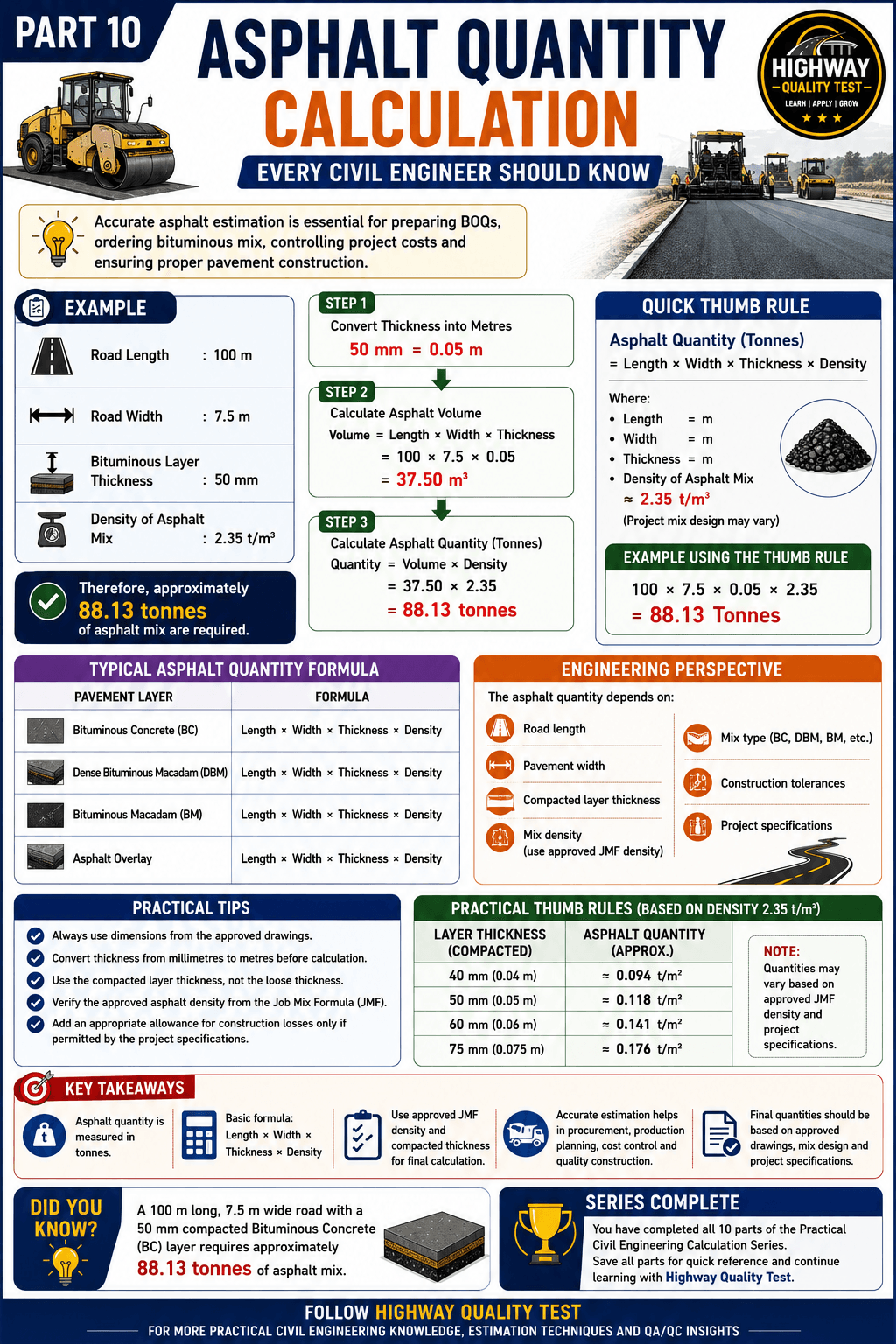
Table of Contents
- Why Asphalt Quantity Calculation is Important
- Asphalt Quantity Formula
- Step-by-Step Calculation Example
- Quick Thumb Rule
- Formula for Different Bituminous Layers
- Practical Site Tips
- Common Mistakes to Avoid
- Frequently Asked Questions
Why is Asphalt Quantity Calculation Important?
Accurate estimation of asphalt quantity plays a crucial role in highway construction and pavement engineering. Incorrect estimation can lead to material shortages, excessive wastage, delayed construction activities, and increased project costs.
Proper asphalt quantity calculation helps engineers to:
- Prepare accurate BOQs and cost estimates.
- Estimate asphalt plant production requirements.
- Plan transportation of bituminous mix.
- Control project costs and material consumption.
- Verify contractor billing quantities.
- Reduce construction waste.
- Improve pavement construction quality.
“`html
Asphalt Quantity Formula
The quantity of asphalt mix required for any pavement layer is calculated by multiplying the pavement volume by the compacted density of the approved asphalt mix. The final quantity is generally expressed in tonnes (t).
Standard Formula
Asphalt Quantity (Tonnes) = Length × Width × Thickness × Density
Where:
| Parameter | Unit | Description |
|---|---|---|
| Length (L) | m | Road length to be paved |
| Width (W) | m | Finished carriageway width |
| Thickness (T) | m | Compacted layer thickness |
| Density (D) | t/m³ | Approved asphalt mix density from JMF |
Note: Always use the compacted thickness and the density approved in the Job Mix Formula (JMF). Never calculate using loose layer thickness.
Step-by-Step Asphalt Quantity Calculation
Let us understand the complete calculation using a practical highway engineering example.
Given Data
| Item | Value |
|---|---|
| Road Length | 100 m |
| Road Width | 7.50 m |
| Bituminous Layer Thickness | 50 mm |
| Approved Asphalt Density | 2.35 t/m³ |
Step 1 – Convert Thickness into Metres
Since all dimensions should be in metres,
Step 2 – Calculate Pavement Volume
Volume = Length × Width × Thickness
Volume = 37.50 m³
Step 3 – Calculate Asphalt Quantity
Multiply the pavement volume by the asphalt density.
= 37.50 × 2.35
= 88.13 Tonnes
Final Answer
A road measuring 100 m long and 7.5 m wide with a 50 mm compacted asphalt layer requires approximately 88.13 tonnes of asphalt mix.
Quick Thumb Rule for Site Engineers
For quick field estimation, use the following thumb rule.
Asphalt Quantity (Tonnes)
Length × Width × Thickness × Density
This formula can be used for estimating the quantity of:
- Bituminous Concrete (BC)
- Dense Bituminous Macadam (DBM)
- Bituminous Macadam (BM)
- Asphalt Overlay Works
Simply replace the dimensions and use the approved mix density specified in the Job Mix Formula.
“`html
Typical Asphalt Quantity Formula for Different Bituminous Layers
The same basic calculation method is applicable to most bituminous pavement layers. The only parameter that may change is the density of the asphalt mix, which depends on the approved Job Mix Formula (JMF).
| Pavement Layer | Calculation Formula | Remarks |
|---|---|---|
| Bituminous Concrete (BC) | Length × Width × Thickness × Density | Use approved BC JMF density |
| Dense Bituminous Macadam (DBM) | Length × Width × Thickness × Density | Use approved DBM JMF density |
| Bituminous Macadam (BM) | Length × Width × Thickness × Density | Density varies with aggregate grading |
| Asphalt Overlay | Length × Width × Thickness × Density | Use compacted overlay thickness |
Typical Density of Asphalt Mix
The density of asphalt mix is determined during the mix design process and approved through the Job Mix Formula (JMF). It varies depending on aggregate grading, binder content, air voids, and compaction characteristics.
| Mix Type | Typical Density (t/m³) |
|---|---|
| Bituminous Concrete (BC) | 2.30–2.40 |
| Dense Bituminous Macadam (DBM) | 2.30–2.45 |
| Bituminous Macadam (BM) | 2.25–2.40 |
Practical Tips for Highway Engineers
- ✔ Always calculate asphalt quantity using dimensions from the approved construction drawings.
- ✔ Convert layer thickness from millimetres (mm) to metres (m) before calculation.
- ✔ Use the compacted layer thickness, not the loose thickness after paving.
- ✔ Verify the approved asphalt density from the latest Job Mix Formula (JMF).
- ✔ Cross-check calculated quantities with asphalt plant production records.
- ✔ Measure the actual carriageway width before preparing final quantities.
- ✔ Include construction losses only when permitted by the contract or project specifications.
- ✔ Verify quantities jointly before preparing contractor bills.
Common Mistakes to Avoid
The following errors frequently result in incorrect asphalt quantity estimation:
- ❌ Using layer thickness in millimetres without converting to metres.
- ❌ Using loose paving thickness instead of compacted thickness.
- ❌ Assuming a standard density without checking the approved JMF.
- ❌ Ignoring pavement widening or variable carriageway widths.
- ❌ Calculating quantities from rough site measurements instead of approved drawings.
- ❌ Ordering asphalt mix without considering construction sequence and daily production capacity.
Key Takeaways
- Asphalt quantity is generally measured in tonnes (t).
- The standard formula is Length × Width × Thickness × Density.
- Always use the compacted layer thickness.
- Use the approved Job Mix Formula (JMF) density.
- Accurate quantity estimation improves procurement, cost control, asphalt production planning, and contractor billing.
- Final quantities should always be verified with approved drawings, project specifications, and site measurements.
Did You Know?
Frequently Asked Questions (FAQs)
1. In which unit is asphalt quantity measured?
Asphalt quantity is generally measured in tonnes (t).
2. Which density should be used for calculation?
Always use the density specified in the approved Job Mix Formula (JMF).
3. Should I use loose thickness or compacted thickness?
Always use the compacted layer thickness because payment and pavement design are based on the compacted thickness.
4. Is the same formula applicable for BC and DBM?
Yes. The calculation method remains the same. Only the density differs according to the approved mix design.
5. Why is asphalt quantity calculation important?
It helps in preparing BOQs, ordering asphalt mix, planning production, controlling costs, reducing wastage, and verifying contractor billing.
Conclusion
Asphalt quantity calculation is one of the most fundamental and frequently used calculations in highway engineering. Whether you are executing Bituminous Concrete (BC), Dense Bituminous Macadam (DBM), Bituminous Macadam (BM), or overlay works, accurate quantity estimation ensures better planning, efficient material management, and cost-effective project execution.
By following the simple formula Length × Width × Thickness × Density, using the approved Job Mix Formula (JMF), and considering the compacted layer thickness, engineers can estimate asphalt requirements accurately and confidently.
Continue Learning with Highway Quality Test
Explore more practical engineering calculations in our Civil Engineering Calculation Series, including RCC Beam Weight, RCC Column Load, RCC Slab Dead Load, Brick Wall Weight, Earthwork Quantity, Concrete Quantity, and many more.