Part 9 – Earthwork Quantity Calculation (Step-by-Step Guide) | Every Civil Engineer Should Know
Earthwork quantity calculation is one of the most important activities in civil and highway engineering. Whether you're constructing a road embankment, highway cutting, canal, railway formation, or site development project, accurate earthwork estimation is essential for preparing Bills of Quantities (BOQs), planning equipment, estimating project costs, scheduling construction activities, and verifying contractor bills.
In highway projects, even a small error in earthwork estimation can result in significant cost overruns, material shortages, and project delays. Therefore, every Civil Engineer, Highway Engineer, Site Engineer, QA/QC Engineer, Quantity Surveyor, Consultant, and Contractor should understand how to calculate earthwork quantity accurately.
This practical guide explains the complete earthwork quantity calculation process using simple formulas, solved examples, engineering principles, and practical site tips.
Why is Earthwork Quantity Calculation Important?
Earthwork estimation forms the foundation of every infrastructure project. Accurate quantity calculation helps engineers estimate excavation and embankment volumes, plan equipment deployment, prepare contractor bills, optimize project costs, and ensure efficient material management.
Proper earthwork quantity calculation also supports project planning by minimizing material wastage, improving productivity, and ensuring compliance with approved drawings and project specifications.
- Prepare accurate BOQs.
- Estimate excavation and embankment quantities.
- Plan manpower and machinery.
- Estimate transportation requirements.
- Control project cost.
- Prepare contractor bills.
- Reduce construction delays.
- Improve construction planning.
Earthwork Quantity Formula
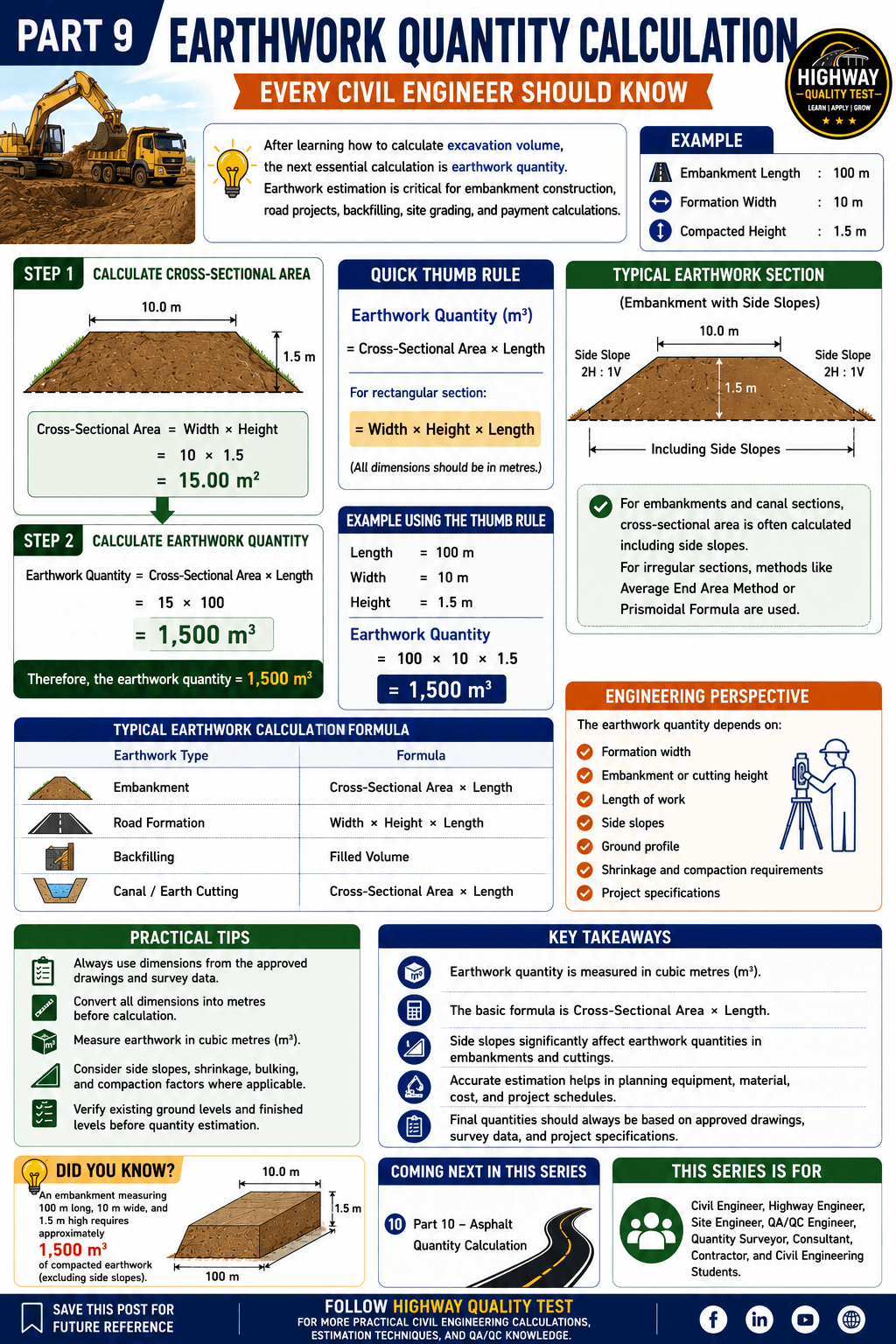
Earthwork quantity is the total volume of soil required for excavation or embankment construction. It is generally measured in cubic metres (m³). For a simple rectangular section, the quantity is calculated by multiplying the cross-sectional area by the length of the work.
Standard Formula
Earthwork Quantity (m³) = Cross-Sectional Area × Length
For a Rectangular Section:
Earthwork Quantity = Length × Width × Height
This formula is suitable for simple embankments, trenches, and excavations having a uniform rectangular cross-section.
Data Required for Earthwork Quantity Calculation
Before performing the calculation, collect the following information from the approved drawings and survey records.
| Parameter | Unit | Description |
|---|---|---|
| Length | m | Total length of embankment or excavation |
| Formation Width | m | Finished formation width |
| Height / Depth | m | Compacted embankment height or excavation depth |
| Side Slopes | Ratio | If applicable for embankments or cuttings |
| Ground Levels | m | Existing Ground Level (EGL) and Finished Road Level (FRL) |
Step-by-Step Earthwork Quantity Calculation
Let's calculate the earthwork quantity using a practical highway embankment example.
Given Data
| Item | Value |
|---|---|
| Embankment Length | 100 m |
| Formation Width | 10.0 m |
| Compacted Height | 1.50 m |
Step 1 – Calculate the Cross-Sectional Area
Use the following formula:
= 10 × 1.5
= 15.00 m²
Therefore, the cross-sectional area of the embankment is15.00 m².
Step 2 – Calculate Earthwork Quantity
Multiply the cross-sectional area by the total length.
= Cross-Sectional Area × Length
= 15 × 100
= 1,500 m³
Final Answer
A highway embankment having a length of 100 metres, a formation width of 10 metres, and a compacted height of 1.5 metres requires approximately1,500 cubic metres (m³)of compacted earthwork.
Quick Thumb Rule
For quick site calculations where the cross-section is rectangular, use the following thumb rule.
Earthwork Quantity (m³)
Length × Width × Height
Example:
| Length | Width | Height | Quantity |
|---|---|---|---|
| 100 m | 10 m | 1.5 m | 1,500 m³ |
This thumb rule is ideal for preliminary estimates during planning and site execution. For actual project billing, always use approved survey data and detailed cross-sections.
Engineering Perspective
In real highway and infrastructure projects, earthwork quantity is influenced by several engineering parameters. The simple rectangular formula is suitable only for uniform sections. Actual embankment and cutting quantities often require additional considerations.
- Formation width
- Embankment or cutting height
- Side slopes
- Existing ground profile
- Finished Road Level (FRL)
- Existing Ground Level (EGL)
- Shrinkage and bulking factors
- Compaction requirements
- Approved project specifications
Methods of Earthwork Quantity Calculation
The method adopted for earthwork quantity calculation depends on the project type, ground profile, and the required level of accuracy. In highway projects, the following methods are commonly used.
| Method | Application | Accuracy |
|---|---|---|
| Cross-Section Method | Simple embankments and excavations | Good |
| Average End Area Method | Highway and railway projects | Very Good |
| Prismoidal Formula | Irregular terrain and detailed estimation | Excellent |
| Digital Terrain Model (DTM) | Large infrastructure projects using survey software | Excellent |
Average End Area Method
Volume = (A₁ + A₂) / 2 × Length
Where:
- A₁ = Area of First Cross-Section
- A₂ = Area of Second Cross-Section
- Length = Distance between Cross-Sections
This method is widely used for highway embankments because it provides reliable results when the ground profile changes gradually.
Practical Tips for Site Engineers
- ✔ Always use dimensions from approved drawings and survey records.
- ✔ Verify Existing Ground Level (EGL) before starting calculations.
- ✔ Check Finished Road Level (FRL) from approved GAD or longitudinal section.
- ✔ Convert all dimensions into metres.
- ✔ Calculate earthwork in cubic metres (m³).
- ✔ Consider side slopes for embankment and cutting sections.
- ✔ Include shrinkage, bulking, and compaction factors wherever applicable.
- ✔ Cross-check quantities with Total Station or survey data.
- ✔ Verify calculations before preparing contractor bills.
- ✔ Follow project specifications and approved drawings for final measurements.
Common Mistakes to Avoid
Many quantity estimation errors occur due to incorrect assumptions or improper measurements. Avoid the following common mistakes:
- ❌ Ignoring side slopes while calculating embankment quantity.
- ❌ Using loose fill dimensions instead of compacted dimensions.
- ❌ Mixing millimetres and metres in calculations.
- ❌ Ignoring survey data and relying only on approximate measurements.
- ❌ Not considering shrinkage or bulking factors.
- ❌ Using design levels instead of actual site levels.
- ❌ Preparing bills without joint measurement verification.
Key Takeaways
- Earthwork quantity is measured in cubic metres (m³).
- The basic formula is Cross-Sectional Area × Length.
- For rectangular sections, use Length × Width × Height.
- Side slopes significantly affect embankment and cutting quantities.
- Use approved survey data and project drawings for final calculations.
- Accurate estimation improves project planning, cost control, equipment utilization, and billing accuracy.
Did You Know?
An embankment measuring 100 m long, 10 m wide, and 1.5 m high requires approximately1,500 cubic metres (m³)of compacted earthwork (excluding side slopes).
Frequently Asked Questions (FAQs)
1. In which unit is earthwork quantity measured?
Earthwork quantity is measured in cubic metres (m³).
2. Which formula is used for simple earthwork calculation?
For a rectangular section:Earthwork Quantity = Length × Width × Height
3. Why are side slopes important?
Side slopes increase the cross-sectional area of embankments and cuttings. Ignoring them can lead to significant underestimation of earthwork quantities.
4. Which method is commonly used for highway projects?
The Average End Area Method is the most commonly used method for earthwork quantity calculation in highway construction projects.
5. What documents should be referred to before calculating earthwork quantity?
Always refer to approved drawings, survey records, longitudinal sections, cross-sections, and project specifications before preparing quantity estimates.
Conclusion
Earthwork quantity calculation is one of the most essential skills for every civil and highway engineer. Accurate estimation ensures efficient planning, proper equipment deployment, optimized material utilization, and effective project cost control.
Although the basic formula Cross-Sectional Area × Length is suitable for simple rectangular sections, real-world highway projects require engineers to consider side slopes, existing ground levels, shrinkage, bulking, and compaction factors. For irregular terrain, methods such as the Average End Area Method and Prismoidal Formula provide more accurate results.
Mastering earthwork quantity calculation will improve your ability to prepare BOQs, verify contractor bills, manage construction activities, and execute infrastructure projects efficiently.
Continue your learning with Part 10 – Asphalt Quantity Calculation to understand how to estimate bituminous material quantities for road construction.