Master Test Parameter Guide for Highway, Bridge & Structural Works
This comprehensive guide introduces the major construction materials,
laboratory tests, field tests and engineering inspections used in
highway, pavement, bridge and structural projects. It is designed
for Civil Engineering students, freshers, site engineers, laboratory
technicians and QA/QC professionals.
For each material, the guide explains where it is used, which
properties are tested, why the tests are performed and what should
be checked before the material is accepted or incorporated into
the works.
What Does This Guide Cover?
- Soil, earthwork, embankment and subgrade testing.
- GSB, WMM, aggregates and cement-treated pavement materials.
- Cement, concrete, reinforcement steel and structural steel.
- Bitumen, bituminous mixes, DBM, BC, DLC and PQC.
- Bridge foundations, piles, culverts, bearings and expansion joints.
- Road safety materials and ancillary construction works.
- Material approval, laboratory testing, field inspection and QA/QC documentation.
- Important test parameters and their engineering significance.
Understand the Three Stages of Quality Control
1. Material approval before use:
Samples, certificates and test reports are examined to establish
whether the proposed material or supply batch meets the applicable
requirements.
2. Production and construction control:
Materials, mix proportions, temperatures, moisture, compaction,
workmanship and construction operations are monitored.
3. Acceptance of completed work:
Field tests, dimensional checks, strength results, structural
inspections and documentation are reviewed against the applicable
acceptance requirements.
Passing a material test does not automatically establish that the
completed work is acceptable. Material quality, construction
workmanship and finished-work compliance must all be verified.
1. Soil Testing and Earthwork
Where is it used?
Soil is used in embankments, earth filling, subgrade construction,
approach embankments and other approved earthwork operations.
Its engineering properties influence settlement, stability and
pavement performance.
Important tests and parameters:
- Grain Size Analysis / Sieve Analysis: Determines particle-size distribution.
- Atterberg Limits: Liquid Limit (LL), Plastic Limit (PL) and Plasticity Index (PI) assess the plasticity of applicable soils.
- Proctor Compaction Test: Determines Maximum Dry Density (MDD) and Optimum Moisture Content (OMC) for the specified compaction method.
- Field Density / In-situ Density: Determines the density achieved in the field.
- Laboratory CBR: Evaluates the bearing-strength characteristics of soil under specified test conditions.
- Field CBR: Conducted where a specified field method and requirement apply.
- Specific Gravity: Determines the specific gravity of soil solids.
- Free Swell Index: Assesses the swelling tendency of applicable soils.
- Swell Pressure: Evaluates swelling pressure under the prescribed test conditions.
- Moisture Content: Determines the water content of soil.
- Sand Replacement Method: A field-density method using calibrated sand to determine the volume of an excavation.
- Core Cutter Method: Determines in-situ density where the soil and method are suitable.
- Relative Density: Used for applicable cohesionless soils where required.
Before accepting the material:
Verify soil classification, source approval, applicable index
properties, compaction characteristics and other specified
requirements. Check for unsuitable material, organic matter or
other prohibited constituents where relevant.
During construction:
- Moisture conditioning and field density.
- Compaction and layer thickness.
- Formation levels and surface profile.
- Drainage and suitability of the prepared formation.
Why does it matter? Proper soil selection and
compaction provide a stable foundation for the pavement and
approach embankments.
2. Embankment and Subgrade Quality Control
Purpose: To verify that earthwork and the
prepared subgrade meet the requirements for the intended use.
Material tests and parameters:
- Material classification and gradation.
- Liquid Limit, Plastic Limit and Plasticity Index, where applicable.
- MDD and OMC from the specified compaction test.
- CBR where required by the design or specification.
- Moisture content.
- Other specified suitability and durability-related checks.
Field tests and inspections:
- Field density and degree of compaction.
- Layer thickness and lift-wise construction records.
- Formation level and cross-sectional profile.
- Camber or cross-fall, as applicable.
- Surface condition, drainage and proof-rolling checks where specified.
Acceptance principle: The material must be suitable
for the designated earthwork or subgrade application, and the
constructed layer must meet the specified compaction, thickness
and geometric requirements.
3. Granular Sub-Base (GSB)
Purpose: GSB forms a granular pavement layer
above the prepared subgrade and performs the functions specified
in the pavement design.
Material approval tests:
- Aggregate gradation and sieve analysis.
- Aggregate Impact Value, where required.
- Aggregate Crushing Value, where applicable.
- Los Angeles Abrasion Test, where required.
- Flakiness and Elongation Index, where applicable.
- Soundness, where specified.
- Water Absorption and Specific Gravity.
- Plasticity or other tests on fine fractions where required.
- MDD and OMC where required by the applicable procedure and specification.
Construction checks:
- Moisture condition and uniform spreading.
- Field density and specified compaction.
- Layer thickness.
- Finished levels, cross-fall and profile.
- Segregation, surface condition and drainage.
Important: Not every aggregate-strength test listed
above is automatically mandatory for every GSB grading. Confirm
the requirements for the specified material and contract.
4. Wet Mix Macadam (WMM)
Purpose: WMM is a mechanically stabilized
granular layer produced using graded aggregates and water, followed
by spreading and compaction.
Material approval tests:
- Aggregate gradation and combined grading.
- Aggregate Crushing Value.
- Aggregate Impact Value, where required.
- Los Angeles Abrasion Test, where required.
- Flakiness and Elongation Index.
- Soundness, where specified.
- Water Absorption and Specific Gravity.
- Plasticity Index of applicable fine fractions.
- MDD and OMC using the applicable specified method.
Construction checks:
- Plant mixing and grading uniformity.
- Moisture content and conditioning.
- Field density and compaction.
- Layer thickness and finished levels.
- Camber, cross-fall, profile and surface regularity.
- Segregation and loose material.
Why does it matter? Proper grading, moisture
control and compaction help the WMM layer achieve its intended
structural function.
5. Aggregate Testing
Aggregates are used in granular pavement layers, bituminous mixes,
concrete, drainage works and structural applications. The test
selection depends on the intended use and applicable specification.
Important tests and parameters:
- Sieve Analysis: Particle-size distribution and grading.
- Specific Gravity: A physical property used in material evaluation and mix calculations.
- Water Absorption: Indicates water absorbed under the specified test procedure.
- Aggregate Crushing Value: Resistance to crushing.
- Aggregate Impact Value: Resistance to impact.
- Los Angeles Abrasion: Resistance to abrasion and degradation.
- Flakiness Index: Proportion of particles meeting the specified flaky-particle definition.
- Elongation Index: Proportion of particles meeting the specified elongated-particle definition.
- Combined Flakiness and Elongation: Evaluates particle shape using the applicable prescribed procedure.
- Soundness: Resistance to deterioration under specified accelerated weathering conditions.
- Deleterious Materials: Identifies undesirable constituents where required.
- Stripping Value / Adhesion: Evaluates aggregate-binder adhesion under the specified method.
- Polished Stone Value: Evaluates polishing resistance where the relevant test and requirement are specified.
Before use:
- Verify source approval and material traceability.
- Check grading and relevant physical properties.
- Confirm that the selected test suite is appropriate for the intended application.
- Check compliance with the applicable material specification.
6. Cement Testing
Cement is used in concrete, mortar, grout and cement-treated
pavement materials. Different cement types and grades have
different conformity requirements.
Important tests and checks:
- Fineness: Evaluates fineness using the applicable test method.
- Standard Consistency: Determines the water content needed for the specified consistency test.
- Initial Setting Time: Determines the time to the specified initial setting condition.
- Final Setting Time: Determines the time to the specified final setting condition.
- Soundness: Evaluates the specified volume-stability characteristics.
- Specific Gravity: Determines a physical property where required.
- Compressive Strength: Evaluates cement mortar specimens under the specified test procedure.
- Cement Type and Grade: Verifies the cement supplied against the approved requirements.
- Storage and Batch Records: Checks traceability, storage condition and supply documentation.
Before use:
Verify manufacturer documentation, applicable test certificates,
batch identification, storage conditions and the required
conformity tests. Cement should be protected from moisture and
deterioration during storage.
7. Concrete Testing
Concrete is used in culverts, drains, retaining structures,
foundations, bridge components, pavements and other civil
engineering works.
Before production: material and mix verification
- Concrete mix design and trial-mix verification.
- Cement type, grade and conformity.
- Fine and coarse aggregate grading.
- Aggregate specific gravity and water absorption, as required.
- Water quality and suitability.
- Admixture conformity and compatibility, where applicable.
- Specified water-cement ratio and cementitious-material content.
- Specified durability-related parameters.
Fresh concrete tests and checks:
- Slump Test: Assesses consistency for suitable concrete mixes.
- Workability: Assessed using the method appropriate to the mix and application.
- Temperature: Recorded where required.
- Batch and Mix Verification: Checks constituent proportions and batching records.
- Water-Cement Ratio: Verified from the controlled mix proportions and relevant records.
- Cement Content: Checked against the approved mix and batching records.
- Sampling: Ensures representative specimens are prepared according to the specified procedure.
Hardened concrete tests:
- Cube Compressive Strength: Evaluates concrete strength at the specified testing age.
- Core Strength: Used for assessment when specified or authorized.
- Density: Determined where required for the intended assessment.
- Durability-Related Tests: Selected according to the specified exposure conditions and project requirements.
Important: Slump is an indicator of consistency,
not a complete measure of workability. A passing slump result alone
does not establish concrete acceptance.
8. RCC, PSC and Structural Concrete
This category covers reinforced concrete and prestressed concrete
components such as foundations, piles, piers, abutments, girders,
bridge decks, culverts and other structures.
Concrete testing:
- Fresh concrete workability and specified fresh-concrete checks.
- Cube compressive strength.
- Core testing where required.
- Concrete mix verification and specified durability parameters.
- Specified grouting-material tests for prestressed works.
Reinforcement inspection:
- Bar diameter, mass and dimensional verification.
- Tensile strength, yield strength and elongation tests.
- Bend and rebend tests where applicable.
- Chemical composition where specified.
- Cover, bar spacing, lap length and anchorage/development length.
- Reinforcement positioning, cleanliness and pre-pour inspection.
Prestressed concrete-specific checks:
- Prestressing steel and anchorage-system conformity.
- Duct integrity, location and alignment.
- Prestressing records, force application and elongation verification.
- Grout material conformity and specified grout properties.
- Grouting records, vents, outlets and completion checks.
Key point: Structural concrete quality requires
material testing, reinforcement inspection, correct execution,
curing and traceable construction records.
9. Bitumen and Bituminous Binder Testing
Bitumen is used as a binder in asphalt mixtures and other specified
bituminous applications. Tests depend on the binder grade and type.
Important tests and parameters:
- Penetration: Measures penetration under specified test conditions for applicable binders.
- Softening Point: Determines softening characteristics using the specified method.
- Ductility: Evaluates elongation characteristics where applicable.
- Absolute or Dynamic Viscosity: Used where specified for the binder type and method.
- Rotational Viscosity: Evaluates viscosity using the applicable rotational method where required.
- Kinematic Viscosity: Used where required for the specified binder and test procedure.
- Flash Point: Determines flash-point characteristics using the applicable method.
- Fire Point: Determined where required by the applicable procedure.
- Specific Gravity or Density: Determines a physical property used for applicable calculations and conformity checks.
- Solubility: Evaluates solubility using the specified test method.
- Elastic Recovery: Evaluates elastic recovery for applicable modified binders.
- Storage and Handling: Monitors specified storage, heating and handling requirements.
Before use:
Verify the binder type and grade, source documentation, batch
traceability, test certificates and conformity with the approved
mix design. Monitor heating and storage conditions to avoid
unacceptable overheating or deterioration.
10. Bituminous Mix Design, DBM and BC
DBM (Dense Bituminous Macadam) and BC (Bituminous Concrete) are
bituminous mixtures produced from specified aggregates, binder
and other approved constituents.
Laboratory mix-design parameters:
- Aggregate grading and combined grading.
- Binder content and specified mix proportions.
- Maximum Theoretical Specific Gravity (Gmm).
- Bulk Density or Bulk Specific Gravity of compacted specimens.
- Air Voids (Va).
- Voids in Mineral Aggregate (VMA).
- Voids Filled with Bitumen (VFB).
- Marshall Stability and Marshall Flow where applicable.
- Moisture susceptibility and Tensile Strength Ratio (TSR) where specified.
- Other design parameters required by the approved mix-design procedure.
Plant production and field control:
- Job Mix Formula (JMF) and approved constituent proportions.
- Aggregate grading and binder content verification.
- Mixing, delivery, laying and compaction temperatures.
- Field density and degree of compaction as specified.
- Core thickness and density where required.
- Layer thickness, levels, camber and profile.
- Surface regularity and workmanship.
Key point: Marshall parameters apply where the
approved design uses the Marshall method. Other specified mix
designs may require different procedures and acceptance parameters.
11. Dry Lean Concrete (DLC) and Pavement Quality Concrete (PQC)
DLC and PQC are used in specified rigid pavement systems. DLC
generally provides a lean concrete base layer, while PQC is the
designed concrete pavement layer.
Material and mix-design checks:
- Aggregate grading and constituent-material conformity.
- Cement content and approved mix proportions.
- Moisture content and moisture conditioning for applicable DLC procedures.
- MDD or density-related parameters where required by the specified DLC method.
- Concrete mix design and trial mixes for the applicable concrete layer.
- Specified workability and fresh-concrete tests.
- Cube compressive strength where required.
- Flexural strength / Modulus of Rupture for applicable pavement concrete.
Construction and finished-layer checks:
- Layer thickness and finished levels.
- Surface regularity and profile.
- Joint layout and specified joint parameters.
- Dowel and tie-bar alignment and positioning.
- Concrete placement and compaction.
- Texturing and curing.
- Core or other strength verification where required.
Important: DLC and PQC have different material
and construction requirements. Apply the test methods and
acceptance criteria specified for the relevant layer.
12. Reinforcement Steel Testing
Reinforcement steel is used in RCC and other reinforced structural
elements. Both product conformity and correct installation must
be verified.
Laboratory tests and material checks:
- Diameter and mass per unit length.
- Tensile strength.
- Yield strength or proof stress, as applicable.
- Elongation.
- Bend test.
- Rebend test where applicable.
- Chemical composition where required.
- Rib geometry and dimensional characteristics where specified.
- Grade, manufacturer, batch identification and test certificates.
Site inspection:
- Bar diameter, spacing and number.
- Cover and reinforcement positioning.
- Lap length, anchorage and development length.
- Bar bending schedule compliance.
- Cleanliness, rust condition and pre-concreting inspection.
Key point: A steel test certificate does not replace
inspection of reinforcement installation against approved drawings.
13. Structural Steel and Steel Fabrication
Structural steel is used in steel bridges, fabricated girders,
trusses, connections, support structures and other steelwork.
The required checks depend on the material grade, fabrication
procedure, design and contract.
Material testing:
- Chemical composition.
- Tensile strength and yield strength.
- Elongation.
- Bend test where specified.
- Dimensions, thickness, section geometry and tolerances.
- Mill test certificates and material traceability.
Welding and fabrication quality control:
- Welding Procedure Specification (WPS) and Procedure Qualification Record (PQR), as applicable.
- Welder qualification.
- Visual Testing / Visual Inspection (VT).
- Dye Penetrant Testing (DPT/PT) where appropriate.
- Magnetic Particle Testing (MPI/MT) where appropriate.
- Ultrasonic Testing (UT) where specified.
- Radiographic Testing (RT) where specified.
- Dimensional, alignment and fit-up inspections.
Bolts, fasteners and protective coating:
- Fastener grade, dimensions and certificates.
- Specified mechanical testing and installation verification.
- Required bolt tightening or tensioning checks.
- Coating thickness measurement.
- Surface preparation and coating inspection.
Important: NDT method selection, inspection extent,
acceptance criteria and personnel qualifications must follow the
applicable welding code, structural specification and approved
inspection plan.
14. Bridges, Culverts and Structural Works
Bridge and culvert quality control covers foundations, substructures,
superstructures, bearings, joints, drainage and approaches.
Not every inspection listed below is a laboratory test.
Foundation and ground-related checks:
- Foundation strata and founding-level verification.
- Geotechnical parameters and bore-log verification.
- Excavation dimensions and founding-condition inspection.
- Concrete and reinforcement conformity.
- Foundation and backfill compaction checks where applicable.
Structural concrete and reinforcement:
- Reinforcement diameter, spacing, cover and positioning.
- Concrete mix, fresh-concrete tests and strength testing.
- Formwork dimensions and stability.
- Concrete placement, compaction, curing and surface inspection.
- Specified NDT or investigation of suspected defects.
Bridge-specific inspections:
- Pile integrity and load testing where specified.
- Bearing type, orientation, level, seating and installation.
- Expansion joint type, installation and movement provisions.
- Deck drainage and drainage outlet arrangements.
- Wearing coat material, thickness and finished surface.
- Approach slab dimensions, reinforcement and concrete quality.
- Approach embankment and backfill compaction.
- Alignment, levels, dimensions and as-built verification.
Key point: Verify each structural component against
the approved drawings, design requirements, method statement,
inspection plan and applicable project specifications.
15. Pile Foundation Testing and Inspection
Piles transfer structural loads to deeper soil or rock strata.
Pile construction and acceptance require verification of geometry,
materials, workmanship and specified performance.
During pile construction:
- Bore depth and diameter.
- Verticality or inclination within specified tolerances.
- Soil or rock strata and bore-log records.
- Reinforcement cage dimensions, cover arrangements and centralizers.
- Concrete quantity and reconciliation against expected requirements.
- Tremie pipe arrangements and concrete-placement records for applicable bored piles.
- Concrete workability and sampling.
- Cube strength and specified concrete quality checks.
- Records of bore cleaning, concreting and interruptions.
Pile testing:
- Pile Integrity Test (PIT): Assesses pile integrity using the applicable low-strain method.
- Static Load Test: Evaluates load-displacement response under the prescribed test arrangement.
- Initial and Routine Load Tests: Conducted according to the applicable design and contract requirements.
- Dynamic Load Test / PDA: Conducted where specified using the applicable procedure.
- Other Integrity or Verification Tests: Used when required by the design or project specification.
Important: Integrity tests and load tests serve
different purposes. One does not automatically replace the other.
Pile acceptance must consider the specified test results and
all relevant construction records.
16. Road Safety and Ancillary Works
Road safety components, road markings, signs, barriers and
associated installations must comply with the applicable product
specifications, approved drawings and installation requirements.
Road markings:
- Material conformity and product identification.
- Thickness or application quantity, as specified.
- Retroreflectivity where required.
- Skid resistance where applicable.
- Application conditions, curing and finished appearance.
Road signs, studs and delineators:
- Sign dimensions, material and mounting arrangements.
- Reflective sheeting and retroreflective performance.
- Road stud and delineator conformity and positioning.
- Visibility, alignment and installation checks.
Crash barriers and guardrails:
- Component dimensions and material conformity.
- Coating and corrosion-protection checks.
- Post spacing, alignment, connections and anchorage.
- Installation geometry and approved-system compliance.
Electrical and lighting works:
- Electrical equipment and component conformity.
- Earthing and electrical safety checks.
- Illumination measurements and operational checks where specified.
- Installation, testing and commissioning records.
Key point: Use the approved road-safety system,
product requirements and applicable IRC or other governing
provisions for acceptance.
17. QA/QC Field Controls, Laboratory Systems and Documentation
QA/QC documentation connects the material source, sample, test
result, construction location, inspection and final acceptance.
Good documentation is essential for traceability and contractual
compliance.
Material and sampling controls:
- Material source and supplier approval.
- Material inspection and delivery-batch verification.
- Sampling plans and sample identification.
- Testing against the correct material specification.
- Test frequency and lot-wise acceptance monitoring.
Laboratory and equipment controls:
- Equipment identification and calibration records.
- Verification of equipment condition and suitability for use.
- Laboratory registers and test reports.
- Calculation checks, units and result traceability.
- Reference materials and verification checks where applicable.
Construction quality controls:
- Trial mixes and trial stretches where required.
- Inspection and Test Plan (ITP) compliance.
- Quality Assurance Plan (QAP) implementation.
- Request for Inspection (RFI) and inspection-clearance records.
- Test-frequency compliance and pending-test tracking.
- Non-Conformance Report (NCR) and Corrective Action Report (CAR) tracking.
- Rectification, reinspection and closure records.
- As-built quality documentation and final records.
Key point: Every important test result should be
traceable to the sample, material source or batch, location,
date, test method, equipment and acceptance decision as applicable.
How to Decide Which Tests Must Be Performed
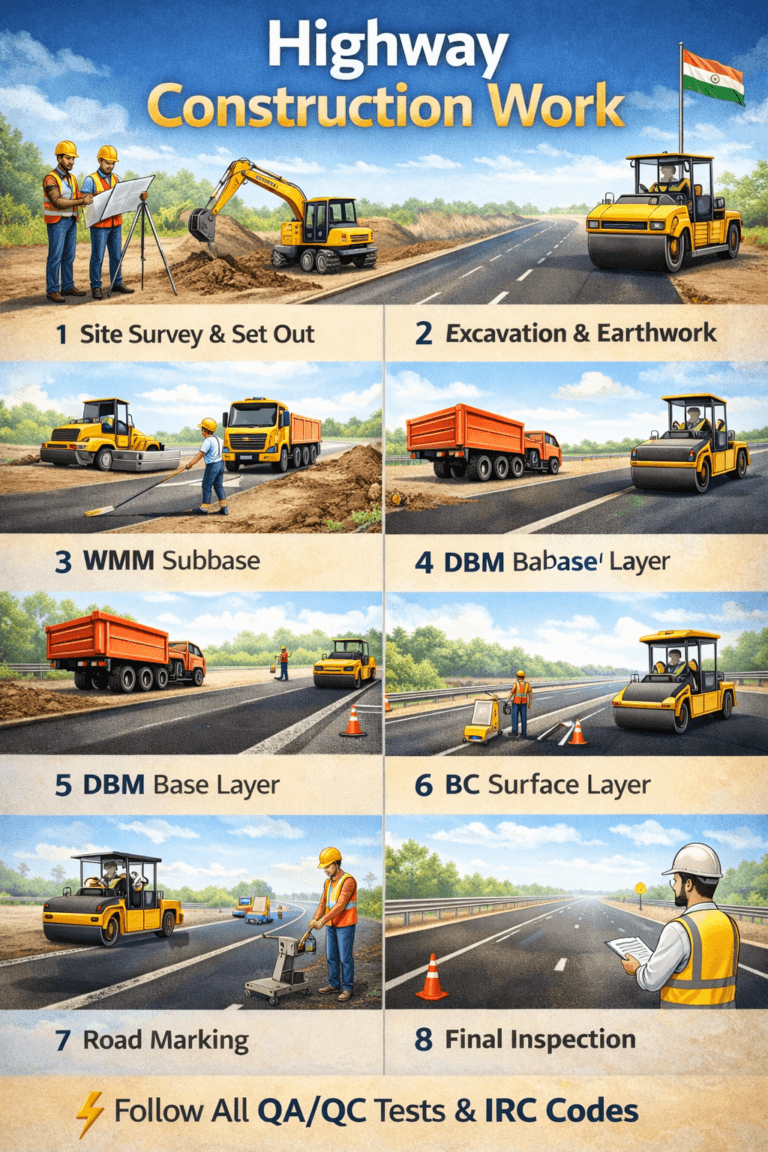
- Identify the work item: For example, embankment, GSB, WMM, DBM, concrete or a bridge pile.
- Identify the material: Establish the material type, grade, source and intended application.
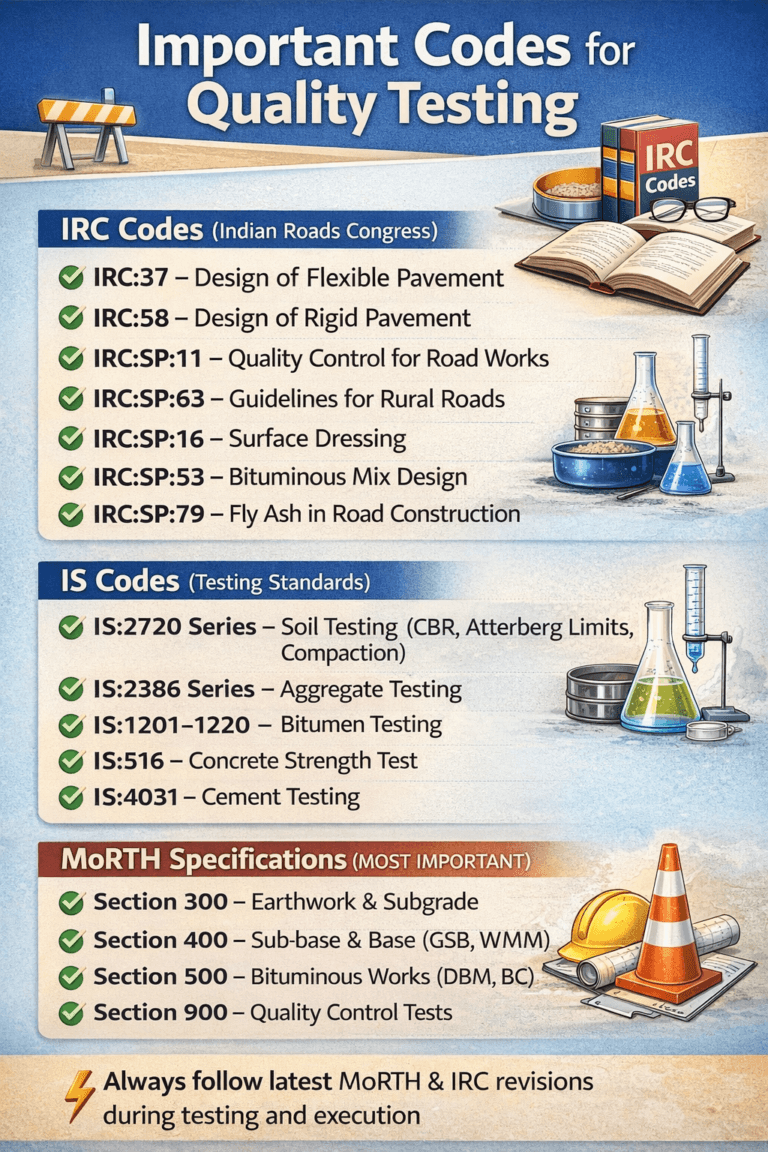
- Check the governing requirements: Review the applicable MoRTH Specification, IRC provisions, IS standards, contract documents and approved drawings.
- Review the approved ITP/QAP: Identify the required tests, inspection stages and specified frequencies.
- Collect and test representative samples: Use the correct sampling procedure, equipment and test method.
- Record and evaluate results: Check calculations, units and traceability, then compare the results against the correct acceptance criteria.
- Obtain required approval: Resolve non-conformities and secure the prescribed clearance before the material is used or the next work stage proceeds.
Do not apply one generic test frequency or acceptance limit to
all projects. Requirements can differ by material, application,
specification, design and contract.
Important Abbreviations for Freshers
- LL: Liquid Limit.
- PL: Plastic Limit.
- PI: Plasticity Index.
- MDD: Maximum Dry Density.
- OMC: Optimum Moisture Content.
- CBR: California Bearing Ratio.
- GSB: Granular Sub-Base.
- WMM: Wet Mix Macadam.
- CTGSB: Cement-Treated Granular Sub-Base.
- CTB: Cement-Treated Base.
- DBM: Dense Bituminous Macadam.
- BC: Bituminous Concrete.
- DLC: Dry Lean Concrete.
- PQC: Pavement Quality Concrete.
- RCC: Reinforced Cement Concrete.
- PSC: Prestressed Concrete.
- FDT: Field Density Test.
- JMF: Job Mix Formula.
- Gmm: Maximum Theoretical Specific Gravity of a bituminous mix.
- VMA: Voids in Mineral Aggregate.
- VFB: Voids Filled with Bitumen.
- TSR: Tensile Strength Ratio.
- PIT: Pile Integrity Test.
- PDA: Pile Driving Analyzer, used in applicable dynamic pile testing.
- NDT: Non-Destructive Testing.
- ITP: Inspection and Test Plan.
- QAP: Quality Assurance Plan.
- NCR: Non-Conformance Report.
- CAR: Corrective Action Report.
Applicable Standards and Acceptance Requirements
Testing and acceptance must be based on the applicable MoRTH
Specifications for Road and Bridge Works, relevant IRC provisions,
applicable IS standards, approved drawings, material specifications,
mix designs, contract documents and approved ITP/QAP.
The applicable edition and amendments must be verified for the
project. The presence of a test in this educational guide does not
mean that it is mandatory for every material or work item.
Test methods, sampling frequencies, acceptance limits, retesting
requirements and lot-acceptance procedures must be confirmed from
the governing documents. Do not use unverified limits or generic
frequencies for contractual acceptance.
Free Highway QA/QC Learning Resources
Start with practical learning resources and selected testing
formats designed to help Civil Engineering students and working
professionals understand highway construction quality control.
Explore Free Download Kit
Explore HQT Engineering Store
Find dedicated testing toolkits, editable Excel formats,
calculators and QA/QC documentation resources for soil, aggregates,
cement, bitumen, concrete and highway pavement construction.
Explore Engineering Store
Advance Your Highway QA/QC Practice
Explore additional QA/QC resources, practical test formats,
laboratory registers, inspection records and engineering tools
to support your professional work.
Explore Premium Membership
About the Author
Kishor Kumar
Founder – HighwayQualityTest.com
HIGHWAY QUALITY HUB – Premium Community
Highway Quality Test provides practical civil engineering and
highway QA/QC learning resources, material-testing guides,
calculators, Excel formats and documentation tools for
construction professionals.