Table of Contents


🚀 QA/QC Toolkit ₹299
Buy Now


🚀 QA/QC Toolkit ₹299
Buy Now

METHOD STATEMENT FOR BORROW AREA

Scope

  •  This method Statement covers the work involved in obtaining borrow Material for work under this contract, including negotiations with owners of the land on which borrow areas are situated, cleaning the site, stripping and disposing of excess overburden, excavating selected material for use in the work, and finishing –off the borrow areas.

Reference

  •  MoRT&H Specification clause No 301 to 303 and technical specification of contract

Equipment

  •  Excavators, Dumpers

Negotiations with owners and authorities

  •  We shall be responsible for all negotiations with and compensation of owners for all borrow area that we shall identify and prescribe. However, for those that are identified are prescribed by the employer consultants, we shall exempted from all obligations and costs in respect of negotiations with and compensations of the owners of the land on which the borrow area situated.

Use of Borrow area

  •  Having concluded verbally and in written all the necessary negotiations with the owners of the ground on which any borrow area is situated. We shall open such a borrow area. The notification to the land owners will be at least 7days before prospecting and the engineer will also informed accordingly.

Obtaining Borrow area material

General

  •  The arrangement for the source of supply of the material for embankment and sub grade and compliance with the guidelines, and environmental requirements, in respect of excavation and borrow area as stipulated from time to time by the ministry of Environmental and forests, government of India and the local bodies, as applicable shall be sole responsibility of the contractor
  •  Borrow pits along the road shall be discouraged. If permitted by the engineer, these shall not be dug continuously. Ridges of not less than 8m width should be left at intervals not exceeding 300m. Small drains shall be cut through the ridges to facilities drainage. The depth of the pits shall be so regulated that their bottom does not cut an imaginary line having a slope of 1 vertical to 4 horizontal projected from the edge of the final section of the bank, the maximum depth in any case being limited to 1.5 m. also, no pits shall be dug within the offset width of a minimum of 10m
  •  Borrow material shall be obtained from approved sources of supply listed and described on the borrow area plans. Or from such other sources as may from time to time be tested and approved by the engineer.

Use for Borrow area material

  •  The decision as to which source of supply of borrow material shall be used at any time shall rest with the engineer, and we shall at any stage of work use that approved source of supply which in the opinion of the engineer is the most suitable in regard to the quality and quantities of the various types of available materials and the ultimate cost of the work to the employee.
  •  Should there be need to obtain material from sources other than those shown on the borrow area schedule, we shall excavate the necessary trail holes, and take such samples and conduct or have conducted such tests as are deemed to be necessary by the engineer, we shall submit the results and sufficient details to the engineer to satisfy him that the quality and quality of the material available in the proposed borrow area are acceptable for the intended use, all at our own expense. Compensation to owners and arrangements for taking any material shall be In terms of the project specification.
  •  Approval of borrow area shall apply only to those portions of the area from which acceptable material can be obtained or produced. We shall organelles our operations in any approved borrow area or portions thereof with a view to using the material for the purpose envisaged.
  •  We shall plan our exploitation of the borrow area in such a manner that the various types of materials excavated can be selected and loaded directly for use. When this is unfeasible for reasons beyond our control, material to be stockpiled for later use shall be loaded, transported and temporarily stockpiled as ordered by the engineer and as determined in clause 3203 of SATCC specifications. No material reversed for a specific purpose shall be used for any other purpose without the written approval of the engineer.
  •  Where suitable sources of materials are available in existing cuttings and side drains, or anywhere else in the road prism or within the road reverse boundaries, such material shall be used for the construction of fills, pavement layers and shoulders, if approved by the engineer.

Opening and working on Borrow area and Haul Roads

Removing topsoil

  •  Prior to opening a borrow area; we shall ascertain from the engineer whether the removal to topsoil is required and shall then remove and stockpile such topsoil as instructed by the engineer. This work shall be carried out, measured and paid for in accordance.

Clearing and grubbing

  •  Clearing and grubbing of borrow area will be measured of payment in accordance with the provisions before excavation is commenced, but only in the following cases, unless otherwise directed by the engineer
  • (i) In borrow area located in paginations.
  • (ii) In borrow area where large trees with trunk exceeding 1.0 m in circumference
  • (iii) Borrow area without any excess overburden but where the removal of grass shrubs and roots is required. Unless the cleaning and grubbing of a borrow area have been prescribed by the engineer in writing, no payment will be made for cleaning and grubbing such borrow area. Thos applies practically to borrow areas opened for obtaining rock or sand used in the construction of stone-pitching, concrete work, crushed-stone base or sub-base permeable subsurface drain material or surfacing.

Excess overburden

  •  We shall advise the engineer in good time, before any excavation at such borrow area is commenced, of his intension of staffing to use a borrow area in order that a survey of the site can be made for the purpose of computing the quantity of excess of overburden, if any, to be removed. No removal of overburden or other quarrying shall proceeded with until agreement has been reached between the engineer and as recording quantity of the such overburden.

Opening and working on Borrow area and Haul Roads

  •  Unless, under exceptional circumstances the clearing and grubbing of the borrow area is required to be done first, the excess overburden shall be measured only after this work has been completed. As instructed by the engineer, excess overburden shall be moved to the outer limits of the proposed area, and if this area is enlarged later on, the excess overburden shall be moved further to the new outer limits, or where possible at the stage, replaced into the borrow area.

Excavating borrow material

  •  Borrow material shall be excavated within be limits of depth and area shown on the borrow area plans or as directed by the engineer, and in a manner that will not prejudice the use of the material for the intended purpose. Where any borrow area contains different types of material in separate layers which require to be mixed to produce a suitable product, the materials shall be excavated over the full depth of the approved working face in one operation without to different types of material being separated.
  •  We shall take all reasonable precautionary measure so as to avoid contamination of the suitable borrow material by the inclusion of clayey or otherwise unsuitable material from the floor of the borrow area the overburden, any unsuitable layers, or area beyond the approved limits of the borrow area. During loading, any hard oversize material which will not break down during processing on the road shall be excluded as far as is practicable.
  •  During borrow operations, and especially when excavating material near the floor and outer boundaries of the borrow areas, we shall plan our operations so as to reduce, in so far as is possible, the amount of earth moving work that will be necessary for finishing-off the borrow area indiscrimate excavation without due regard to the desired final shape of the borrow area will not be permitted. The material in borrow area shall be blasted or ripped and excavated in a manner that will ensure the effective breaking-down of the material in the borrow area before it is loaded. Rip able material which tends to break into large blocks shall be cross-ripped.

Selecting the material

  •  We shall use materials strictly accordance with the purpose for which they have been approved and in accordance with the details as indicated on the drawings or as directed by the engineer. During our activates in borrow area or cuttings, we shall ensure that approved materials are not unnecessarily polluted with unsuitable material or that approved materials are not unnecessarily wasted. Where unnecessary pollution or wastage of suitable material has occurred, we shall supply other suitable material at our own cost..

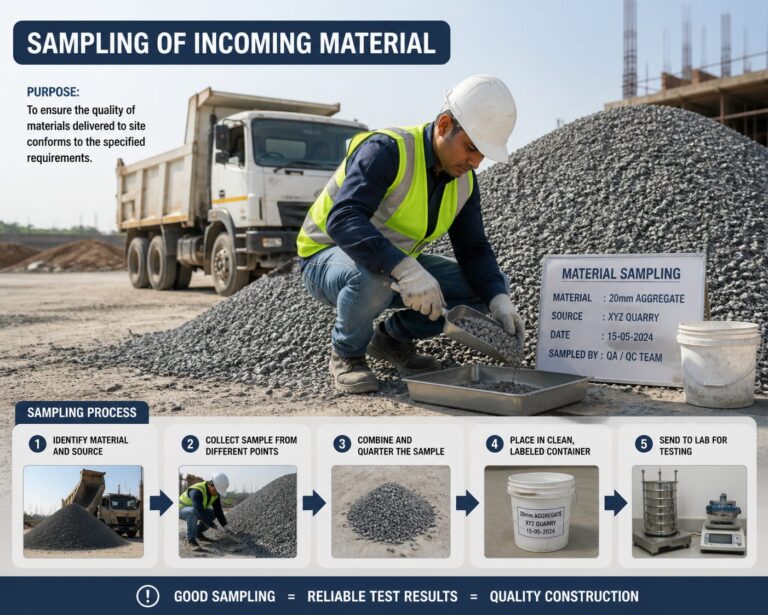
Type of Tests to be Conducted

Type of Test to be ConductedNo. of Sample and Sample Test Size
Free Swell Index1 Test per 3000 cum soil
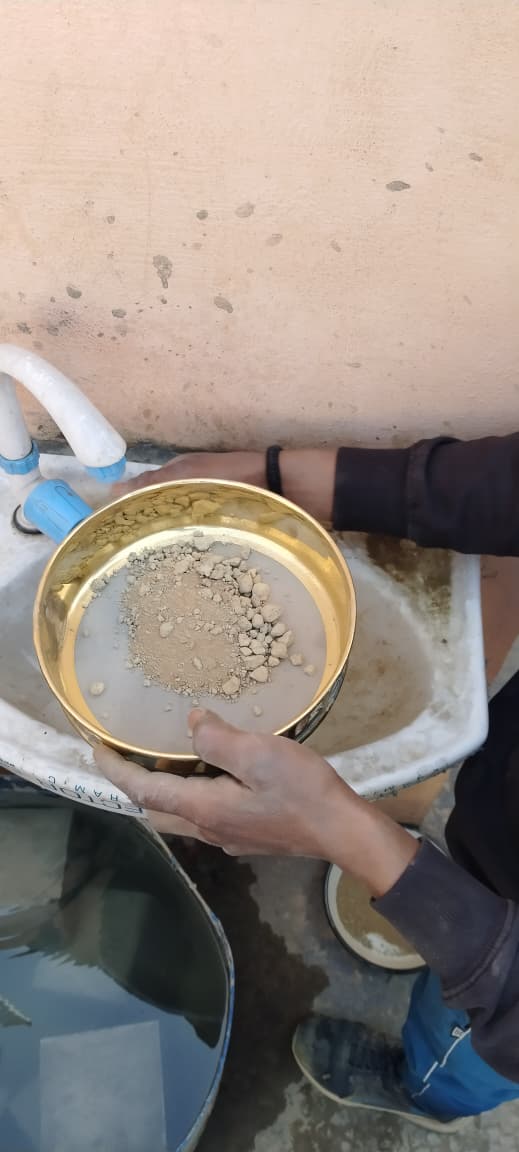
Grain Size Analysis2 Tests per 3000 cum soil
Liquid Limit (LL), Plastic Limit (PL), Plasticity Index (PI)2 Tests per 3000 cum soil
MDD & OMC2 Tests per 3000 cum soil
Deleterious content testMinimum one test on source or change of source or as and when required
Moisture content test2 Tests for every 3000 cum
CBR (Soaked / Unsoaked)One test for every 3000 cum

Safety Measures

  •  All safety measures shall be as per approved EHS Plan.