Grain Size Analysis of Soil
Sieve Analysis Procedure, Calculation & Interpretation for Highway and Civil Engineering Applications.
Introduction
Grain Size Analysis of Soil, also known as Mechanical Analysis of Soil, is the determination of the amount and proportion of individual grain sizes present in a representative soil sample.
Grain-size distribution is an important physical property used in soil identification and classification. Along with properties such as liquid limit and plasticity index, it is also used in assessing the engineering behaviour and suitability of soils for various civil engineering applications.
In highway engineering, grain-size distribution is particularly useful for evaluating subgrade and earthwork materials and for understanding characteristics relevant to drainage, compaction and material selection.
Purpose of Grain Size Analysis
Principle of Grain Size Analysis
Grain-size analysis separates soil particles according to their size and determines the percentage of the total sample represented by each size fraction.
For particles larger than 75 µm (0.075 mm), mechanical separation is generally carried out using a series of sieves having progressively smaller openings.
The material retained on each sieve is collected and weighed. The mass retained is then expressed as a percentage of the appropriate dry sample mass.
For particles finer than 75 µm, the particle-size distribution is determined by a sedimentation method, commonly using either the Pipette Method or Hydrometer Method.
- Sieve analysis for the coarser fraction.
- Sedimentation analysis for the fine fraction.
Methods of Grain Size Analysis
4.1 Sieve Analysis
Sieve analysis is used for soil particles that can be separated mechanically through suitable sieves. The soil is passed through a series of decreasing sieve openings and the material retained on each sieve is determined by mass.
4.2 Sedimentation Analysis
The sedimentation principle is used for determining the grain-size distribution of the fine fraction. The two commonly used methods are:
- Pipette Method
- Hydrometer Method
4.3 Dry Sieving
Dry sieving may be used for cohesionless, single-grained soils having negligible quantities of clay and silt and where the particles can be separated without washing.
4.4 Wet Sieving
Wet sieving is used where fines, clay coatings, aggregation or cohesion prevent reliable separation by dry sieving alone.
Applicable Standards
| Standard / Specification | Application |
|---|---|
| IS 2720 (Part 4) | Grain Size Analysis of Soil |
| IS 2720 (Part 1) | Preparation of soil samples for testing |
| MoRTH Specifications | Material requirements and acceptance criteria applicable to highway works |
| Project Specifications | Project-specific material and testing requirements |
Apparatus Required
| S. No. | Apparatus | Purpose |
|---|---|---|
| 1 | Standard IS Sieves | Separation of soil into particle-size fractions |
| 2 | Mechanical Sieve Shaker | Controlled mechanical sieving |
| 3 | Balance | Determination of mass of soil fractions |
| 4 | Oven | Drying of soil and retained fractions |
| 5 | Riffle Sampler | Obtaining representative test portions |
| 6 | Mortar & Rubber-Covered Pestle | Breaking soil lumps without crushing particles |
| 7 | Trays / Containers | Collection of soil fractions |
| 8 | Brush | Careful recovery of particles from sieves |
| 9 | Hydrometer Apparatus | Fine-fraction sedimentation analysis, where required |
Sample Preparation
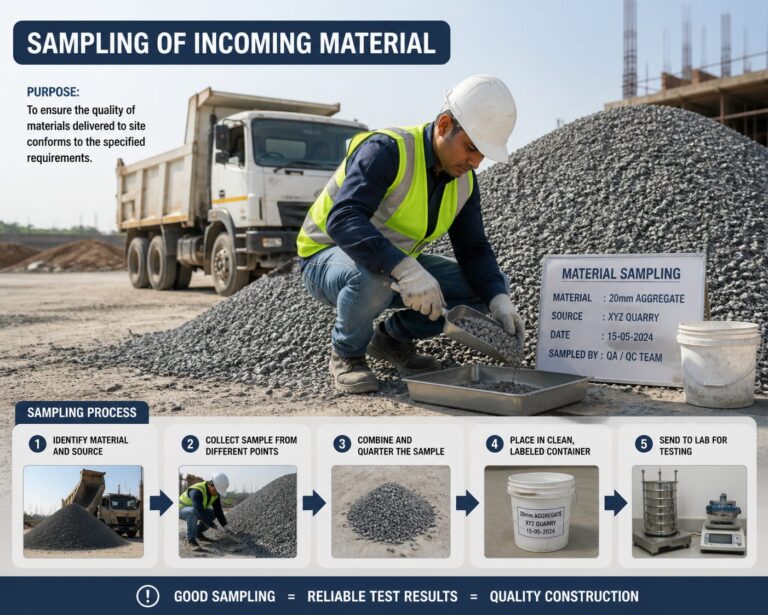
The soil sample received from the field should be made representative before carrying out the test.
Reduce the bulk sample using an appropriate sample-reduction procedure such as riffling or quartering, as applicable.
Prepare the sample in accordance with the applicable standard and adopted laboratory procedure.
Break soil lumps gently using a mortar and rubber-covered pestle. Avoid crushing individual soil particles.
Determine and record the dry mass of the sample used for the applicable analysis.
Fraction Retained on 2.0 mm Sieve
The soil fraction retained on the 2.0 mm sieve is subjected to separation using an appropriate series of larger sieves.
Take a sufficient quantity of dry soil retained on the 2.0 mm sieve. The quantity may need to be increased when the maximum particle size is large.
Arrange the required sieve set in descending order of sieve opening, with the largest opening at the top.
A typical series may include: 100 mm, 63 mm, 20 mm, 6 mm, 4.75 mm and 2.0 mm, with additional sieves where required.
Place the sample on the upper sieve and sieve mechanically or manually using the approved laboratory procedure.
Any soil lumps should be gently broken using suitable equipment without crushing individual particles. Re-sieve where necessary.
Carefully collect and determine the mass retained on each sieve.
Fraction Passing 2.0 mm and Retained on 0.075 mm
The fraction passing the 2.0 mm sieve and retained on the 0.075 mm sieve may be subjected to dry or wet sieving depending on the characteristics of the soil.
Suitable for cohesionless, single-grained soils with negligible fines and without persistent lumps.
Used where clay, silt, coatings, aggregation or cohesion may prevent effective separation by dry sieving.
Dry Sieve Analysis Procedure
Obtain the required representative quantity by riffling or quartering.
Prepare the soil in accordance with the applicable sample-preparation procedure.
A typical fine-fraction sieve series may include:
2.0 mm → 0.6 mm → 0.425 mm → 0.15 mm → 0.075 mm → Pan
Additional sieves may be included depending on the required particle-size range.
Place the sample on the upper sieve and carry out sieving using the approved method and equipment.
Collect and weigh the material retained on each sieve and the pan separately.
Wet Sieve Analysis Procedure
Wet sieving may be adopted where the soil contains cohesive material or fines that cannot be reliably separated by dry sieving.
Obtain the required test quantity by riffling or quartering and determine its mass.
Place the sample in a suitable tray or container and cover it with water. Allow sufficient soaking for disaggregation according to the adopted procedure.
For soils containing fractions likely to flocculate, an appropriate dispersing agent may be used in accordance with the applicable standard or approved laboratory method.
Place the soaked sample over the required sieve set, with the finest sieve and pan at the bottom, and wash thoroughly.
Continue washing until the water passing through the sieve is substantially clear.
Carefully recover the material retained on each sieve, transfer it without loss to separate containers, dry and determine the mass of each fraction.
Sieve Analysis Calculations
Determine the dry mass retained on each sieve and express it as a percentage of the appropriate total dry sample mass.
Percentage Retained
Cumulative Percentage Retained
Percentage Finer
Typical Sieve Analysis Calculation Table
| Sieve Size | Weight Retained | % Retained | Cumulative % Retained | % Finer |
|---|---|---|---|---|
| 100 mm | ||||
| 63 mm | ||||
| 20 mm | ||||
| 6 mm | ||||
| 4.75 mm | ||||
| 2.00 mm | ||||
| 0.600 mm | ||||
| 0.425 mm | ||||
| 0.150 mm | ||||
| 0.075 mm | ||||
| Pan |
Particle Size Distribution Curve
The calculated particle-size distribution is presented as a Particle Size Distribution (PSD) Curve.
The curve is plotted on a semi-logarithmic graph with:
Uniformity Coefficient and Coefficient of Curvature
Uniformity Coefficient — Cu
where:
- D60 = particle size corresponding to 60% finer
- D10 = particle size corresponding to 10% finer
Coefficient of Curvature — Cc
where D30 is the particle size corresponding to 30% finer.
Common Errors in Sieve Analysis
| Common Error | Possible Effect | Control Measure |
|---|---|---|
| Non-representative sample | Unreliable gradation | Use proper sample reduction and mixing |
| Insufficient sieving | Excess material retained on sieves | Ensure adequate sieving according to procedure |
| Crushing soil particles | Artificial increase in finer fraction | Break lumps gently without crushing particles |
| Loss of material during transfer | Mass-balance error | Use careful quantitative recovery |
| Incorrect weighing | Incorrect percentage retained | Use calibrated balance and verify readings |
| Incomplete washing | Fines remain attached to coarser particles | Continue washing until adequately clean |
| Incorrect sieve arrangement | Invalid gradation results | Arrange sieves in descending opening size |
| Incorrect calculation basis | Incorrect percentage finer | Maintain consistent dry sample-mass basis |
Laboratory Precautions
Hydrometer Analysis of Soil
Particles finer than 75 µm (0.075 mm) require sedimentation-based analysis where a complete grain-size distribution is required.
The hydrometer method determines the fine-particle distribution from the settling behaviour of soil particles in suspension.
Hydrometer Analysis of Soil →