Setting-Time Tests
Establishes the reference paste consistency used for cement setting-time testing.
Table of Contents
ToggleTest reference: IS 4031 (Part 4): 1988
Definition and engineering significance
Standard consistency is the water content, expressed as a percentage of the mass of dry cement, required to prepare a cement paste that produces the prescribed penetration of the standard Vicat plunger under the specified test conditions.
Applications in cement laboratory testing and highway QA/QC
Establishes the reference paste consistency used for cement setting-time testing.
Provides the consistency reference required by the applicable cement soundness test method.
Helps monitor changes in cement water demand between samples, deliveries or sources.
Supports laboratory quality control for highway concrete, bridges and rigid pavement works.
Use the relevant edition and approved project documents
Methods of physical tests for hydraulic cement — determination of consistency of standard cement paste.
Apply the relevant requirements of the contract, applicable MoRTH Specifications, approved QAP/ITP and Engineer's instructions.
Reference the applicable cement product specification, current amendments and project-specific requirements where relevant. Do not assume that every cement test has an independent acceptance limit under the consistency test method.
Prepare and check the equipment before starting the test
Apparatus with a movable rod, graduated scale and the standard plunger specified for the consistency test.
Standard mould for holding the prepared cement paste during the penetration test.
A clean, non-porous plate to support the mould and prevent moisture absorption through the base.
A suitable, verified balance for measuring the cement mass and other quantities required by the test.
Suitable measuring equipment or a balance for determining the required quantity of mixing water.
Clean mixing tray and suitable tools for preparing a homogeneous cement paste.
Maintain consistency throughout the test
| Parameter | Requirement / Guidance |
|---|---|
| Mass of cement | 400 g for the test procedure described here. |
| Plunger | Standard Vicat consistency plunger, nominally 10 mm diameter. |
| Temperature | Maintain the prescribed laboratory and material conditions, generally 27 ± 2°C under the referenced method. |
| Water content | Determine through trial pastes; no single percentage is correct for every cement. |
| Gauging time | Follow the prescribed mixing and gauging sequence and timing in the applicable standard. |
| Endpoint | Penetration to approximately 5–7 mm from the bottom of the mould. |
The controlled copy of IS 4031 (Part 4), including applicable amendments, takes precedence over this educational summary.
Standard consistency determination using Vicat apparatus
Ensure that the Vicat apparatus, plunger, mould and base plate are clean and in suitable condition. Check the balance and maintain the required laboratory conditions.
Weigh 400 g of cement for the test procedure described here. Record the sample identification and cement source in the laboratory register.
Add a measured quantity of clean water to the cement. Select an initial trial quantity based on laboratory experience, then adjust it in subsequent trials as required.
Mix and gauge the cement paste in accordance with the prescribed sequence and timing of IS 4031 (Part 4). Complete the operation promptly and consistently.
Place the mould on the non-porous base plate and fill it with the freshly prepared paste using the prescribed procedure. Strike off the excess paste to obtain a suitable surface.
Place the mould and base plate beneath the plunger. Bring the plunger into contact with the paste surface and release it as specified by the test method.
Record the penetration reading. Determine whether the plunger reaches the prescribed endpoint, approximately 5–7 mm from the bottom of the mould.
If the endpoint is not achieved, prepare a fresh paste with an appropriately adjusted quantity of water and repeat the procedure. Avoid treating a previous trial paste as a new sample.
Calculate the water content as a percentage of the mass of dry cement. Record the successful trial, penetration reading, water quantity and final consistency value.
Express the required water as a percentage of dry cement mass
Separate the test endpoint from the cement acceptance criteria
Identify the trial that meets the prescribed Vicat plunger penetration criterion.
Calculate and record P as a percentage of the mass of dry cement.
Compare the result against the applicable cement product standard and contractual requirements, where a limit is specified.
Review test conditions, sampling, water measurement and cement characteristics when an unusual result is obtained.
Practical checks for the cement testing laboratory
Minimum practical fields for a QA/QC test sheet
| Record field | Details to enter |
|---|---|
| Project and sample ID | Project name, sample number and sample location/source. |
| Cement details | Manufacturer, cement type/grade, batch or lot identification. |
| Test reference | IS 4031 (Part 4): 1988 and applicable amendments. |
| Mass of cement | Actual measured cement mass in grams. |
| Mass of water | Actual water mass used in each trial, in grams. |
| Penetration reading | Observed reading and confirmation of the specified endpoint. |
| Standard consistency | Calculated P value, expressed as a percentage. |
| Test traceability | Test date, operator, equipment identification and review/approval. |
Common questions from civil engineering students and QA/QC engineers
Sequential cement testing procedures performed as per Indian Standard Codes for concrete quality assurance in highway, bridge, rigid pavement, structural, and infrastructure projects.
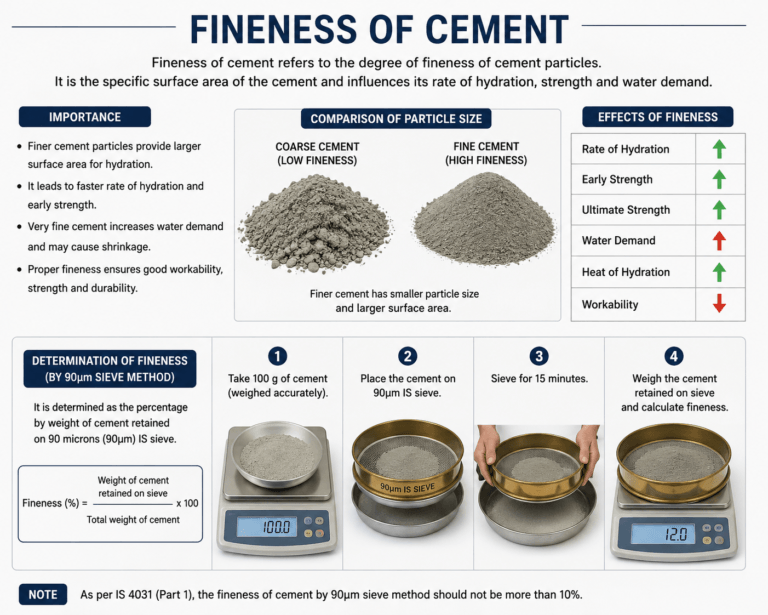
Determination of cement particle fineness using 90 micron IS sieve and Blaine air permeability method.
Determination of optimum water percentage using Vicat apparatus.
Measurement of initial hardening stage using Vicat needle penetration.
Determines complete hardening stage of cement paste.
Le Chatelier method for determining expansion characteristics of cement.
Mortar cube compressive strength evaluation at different curing ages.
Cement testing must be performed in proper IS code sequence to establish accurate correlation between fineness, consistency, setting characteristics, soundness, and strength development. Sequential testing is mandatory during NHAI, MoRTH, bridge, highway, rigid pavement, and third-party QA/QC inspections.
Engineering Precision. Digital Quality. Highway Excellence.
© 2026 HIGHWAY QUALITY TEST. All rights reserved.