🧪
Determination of Fineness of Cement
IS 4031 (Part 3)
🎯 Objective
To determine the fineness of cement by dry sieving method using 90 micron IS sieve as per IS 4031 (Part 3).
🛠 Apparatus Required
- Standard balance with 100 g weighing capacity
- IS 90 micron sieve
- Soft sieve brush
- Cement sample
⚙ Test Procedure
- Break down any air-set lumps in the cement sample gently with fingers.
- Accurately weigh 100 g of cement sample.
- Place the sample on a standard 90 micron IS sieve.
- Continuously sieve the sample for 15 minutes.
- Collect and weigh the residue retained on the sieve after sieving.
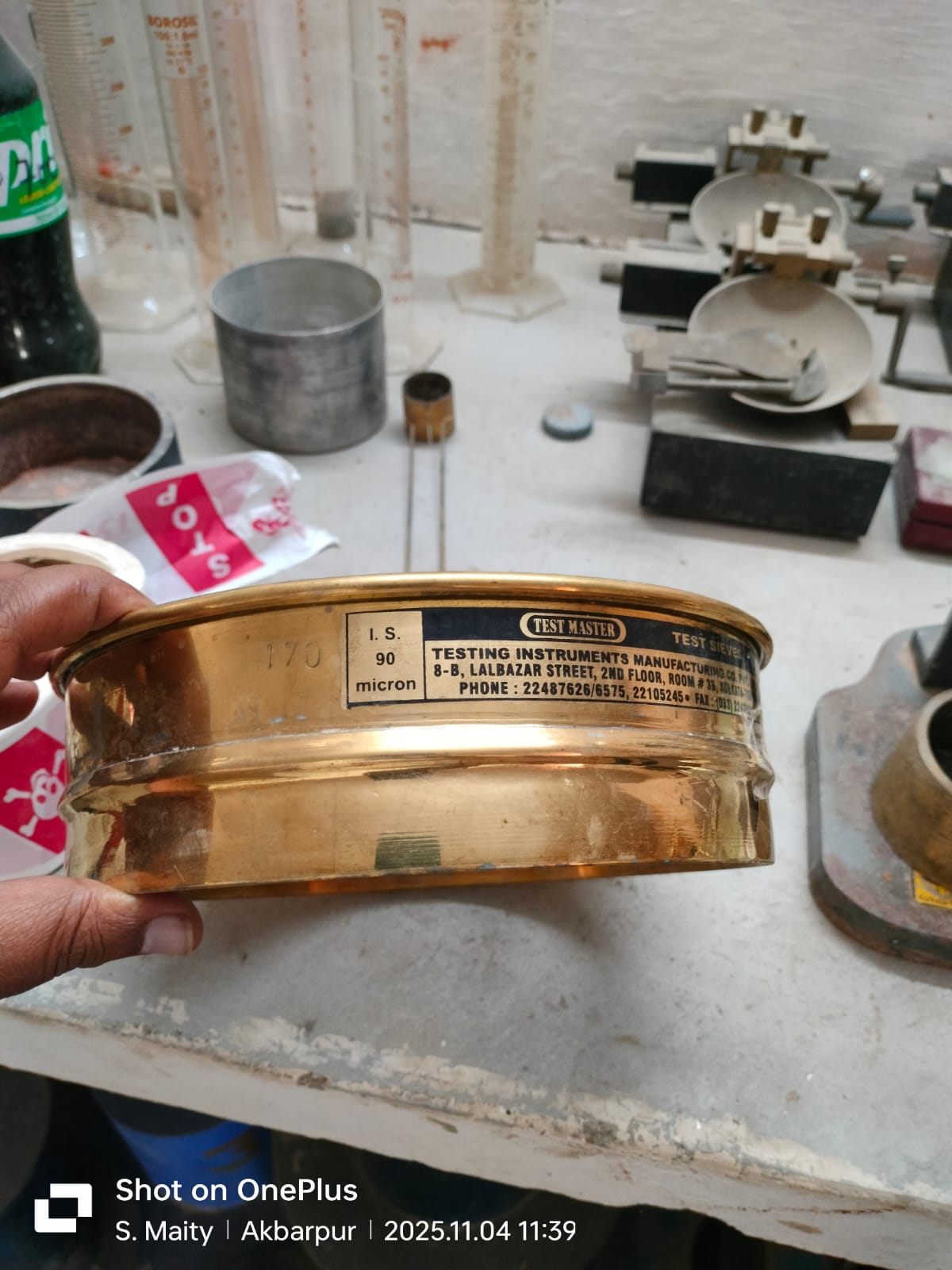
📷 Laboratory Fineness Test of Cement using 90 Micron IS Sieve
📐 Calculation
The percentage residue by weight over the total cement sample is reported as the fineness of cement.
% Weight of Residue =
(Weight of Sample Retained on Sieve × 100)
----------------------------------------------
Total Weight of Cement Sample
(Weight of Sample Retained on Sieve × 100)
----------------------------------------------
Total Weight of Cement Sample
📊 Permissible Limits
The percentage residue retained on 90 micron sieve
should NOT exceed 10%.
💡 Importance of Test
Fineness of cement directly affects the rate of hydration, heat generation, setting time, and strength development of concrete. Finer cement provides higher early strength but may increase shrinkage and heat of hydration. This test is essential for NHAI, MoRTH, bridge, highway, and structural QA/QC works.
