Concrete Work

DLC & PQC

Consistence-cement

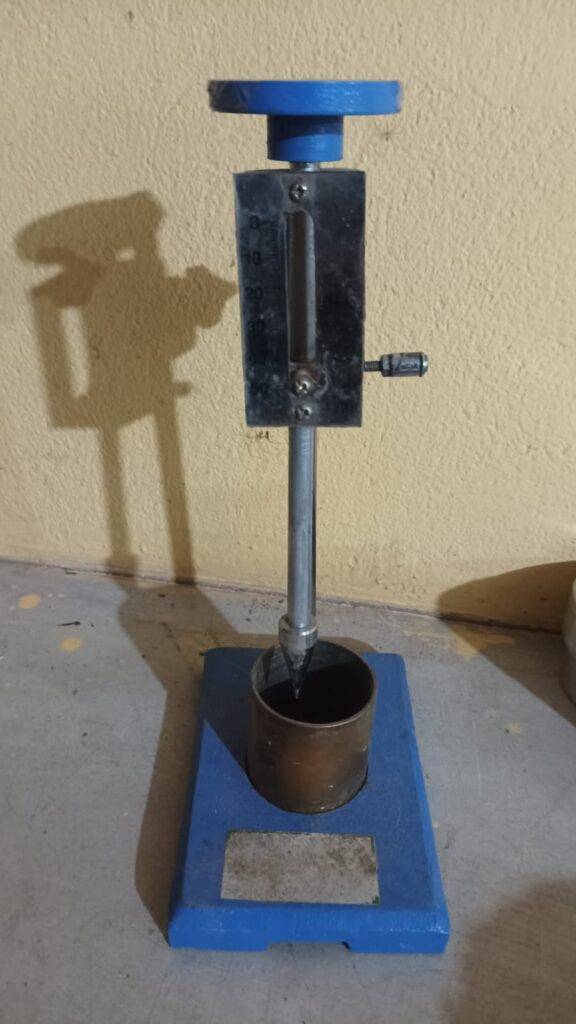
Consistency of Cement | Standard Consistency Test (Vicat Apparatus)

The cement consistency test is performed to determine the standard water content required to achieve a paste of normal consistency, which is crucial for ensuring optimum hydration of cement, achieving desired strength & workability in concrete and mortar.
• Preventing excess bleeding or shrinkage.

Consistency of Cement | Standard Consistency Test (Vicat Apparatus) Read More »

Cement

COMPLETE CEMENT TESTING EXCEL TOOLKIT

⭐ PREMIUM QA/QC EXCEL TOOLKIT Complete Cement Testing Excel Toolkit A practical collection of 8 ready-to-use Excel formats for cement testing, calculations, laboratory records, QA/QC documentation and professional reporting. ✓ Automatic Calculations ✓ Editable Excel ✓ QA/QC Reporting ✓ Lifetime Access WHY THIS TOOLKIT? Simplify Routine Cement QA/QC Work Cement quality control involves repeated observations, calculations, test result recording and compliance checks. These Excel formats are designed to make routine laboratory work faster, more consistent and easier to review. 📋 8 Excel Formats Included Ready-to-use formats for common cement laboratory testing and QA/QC documentation. ✓ Cement Fineness Test (IS 4031 Part 1) ✓ Standard Consistency Test (IS 4031 Part 4) ✓ Initial Setting Time Test (IS 4031 Part 5) ✓ Final Setting Time Test (IS 4031 Part 5) ✓ Soundness Test (IS 4031 Part 3) ✓ Specific Gravity Test of Cement ✓ Cement Fineness Methodology & Calculation Format ✓ Professional Cement Test Reporting Sheet ⚡ Automatic Calculations Reduce repetitive calculations and improve consistency in routine cement test records. 📊 Calculation Sheets Organized worksheets for observations, calculations and final test results. 📑 Professional Reporting Maintain structured laboratory records suitable for routine QA/QC documentation and review. ✏️ Fully Editable Enter your project data and adapt the worksheets to your laboratory workflow. 👷 Who Is This Toolkit For? ✓ Highway & Infrastructure Projects ✓ QA/QC Engineers ✓ Laboratory Engineers & Technicians ✓ Site Engineers ✓ Consultants & Contractors ✓ Civil Engineering Students 🔧 Practical QA/QC Applications Cement Receipt & Quality Control: Maintain organized records of routine cement quality testing and laboratory observations. Routine Laboratory Testing: Use structured worksheets for recording observations, calculations and test results. Quality Verification: Review important cement properties through standardized calculation and reporting formats. QA/QC Documentation: Maintain consistent records for project quality documentation, internal review and technical reporting. 📚 Standards & Technical Basis The toolkit is prepared with reference to applicable Indian Standards for cement testing, including relevant parts of the IS 4031 series, as applicable to the respective tests. Cement requirements should also be verified against the applicable cement product standard, project specifications and relevant MoRTH requirements before acceptance. ❓ QUICK QUESTIONS Frequently Asked Questions Everything you need to know before purchasing the Cement Testing Excel Toolkit. What exactly is included in this toolkit? You receive 8 ready-to-use Excel formats covering cement fineness, standard consistency, initial and final setting time, soundness, specific gravity, fineness methodology and professional cement test reporting. Are the Excel files editable? Yes. The worksheets are provided as editable Excel formats. You can enter your laboratory and project data and adapt the records to your applicable workflow. Do the sheets contain automatic calculations? Yes. Applicable worksheets contain formulas to reduce repetitive manual calculations and help maintain consistent cement test records. Can I use this toolkit for highway and infrastructure projects? Yes. The toolkit is designed for practical highway, bridge and infrastructure QA/QC work, including cement quality control, laboratory testing and routine project documentation. Always verify the applicable project specification before acceptance. Which standards are covered? The applicable test formats are prepared with reference to relevant parts of the IS 4031 series and other applicable Indian Standards. The latest applicable standard, cement product requirements and project specifications should always be checked before testing and acceptance. Who can use this toolkit? It is useful for QA/QC engineers, laboratory engineers, site engineers, consultants, contractors, technicians and civil engineering students involved in cement testing and quality documentation. How will I receive the toolkit after payment? After successful payment, the toolkit is provided through the designated digital delivery process. You receive the Excel files for use on your computer or compatible device. Is this a one-time payment? Yes. The toolkit is available as a one-time purchase. There is no recurring subscription for this product. Do I get lifetime access? Yes. The purchase includes lifetime access to the toolkit, subject to the product’s delivery and access terms. Can these Excel formats replace the applicable test standard? No. The toolkit is a calculation and documentation aid. It does not replace IS, IRC, MoRTH, project specifications or approved laboratory procedures. The applicable standard and project requirements should always be followed. COMPLETE CEMENT TESTING TOOLKIT Get All 8 Excel Formats Today ₹894 ₹499 44% OFF One-time payment • Instant Download • Editable Excel • Lifetime Access 🚀 Get Cement Toolkit – ₹499 🔒 Secure Payment   •   📥 Instant Access   •   📊 Editable Excel Formats   •   ♾️ Lifetime Access Prepared for practical QA/QC use with reference to applicable Indian Standards and project requirements.

COMPLETE CEMENT TESTING EXCEL TOOLKIT Read More »

Cement

COMPLETE CONCRETE MIX DESIGN TOOLKIT

⭐ MOST POPULAR QA/QC EXCEL TOOLKIT Complete Concrete Mix Design Excel Toolkit A practical collection of 15 ready-to-use Excel formats for concrete mix design, mix proportioning, trial mixes, calculations and project QA/QC documentation. ✓ Automatic Calculations ✓ Editable Excel ✓ Mix Proportioning ✓ Lifetime Access WHY THIS TOOLKIT? Simplify Concrete Mix Design & QA/QC Work Concrete mix design involves repeated calculations for target mean strength, water-cement ratio, water content, cementitious materials, aggregate proportions, admixture dosage, moisture corrections and trial mix adjustments. These Excel formats are designed to make routine mix design and QA/QC documentation faster, more systematic and easier to review. 📋 15 Concrete Mix Design Excel Formats Ready-to-use formats for structural, highway and infrastructure concrete mix design applications. ✓ M15 Grade Concrete Mix Design ✓ M20 PCC Mix Design ✓ M20 RCC Mix Design ✓ M20 Median Kerb Mix Design ✓ M25 RCC Mix Design ✓ M30 RCC Mix Design ✓ M35 RCC Mix Design ✓ M35 Piling Concrete Mix Design ✓ M35 RE Wall / Panel / Block Mix Design ✓ M40 RCC Mix Design ✓ M45 RCC Mix Design ✓ M50 PSC Mix Design ✓ DLC Mix Design ✓ PQC Mix Design ✓ Filter Media Mix Design ⚡ Automatic Calculations Formula-based worksheets help reduce repetitive manual calculations during mix proportioning and related QA/QC work. 📊 Mix Proportion Calculations Organized calculation sheets for material quantities and concrete mix proportioning. 📑 Professional Reporting Structured formats suitable for laboratory records, trial mixes and project QA/QC documentation. ✏️ Fully Editable Excel Enter project-specific material properties and adjust the worksheets to suit your approved mix design workflow. 👷 Who Is This Toolkit For? ✓ Highway & Infrastructure Projects ✓ QA/QC Engineers ✓ Concrete Technologists ✓ Laboratory Engineers & Technicians ✓ Site Engineers ✓ Consultants & Contractors ✓ Ready-Mix Concrete Professionals ✓ Civil Engineering Students 🔧 Practical QA/QC Applications Concrete Mix Design: Use structured worksheets for concrete mix proportioning and material quantity calculations. Trial Mix Preparation: Record trial mix quantities, adjustments and observed results in an organized format. Highway Concrete: Useful for DLC, PQC, kerbs and other highway concrete applications. Structural Concrete: Suitable for routine RCC, PSC, piling and infrastructure concrete mix design documentation. QA/QC Documentation: Maintain systematic calculation sheets and supporting records for review, verification and project documentation. 📚 Standards & Technical Basis The concrete mix design formats are prepared with reference to IS 10262 and applicable Indian Standards for concrete materials and testing, along with relevant IS 456, IRC, MoRTH and project-specific requirements, as applicable to the respective concrete application. The latest applicable standards, approved mix design criteria and project specifications should always be checked before use and acceptance. ❓ QUICK QUESTIONS Frequently Asked Questions Everything you need to know before purchasing the Concrete Mix Design Excel Toolkit. What exactly is included in this toolkit? You receive 15 ready-to-use Excel formats covering M15 to M50 concrete applications, RCC, PCC, PSC, piling, RE wall components, DLC, PQC, median kerbs and filter media. Are the Excel files editable? Yes. The worksheets are provided in an editable Excel format. You can enter your project-specific material properties, design parameters and test results as applicable. Do the worksheets contain automatic calculations? Yes. The applicable worksheets contain formulas designed to reduce repetitive manual calculations and help maintain consistent mix design records. Can I use the toolkit for highway projects? Yes. The toolkit includes formats for DLC, PQC, median kerbs and other concrete applications commonly encountered in highway and infrastructure projects. Applicable project specifications and approved mix design criteria must be followed. Which standards are used for the mix design formats? The formats are prepared with reference to IS 10262 and applicable Indian Standards, with relevant IS 456, IRC, MoRTH and project requirements considered as applicable to the respective concrete application. Who can use this toolkit? It is useful for QA/QC engineers, concrete technologists, laboratory engineers, site engineers, consultants, contractors, RMC professionals, technicians and civil engineering students working with concrete mix design and quality documentation. How will I receive the toolkit after payment? After successful payment, the toolkit is provided through the designated digital delivery process. You receive the Excel files for use on a computer or compatible device. Is this a one-time payment? Yes. The current price is ₹999 as a one-time payment. There is no recurring subscription for this toolkit. Do I get lifetime access? Yes. The purchase includes lifetime access to the toolkit, subject to the product’s delivery and access terms. Can these Excel formats replace the applicable mix design standard? No. The toolkit is a calculation and documentation aid. It does not replace IS, IRC, MoRTH, project specifications, approved mix design procedures or laboratory requirements. The applicable standards and project requirements should always be followed for design approval and acceptance. COMPLETE CONCRETE MIX DESIGN TOOLKIT Get All 15 Excel Formats Today ₹1,599 ₹999 38% OFF One-time payment • Instant Download • Editable Excel • Lifetime Access 🚀 Get Concrete Toolkit – ₹999 🔒 Secure Payment   •   📥 Instant Access   •   📊 Editable Excel Formats   •   ♾️ Lifetime Access Prepared for practical concrete QA/QC use with reference to applicable Indian Standards, IRC, MoRTH and project requirements.

COMPLETE CONCRETE MIX DESIGN TOOLKIT Read More »

Concrete Work
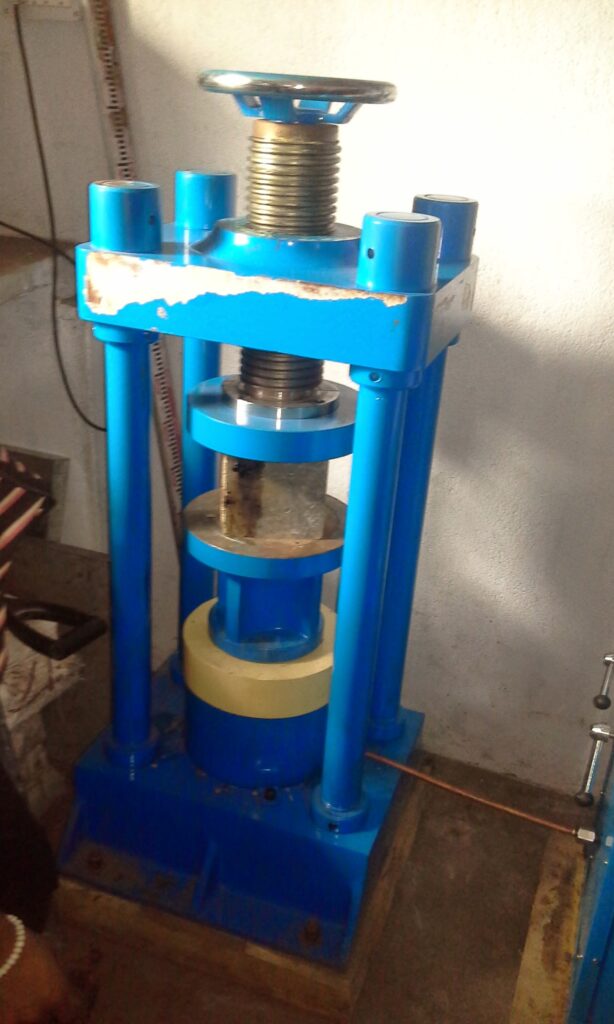
cube testing machine

Compressive Strength of Concrete Cube Test (IS 516 Guide)

Concrete Cube Test – IS 516 Procedure, Compressive Strength & Formula 1. Objective The Concrete Cube Compressive Strength Test, conducted in accordance with IS 516 (Part 1/Sec 1), is the most widely accepted method for assessing the compressive strength of hardened concrete. It is one of the most critical quality control tests used to verify that concrete has achieved the specified design strength and complies with the requirements of IS 456, MoRTH Specifications, project specifications, and contractual acceptance criteria. The test is routinely performed on highways, bridges, buildings, industrial facilities, airports, and other infrastructure projects to ensure the structural safety, durability, and long-term performance of concrete. For EPC contractors, consultants, and QA/QC teams, concrete cube testing forms an integral part of the Quality Assurance and Quality Control (QA/QC) system. The reliability of the test depends not only on the Compression Testing Machine (CTM) but also on the accuracy of every preceding activity, including representative sampling, cube casting, compaction, curing, specimen handling, identification, and laboratory testing. Failure to follow standard procedures at any stage can significantly influence the measured compressive strength and may result in incorrect acceptance or rejection of concrete. Concrete test specimens are generally prepared using standard cube moulds of 150 × 150 × 150 mm, which are widely used for routine structural concrete testing. Where the nominal maximum size of coarse aggregate does not exceed 20 mm, 100 × 100 × 100 mm cube moulds may also be used in accordance with the applicable provisions of IS 516. Specimens are normally tested at 7 days to evaluate early strength development and at 28 days to determine the characteristic compressive strength. Additional testing ages may be specified for high-performance concrete, mass concrete, or project-specific requirements. Scope of the Concrete Cube Test Procedure A standard Concrete Cube Compressive Strength Test consists of the following sequential activities: Inspection, cleaning, assembly, and lubrication of cube moulds before casting. Collection of representative fresh concrete samples from the point of discharge or placement. Recording of specimen identification, concrete grade, batch details, casting location, date, and time for complete traceability. Layer-wise placement of concrete into cube moulds followed by proper compaction using a tamping rod or vibration table, depending on the workability of the concrete. Finishing the top surface flush with the mould and marking each specimen for identification. Protecting freshly cast specimens from vibration, direct sunlight, excessive moisture loss, and mechanical disturbance during the initial setting period. Demoulding the specimens after 24 ± ½ hours and transferring them immediately to a curing tank maintained under standard curing conditions. Continuous water curing until the specified testing age. Testing the specimens using a calibrated Compression Testing Machine (CTM) in accordance with IS 516. Calculating the compressive strength by dividing the maximum failure load by the loaded cross-sectional area of the specimen. Comparing the test results with the acceptance criteria specified in IS 456, MoRTH Specifications, project Quality Assurance Plans (QAP), and other applicable contract documents. Importance of Proper Testing The accuracy of the Concrete Cube Compressive Strength Test depends on strict adherence to standard laboratory procedures. Common errors such as improper sampling, inadequate compaction, poor curing, damaged specimens, incorrect loading rates, or inaccurate specimen identification can produce misleading test results. Therefore, every stage of the testing process shall be carried out in accordance with IS 516 and the approved Quality Assurance procedures to ensure reliable, repeatable, and technically valid results. Benefits of Routine Concrete Cube Testing Verifies that the concrete has achieved the specified grade (M20, M25, M30, M40, and higher). Detects deficiencies in batching, mixing, transportation, placement, compaction, and curing practices at an early stage. Evaluates the consistency and quality of concrete production throughout the project. Confirms the performance of the approved concrete mix design under actual site conditions. Demonstrates compliance with IS 456, IS 516, MoRTH Specifications, consultant requirements, and contractual QA/QC procedures. Provides documented laboratory records for inspections, audits, quality reviews, and client approvals. Enhances confidence in the structural safety, durability, and long-term service performance of concrete structures. 👷 Expert Recommendation Concrete cube strength should never be evaluated in isolation. When low-strength results are obtained, review the complete quality control cycle, including material quality, batching accuracy, water-cement ratio, slump test results, transportation time, placing method, compaction, curing conditions, CTM calibration, and testing procedures. In practice, many low-strength results are caused by deficiencies in sampling, specimen preparation, curing, or testing rather than by the concrete mix itself. A systematic investigation should always be carried out before concluding that the concrete has failed. This guide presents the complete IS 516 Concrete Cube Compressive Strength Test Procedure in a practical, step-by-step sequence followed on major NHAI, MoRTH, EPC, HAM, BOT, and O&M projects. It is intended as a comprehensive reference for site engineers, material engineers, QA/QC engineers, laboratory technicians, consultants, contractors, engineering students, and project managers responsible for concrete quality control and acceptance testing. 2. Apparatus Required The following apparatus and equipment are required for casting, curing, and testing concrete cube specimens in accordance with IS 516 (Part 1/Sec 1). All equipment shall be clean, properly maintained, and calibrated (where applicable) to ensure accurate and reliable test results. Apparatus Specification / Requirement Purpose Cube Moulds 150 × 150 × 150 mm or 100 × 100 × 100 mm, steel/cast iron Preparation of standard concrete test specimens. Mixing Tray Clean, rigid and non-absorbent Mixing and remixing representative concrete samples before casting. Scoop / Shovel Steel Handling and transferring fresh concrete into cube moulds. Tamping Rod 16 mm diameter, 600 mm long, rounded ends Manual compaction of concrete (35 strokes per layer as specified). Steel Trowel / Float Standard masonry trowel Levelling and finishing the top surface of the concrete cube. Vibrating Table or Needle Vibrator Suitable capacity Mechanical compaction of workable concrete where specified. Concrete Mixer (If Required) Pan or drum type Uniform mixing of concrete for laboratory or trial batches. Vernier Caliper / Steel Scale Calibrated Measurement of cube dimensions before compressive strength testing. Curing Tank Maintained at 27 ± 2°C Standard water curing of

Compressive Strength of Concrete Cube Test (IS 516 Guide) Read More »

Concrete Work
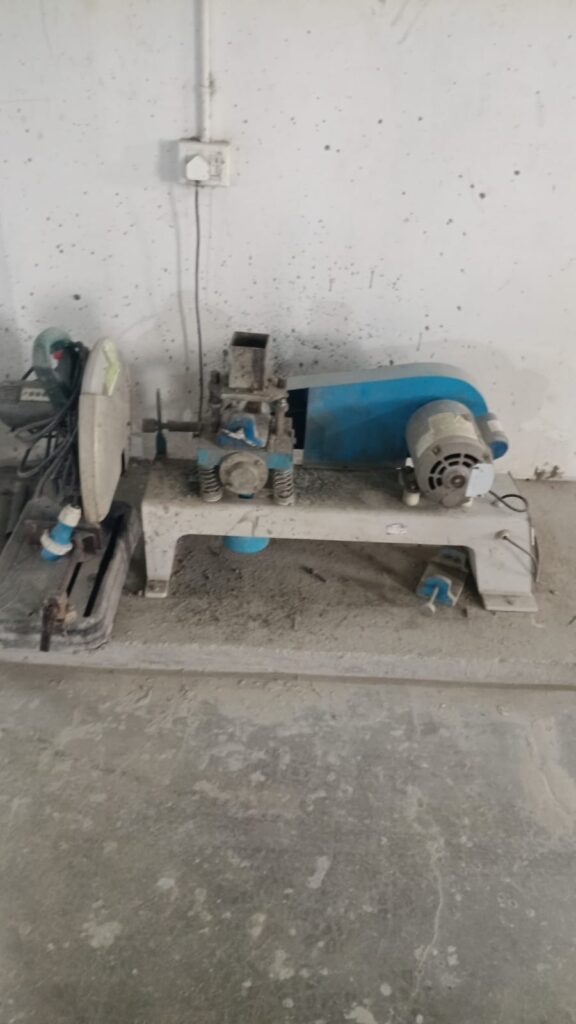
Mortar cube vibrator

Compressive Strength of Cement

Compressive Strength Test of Cement Mortar Cubes – IS 4031 (Part 6) | Step-by-Step with Examples Compressive Strength Test of Cement Mortar Cubes (IS: 4031 – Part 6) Quick Summary: IS:4031 (Part-6) specifies the method for determination of compressive strength of cement using standard mortar cubes of size 70.6 mm. Cubes are prepared in a 1:3 cement–standard sand mix, compacted by vibration, cured for 3, 7 and 28 days, and tested at a loading rate of 35 N/mm²/min. The test ensures that cement meets the minimum strength requirements prescribed for OPC-43 and OPC-53 grades. Example: This test is used to check whether an OPC 43 or OPC 53 cement bag supplied to site meets BIS strength requirements at 3, 7 and 28 days. 1. Intoduction: To determine the compressive strength of hydraulic cement, standard cement mortar cubes (70.6 mm size) are cast and compacted using a standard vibration machine as per IS 4031 (Part 6). This Compressive Strength Test ensures cement quality by covering cube casting, curing, testing, calculation, and result interpretation, making it field-ready for engineers and QA/QC teams to ensure reliable concrete performance in highway and structural applications. 2. Apparatus Vibration machine (12,000 ± 400 vibrations/min) Cube moulds – 70.6 mm × 70.6 mm × 70.6 mm Standard sand (IS 650 : 1966) Prodding rod Non-porous mixing plate Weighing balance Cube crushing testing machine (CTM) Mould oil, petroleum jelly Potable / distilled water Example: If your CTM capacity is 2000 kN and vibration machine speed is calibrated annually, the setup satisfies IS requirements. 3. Standard Sand (IS 650) Particle Size Range Percentage 2.0 mm – 1.0 mm 33.33% 1.0 mm – 500 micron 33.33% 500 micron – 90 micron 33.33% Example: If 900 g of standard sand is tested for gradation, each fraction should weigh approximately 300 g. 4. Mix Proportion Material Quantity Cement 200 g Standard Sand 600 g Water (P/4 + 3)% P = % water required for standard consistency (IS 4031 Part 4) Example: If standard consistency P = 26% Water = (26/4 + 3)% = 9.5% Total mass = 800 g Water = 0.095 × 800 = 76 g 5. Mixing Procedure Dry mix cement + sand for 1 minute. Add calculated water. Mix for minimum 3 minutes. Reject mix if uniform colour is not achieved within 4 minutes. Example: Dry mixing from 10:00–10:01 AM Wet mixing ends at 10:04 AM → ACCEPTABLE If mixing continues beyond 10:05 AM → REJECT batch 6. Moulding of Specimens Oil mould and base plate. Fix mould firmly on vibration table. Fill mortar in layers. Prod each layer 20 times in ~8 seconds. Vibrate for 2 minutes. Finish surface using trowel. Example: 1st layer: 20 rod blows in 8 s 2nd layer: 20 rod blows in 8 s Vibration time: 2 minutes exactly 7. Curing of Specimens Keep moulds in moist room for 24 hours. Demould and immerse in water. Maintain water temperature at 27 ± 2°C. Renew water every 7 days. Example: Casting completed at 4 PM on Day-0 Demould at 4 PM on Day-1 3-day test conducted at 4 PM on Day-3 8. Testing of Specimens Test cubes on their sides. Load rate: 35 N/mm² per minute. Test minimum three cubes. Example: For cube area 50 cm² (=5000 mm²), Load rate ≈ 175 kN per minute 9. Calculation of Compressive Strength Compressive Strength = P / A Example (kg-machine): Crushing load = 7200 kg Area = 50 cm² Strength = 7200 / 50 = 144 kg/cm² Example (kN-machine): Load = 720 kN Equivalent load = 720 × 101.97 = 73418 kg Strength = 73418 / 50 = 1468 kg/cm² 10. Minimum Strength Requirements OPC 43 Grade Cement Age Strength (MPa) kg/cm² 3 Days 23 235 7 Days 33 337 28 Days 43 438 OPC 53 Grade Cement Age Strength (MPa) kg/cm² 3 Days 27 275 7 Days 37 377 28 Days 53 540 ⬇ Download Cement Mortar Cube Test – Excel Sheet Top 10 FAQs – Compressive Strength of Cement What is the compressive strength of cement? It is the maximum load per unit area that a cement mortar cube can withstand under compression. Which IS code governs the compressive strength test of cement? IS:4031 (Part-6) specifies the procedure for determination of compressive strength of cement. Why is standard sand used in cement strength testing? Standard sand (IS:650) ensures uniform grading and repeatable test results. What is the size of cement mortar cube? Standard cube size is 70.6 mm × 70.6 mm × 70.6 mm with a cross-sectional area of 50 cm². What is the mix proportion for cement mortar cubes? Cement : Standard Sand = 1 : 3 by weight. How is water quantity calculated? Water = (P/4 + 3)% of the combined weight of cement and sand, where P is the standard consistency. What are standard curing periods? Cement mortar cubes are tested at 3 days, 7 days, and 28 days. What is the required compressive strength for OPC cement? OPC-43: 23, 33, 43 MPa and OPC-53: 27, 37, 53 MPa at 3, 7, and 28 days respectively. How is compressive strength calculated? Strength (kg/cm²) = Crushing Load (kg) / Area (cm²). Can a compression testing machine display load in kN? Yes. Load in kN must be converted into kg before calculating strength. Prepared by Kishor Kumar | Source: HighwayQualityTest.com Standard Reference: IS 4031 (Part 6) – Methods of Physical Tests for Hydraulic Cement (BIS). Quick Reference: Compressive Strength of Cement (IS:4031 Part-6) Test Objective: Determine compressive strength of standard cement mortar cubes Specimen Size: 70.6 mm × 70.6 mm cube (area = 50 cm²) Mix Proportion: Cement : Standard Sand = 1 : 3 by weight Quantity per Cube Set: Cement = 200 g, Sand = 600 g Water Content: (P/4 + 3)% of combined mass of cement and sand Standard Sand: Conforming to IS:650 (100% passing 2 mm, retained on 90 micron) Compaction: Vibration for 2 minutes @ 12,000 ± 400 vibrations/min Curing Periods: 3 days, 7 days & 28 days

Compressive Strength of Cement Read More »

Cement

METHOD STATEMENT FOR OPEN FOUNDATION

Method Statement for Open Foundation 1. Description This Method Statement covers the construction of Plain Cement Concrete (PCC) and Reinforced Cement Concrete (RCC) Open Foundations in accordance with the approved drawings, contract specifications, and the MoRTH Specifications for Road and Bridge Works. The scope of work includes survey and setting out, excavation, preparation of the foundation bed, dewatering (where required), laying of PCC, reinforcement fixing, formwork, concreting, curing, quality control, safety requirements, and backfilling after completion of foundation works. 2. Materials All materials used for the construction of the open foundation shall conform to Section 1000 of the MoRTH Specifications, relevant Indian Standards (IS Codes), approved mix designs, and the requirements of the Contract. Only approved materials accompanied by valid test certificates and accepted by the Engineer shall be used for the work. Materials shall be properly stored, handled, and protected from contamination or deterioration prior to use. Cement conforming to the relevant IS Specifications. Fine Aggregate conforming to IS 383 and MoRTH requirements. Coarse Aggregate conforming to IS 383 and MoRTH requirements. Reinforcement Steel conforming to IS 1786 and approved Bar Bending Schedule (BBS). Water suitable for concrete production and curing in accordance with IS 456. Approved chemical admixtures, if specified in the approved mix design. Formwork materials capable of maintaining the required line, level, dimensions, and finish. Quality Requirement: All construction materials shall be inspected, tested, and approved before use. Material test reports shall be maintained as part of the project Quality Assurance/Quality Control (QA/QC) documentation. 3. Preparation of Foundations Excavation for laying the foundation shall be carried out in accordance with MoRTH Clause 300 and the approved drawings. The excavation shall be taken to the required line, level, dimensions, and founding level specified in the drawings. Open foundations shall preferably be constructed under dry conditions. Where groundwater or seepage is encountered, suitable dewatering arrangements such as pumping, well-point systems, or diversion channels shall be provided and maintained throughout the construction period to ensure a clean, stable, and workable foundation bed. The excavation bed shall be cleaned of all loose, soft, organic, and unsuitable materials before inspection by the Engineer. No concrete shall be placed until the foundation bed has been inspected and approved. 4. Setting Out The foundation layout shall be established in accordance with the approved General Arrangement (GA) drawings and survey control points. The plan dimensions of the foundation shall be set out at the bottom of the excavation using a Total Station, Auto Level, and measuring tape. The layout shall be checked with respect to the original centre line, reference benchmarks, and structural axes to ensure dimensional accuracy. It shall be ensured that no portion of the bearing surface is higher than the approved founding level indicated on the drawings. All survey checks shall be verified and approved by the Engineer before commencement of PCC works. 5. Safe Bearing Capacity (SBC) of Soil The Safe Bearing Capacity (SBC) of the foundation soil shall be verified at the founding level in accordance with the approved drawings, geotechnical investigation report, and project specifications. Where specified in the Contract, the SBC shall be confirmed by the in-house Quality Control (QC) Laboratory or an approved testing agency before commencement of foundation works. Test results shall be reviewed and approved by the Engineer prior to placing Plain Cement Concrete (PCC). If the actual soil conditions or Safe Bearing Capacity are found to differ from the design assumptions, the matter shall be immediately reported to the Engineer for further investigation and approval before proceeding with the work. 6. Construction of Open Foundation Construction of the open foundation shall be carried out in accordance with the approved drawings, relevant MoRTH Specifications, and the approved Method Statement. The foundation bed shall be inspected and approved by the Engineer before commencement of concrete works. Where the bearing surface consists of natural earth, a 150 mm thick Plain Cement Concrete (PCC) layer of Grade M15 shall be laid below the structural foundation concrete unless otherwise specified in the drawings or Contract. The lean concrete shall provide a clean, level, and stable working surface for reinforcement fixing and formwork erection. Generally, no side formwork is required for the lean concrete layer. However, where necessary to maintain dimensions or due to unstable excavation sides, suitable formwork may be provided with the approval of the Engineer. Side formwork shall be provided for the structural foundation concrete to maintain the required dimensions, alignment, and surface finish. Top formwork shall also be provided where the slope of the concrete surface is steeper than 1 Vertical : 3 Horizontal (1V:3H) to prevent displacement or slippage of freshly placed concrete. Where concrete is placed on sloping surfaces without top formwork, the concrete slump shall be carefully controlled to ensure adequate workability while preventing segregation or movement of fresh concrete. The concrete shall be placed in a continuous operation and compacted using approved mechanical vibrators. In cases involving steeply sloping surfaces, the top formwork may be erected progressively as concreting advances to ensure proper compaction and dimensional accuracy. Reinforcement shall be fabricated, fixed, and supported strictly in accordance with the approved structural drawings, Bar Bending Schedule (BBS), IRC:112, and MoRTH Specifications. The specified clear cover shall be maintained throughout the concreting operation using approved concrete cover blocks. Before placing the lean concrete, the foundation bed shall be thoroughly cleaned of all loose soil, organic matter, standing water, and other deleterious materials. The surface shall be lightly moistened to prevent excessive absorption of water from the concrete. Care shall be taken to avoid muddy conditions. Any softened or disturbed portion of the foundation bed resulting from over-wetting or other causes shall be removed, re-compacted where necessary, and brought back to the required level before concrete placement. Quality Control: Lean concrete and foundation concrete shall not be placed until the excavation, founding level, reinforcement, formwork, and foundation bed have been inspected and approved by the Engineer. 7. Inspection Plan and Testing S. No. Construction Activity Inspection Required Testing / Verification Required Remarks 1

METHOD STATEMENT FOR OPEN FOUNDATION Read More »

Concrete Work

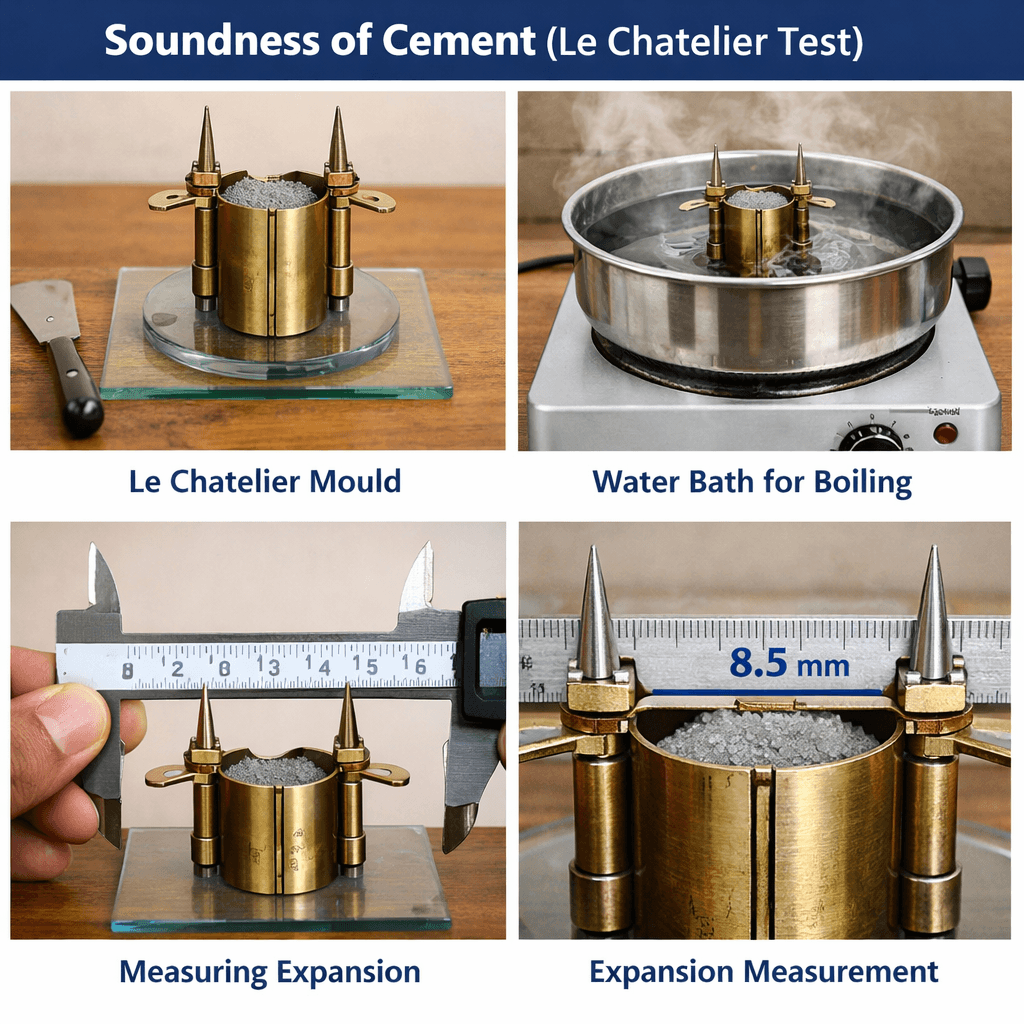
Soundness Test of Cement – Le Chatelier Method

Soundness Test of Cement – Le Chatelier Method Author: Kishor Kumar · Updated: February 2026 · Read time: ~8 minutes 1. Introduction The Soundness Test of Cement ensures that cement does not undergo excessive expansion after setting, which can cause cracks in concrete and structural failure. The Le Chatelier Method specifically measures expansion due to free lime (CaO) or magnesia content. 2. Purpose Check dimensional stability of cement Detect presence of free lime (CaO) or magnesia Prevent cracking in concrete structures Ensure compliance with IS 4031 Part 3 and MoRTH specifications 3. Applicable Standards IS 4031 (Part 3) – Soundness test of cement using Le Chatelier method IS 4031 (Part 4) – Standard consistency for paste MoRTH Specifications – Cement quality control 4. Apparatus Le Chatelier Mould (split ring, inner & outer arcs) Vernier Caliper – for measuring expansion Water Bath / Beaker – 27–30°C Glass Plate / Base Plate Mortar Preparation Tools (trowel, spatula) 5. Test Sample Preparation Cement paste is prepared using standard consistency water. Example ratio: 1 part cement : 0.78 parts water (by weight). Sample Preparation Example: For 100 g of cement: Water required = 100 × 0.78 = 78 g Mix cement and water to obtain a uniform paste for filling the Le Chatelier mould. 6. Test Procedure – Le Chatelier Method Preparation of Cement Paste Determine the standard consistency of cement using IS 4031 (Part 4). Mix cement and water (~1:0.78 by weight) to obtain uniform paste. Avoid lumps to ensure accurate test results. Filling the Le Chatelier Mould Clean mould thoroughly and lightly oil to prevent sticking. Fill mould carefully, avoiding air pockets. Tap gently or use spatula to compact paste evenly. Leveling the Paste Level top of paste to match upper rim of mould. Ensure flush surface to avoid erroneous readings. Immersion in Water Bath Place mould in water bath maintained at 27–30°C for 24 hours. Keep undisturbed and maintain constant temperature. Measurement of Expansion Remove mould carefully after 24 hours. Measure distance between indicator arms using vernier caliper. Take measurements to nearest 0.5 mm for precision. Calculation of Expansion Formula: Expansion (mm) = Final distance between arms – Original distance between arms Record mean of two measurements if multiple moulds are tested for accuracy. 7. Acceptance Criteria Maximum expansion for OPC: ≤ 0.8 mm (IS 4031 Part 3) Rapid Hardening Cement: slightly lower limits 8. Engineering Significance Prevents cracks in concrete due to excessive expansion Ensures dimensional stability of cement in structural and pavement applications Critical for highway pavements, bridges, and high-rise concrete structures 9. Common Mistakes Air bubbles while filling mould Incorrect water bath temperature Improper vernier caliper measurement Using non-standard consistency paste Ensure proper handling to avoid false readings; repeat test if inconsistent. 10. Frequently Asked Questions What is the purpose of the Le Chatelier test? It checks cement expansion due to free lime or magnesia, ensuring dimensional stability. Which IS code covers the test? IS 4031 (Part 3) What is the maximum allowable expansion? ≤ 0.8 mm for Ordinary Portland Cement (OPC) How is cement paste prepared? Using standard consistency water; example ratio: 1 part cement : 0.78 parts water by weight. What happens if expansion exceeds the limit? Excessive expansion indicates free lime; cement should be rejected or used with caution in structural work. 11. Conclusion The Soundness Test of Cement – Le Chatelier Method ensures cement stability, prevents cracks, and guarantees compliance with IS 4031 and MoRTH specifications. Always perform this test for critical concrete and pavement works. Written by: Kishor Kumar · Civil / Highway Engineer – QA/QC & Site Execution · Source: HighwayQualityTest.com 🧪 Complete Cement Laboratory Test Series IS 4031 IS 516 MoRTH NHAI QA/QC These laboratory tests are conducted sequentially for complete cement and concrete quality verification in highway, bridge, structure, and rigid pavement works as per IS 4031, IS 516, MoRTH Specifications, and NHAI Quality Assurance Protocols. 🔬 Fineness of Cement IS 4031 (Part 1) Sieve analysis and Blaine air permeability method for determining cement particle fineness. ⚙️ Standard Consistency IS 4031 (Part 4) Determination of optimum water percentage using Vicat apparatus. ⏱️ Initial Setting Time IS 4031 (Part 5) Measures the beginning of cement hardening using Vicat needle penetration. 🧱 Final Setting Time IS 4031 (Part 5) Determines the complete hardening stage of cement paste. 💪 Compressive Strength IS 4031 (Part 6) Mortar cube crushing strength evaluation at different curing ages. 🏗️ Concrete Cube Test IS 516 Concrete compressive strength testing for site quality control and mix validation. 📌 Quality Control Insight These tests must be conducted in proper sequence to establish correlation between cement fineness, water demand, setting characteristics, and strength development during highway, bridge, and structural concrete works—especially under NHAI, MoRTH, and independent third-party QA/QC audits. HIGHWAY QUALITY TEST Download Soundness of Cement Test Excel Format Prepare professional Soundness of Cement test reports in minutes using our ready-to-use Excel format with automatic calculations. Accurately determine the soundness of cement using the Le Chatelier Method and generate laboratory-ready reports while eliminating manual calculation errors. 💰 Only ₹99 One-Time Payment • Instant Access • Lifetime Access 🛒 Buy Soundness of Cement Excel Format ✔ Secure Payment   |   ✔ Instant Download   |   ✔ Editable Excel

Soundness Test of Cement – Le Chatelier Method Read More »

Cement

© 2026 HIGHWAY QUALITY TEST. All rights reserved.

WhatsAppNeed Help?
Scroll to Top