HIGHWAY QUALITY TEST

Precision Testing. Proven Quality. Safer Infrastructure.

Kishor Kumar

Embankment Construction Methodology | Highway Earthwork Guide

Embankment Construction Methodology with Quality Control | MoRTH Clause 305 Embankment Construction Methodology with Quality Control – MoRTH Clause 305 Scope of Work The work shall consist of construction of embankment with approved and specified materials obtained from approved borrow areas or suitable material obtained from roadway excavation and drain excavation and in accordance with clause 305 of MORTH specifications. Reference Standards MoRTH Specifications – Section 305 (5th Revision) IRC SP: 84 IS 2720 Series – Soil Testing Approved Project Drawings Manpower & Responsibilities Manpower & Responsibilities Construction Manager Engineer / Supervisor Land Surveyor Material Engineer Safety Supervisor Helpers Construction Manager He shall be overall responsible for the activity including: Planning and organizing resources required for execution in consultation with the Project Manager. Implementation of safety requirements during the work including utility services protection. Ensuring all relevant tests are conducted as per specification. Maintaining all QA/QC records as per contract requirements. Coordinating with the consultant engineer for obtaining necessary approvals for completed activities. Engineer / Supervisor Responsibilities include: Deployment of required resources at site as per planning. Execution of work as per approved drawings. Maintaining quality control as per specifications. Implementation of safety regulations at site. Obtaining approvals for completed works from consultant/authority. Land Surveyor Responsibilities include: Establishing reference points for alignment and levels. Ensuring correct setting out of works. Checking and recording levels of completed work. Coordinating with consultant staff for final approval of finished works. Material Engineer Responsibilities include: Implementation of quality procedures as per approved plan. Ensuring all materials meet specification requirements. Conducting required laboratory and field tests as per standards. Maintaining complete material testing records and reports. Safety Supervisor Responsibilities include: Ensuring safe execution of all site activities. Implementation of project safety plan and guidelines. Monitoring compliance of safety measures at site. Setting Out After completion of site clearance, the limits of embankment shall be marked by fixing pegs on both sides at regular intervals. The chainage boards and working bench mark shall be set outside the limits of construction areas. Material Selection & Borrow Area Testing Selection of Material and Borrow Areas Material The material used in embankment shall be soil, moorum, gravel, reclaimed material from pavement, fly ash, pond ash, a mixture of these or any other material approved by the AE. It shall be free of logs, stumps, roots, rubbish and any other material likely to deteriorate or affect the stability of the embankment. The material for embankment shall be obtained from the approved source with preference to the material becoming available from nearby roadway excavation or any other excavation under the contract. The material requirements shall be in accordance with Clause 305.2 of MORTH specifications. These materials shall be free from logs, stumps, roots, rubbish or any other ingredients likely to affect the stability of the embankment. The material that has LL less than 55%, PI less than 25%, and Free Swell Index less than 50% shall be used for embankment construction. The material which is having lab MDD 15.2 minimum as per IS: 2720 Part-8 shall be used in embankment filling. The sample from the borrow area shall be brought to the laboratory and tested for the above requirements. Clods and hard humps of earth will be broken to a maximum size of 75 mm for embankment. If the moisture content (NMC) is less than OMC, the water shall be added by sprinkling considering evaporation losses, so that at the time of compaction it is in the range of 1% above to 2% below the optimum moisture content. If NMC is more than OMC, the material can be allowed to dry by exposure to the sun. EMBANKMENT/STRUCTURE BACK FILLS The following type of material shall be considered un-suitable. Material from swamps, marshes and bogs. Peat, log, stump and perishable material. Soil classified as OL, OI, OH or Pt. in accordance with IS: 1498. Material susceptible to spontaneous combustion. Material in frozen condition. Clay having LL exceeding 70 and PI exceeding 45 for Embankment. Clay having LL exceeding 50 and PI exceeding 25 for Subgrade. Material with salts resulting in leaching in the embankment. Soils having free swelling index more than 50% shall not be used as filled material. Soil having acceptedbelow free swelling index (non-expensive soils) shall be used up to 500 mm below sub-grade/embankment top. Fill material having soluble Sulfate content exceeding 1.9 gm. of Sulfate per liter (As per BS: 1377 test 10) not to be deposited with 500 mm in contact with concrete structure or cement bound materials forming part of permanent work. Fill material having total Sulfate content exceeding 0.5% by mass. (Tested as per BS: 1377 test 9) shall not be deposited with 500 mm of metallic item forming part of Permanent Work. The maximum size of coarse material in earth mixture shall not exceed 75 mm for embankment fill and 50 mm for sub grade fill. Soil material shall satisfy density requirement as given in BELOW Density Requirements for Embankment & Subgrade Material Sl. No Type of Work Maximum Laboratory dry unit weight when tested as per IS: 2720 (Part 8) 1 Embankments up to 3.0 m high not subjected to extensive flooding. Not less than 15.2 KN/cum or 1.55 gm /cc. 2 Embankment exceeding 3.0 m ht. or Embankment of any height subject to long period of inundation. Not less than 16.0 KN/cum 1.631 gm/cc. or 1.6 gm/cc 3 Sub grade and earthen shoulder / backfill Not less than 17.5 KN/cum or 1.784 gm/cc Note: Materials used shall satisfy design CBR i.e. soaked CBR shall not be less than 12% and 10% as per design locations for Heavy weight fill material. This below is not applicable for light weight fill material. Compaction Requirement The Embankment /sub grade material shall be compacted in one or more layer as per contract. The compacted field density shall meet minimum density requirement as given in BELOW Compaction Requirements for Embankment & Sub grade Sl. No Type of work/material Relative Compaction % of max. Laboratories dry density as

Embankment Construction Methodology | Highway Earthwork Guide Read More »

Earthwork
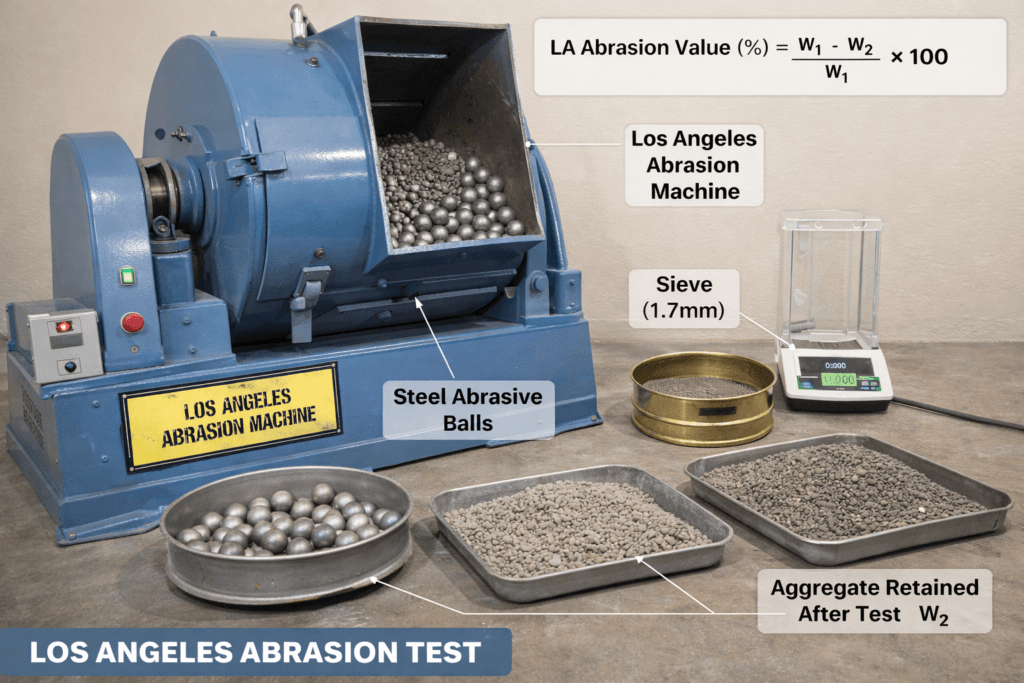
Los Angeles Abrasion Test Apparatus

Los Angeles Abrasion Test IS 2386 Part IV

Los Angeles Abrasion Test – Procedure, Calculation, Apparatus & Limits (IS 2386 Part IV) The Los Angeles Abrasion Test is one of the most important tests used to evaluate the toughness and abrasion resistance of coarse aggregates used in road construction and concrete works. This test determines how aggregates behave when subjected to wear, impact and grinding action. Aggregates with high abrasion resistance ensure longer pavement life, better durability and reduced maintenance costs. The test is conducted according to IS 2386 (Part IV) – Methods of Test for Aggregates and is also specified in MoRTH Specifications for Road and Bridge Works (5th Revision, 2013). Importance of Los Angeles Abrasion Test in Highway Engineering Aggregates are the primary load-bearing material in flexible pavements. When traffic loads move over pavement surfaces, aggregates are continuously subjected to: Abrasion due to tyre friction Impact from moving vehicles Grinding action between aggregate particles If aggregates are weak, they will break into smaller particles, causing: Pavement rutting Loss of surface texture Premature road failure The Los Angeles Abrasion Test helps engineers select durable aggregates suitable for highway construction. Objective of the Test The main objectives of the Los Angeles Abrasion Test are: To determine the abrasion resistance of aggregates To measure the toughness of aggregates To evaluate the quality of aggregates for road works To ensure aggregates meet MoRTH specifications Relevant Standards IS 2386 (Part IV) – 1963 Methods of test for aggregates for concrete. MoRTH Specifications (2013) Specifications for road and bridge works. ASTM C131 / ASTM C535 International standards for abrasion testing. Apparatus Required for Los Angeles Abrasion Test Los Angeles Abrasion Machine Hollow steel drum Internal diameter: 700 mm Length: 500 mm Rotational speed: 30–33 rpm Steel Abrasive Balls Diameter: 48 ± 2 mm Weight: 390 – 445 g each Hardness: 400 – 450 HB IS Standard Sieves Weighing Balance (accuracy 1 g) Drying Oven (105 – 110°C) Tray and sieve brush Sample Preparation Proper sample preparation is essential for accurate test results. The following steps should be followed: Collect representative aggregate samples. Wash aggregates to remove dust and impurities. Dry the aggregates in an oven at 105–110°C. Allow the sample to cool to room temperature. Weigh the required sample weight (usually 5000 g). Grading of Aggregates for the Test Grading Aggregate Size (mm) Sample Weight (g) No. of Revolutions Typical Use A 63 – 50 5000 500 Granular Sub Base B 50 – 40 5000 500 WMM Base C 40 – 25 5000 500 Dense Bituminous Macadam D 25 – 20 5000 500 Bituminous Macadam E 20 – 12.5 5000 1000 Bituminous Concrete Test Procedure PROCEDURE – LOS ANGELES ABRASION TEST Clean aggregates dried in an oven at 105–110°C shall be used for testing. The grading used in the test should be nearest to the grading to be used in the construction. Aggregates weighing 5 kg for grading A, B, C or D and 10 kg for grading E, F or G may be taken as test specimen and placed in the cylinder. Choose the abrasion charge depending on the grading of the aggregate and place in the cylinder of the machine. Fix the cover dust tight and rotate the machine at a speed of 30 to 33 revolutions per minute. The machine shall be rotated for 500 revolutions for grading A, B, C and D, and for grading E, F and G it shall be rotated for 1000 revolutions. After the desired number of revolutions, stop the machine and discharge the material from the machine taking care to take out entire stone dust. Using a sieve of size 1.70 mm IS Sieve, the material is first separated into two parts and the finer portion is taken out and sieved further on a 1.70 mm IS Sieve. The portion of material coarser than 1.70 mm size is washed and dried in an oven at 105–110°C to constant weight and weighed correct to one gram. Calculation of Los Angeles Abrasion Value The Los Angeles abrasion value is calculated using the following formula: Los Angeles Abrasion Value (%) = ((A − B) / A) × 100 Where: A = Original weight of sample (g) B = Weight retained on 1.70 mm sieve after test (g) Example Calculation Initial weight of sample = 5000 g Weight retained after test = 3600 g Abrasion Value = ((5000 − 3600) / 5000) × 100 Abrasion Value = 28% Permissible Limits as per MoRTH Layer Maximum LA Abrasion Value Granular Sub Base 45% Base Course 40% Bituminous Layers 35% Wearing Course 30% Advantages of the Test Simple and widely used method Provides reliable measure of aggregate toughness Essential for pavement design Helps maintain highway quality control Limitations of the Test Does not fully simulate field traffic conditions Results may vary for soft aggregates Not suitable for very small aggregates Frequently Asked Questions (FAQ) What is the Los Angeles Abrasion Test? It is a laboratory test used to determine the resistance of aggregates to abrasion and impact. What is the maximum permissible abrasion value? For wearing courses in highways, the maximum value is typically 30%. Which IS code specifies the test? The test is specified in IS 2386 (Part IV). What does a lower abrasion value indicate? Lower abrasion value means stronger and more durable aggregates. Related Aggregate Tests for Highway & Concrete Works Explore detailed test procedures, calculations and acceptance criteria as per IS, MoRTH & IRC specifications: ✅ Aggregate Impact Value (AIV) Test – Toughness of Aggregates ✅ Los Angeles Abrasion Test – Wear & Abrasion Resistance ✅ Aggregate Crushing Value (ACV) Test – Strength Evaluation ✅ Flakiness & Elongation Index Test – Shape Characteristics ✅ Water Absorption Test – Durability & Porosity Check 📌 Pro Tip: Use AIV, ACV, Los Angeles Abrasion, and Shape & Water Absorption Tests together to ensure aggregate suitability for bituminous layers & cement concrete as per MoRTH Section 400 & 500. HIGHWAY QUALITY TEST Download Los Angeles Abrasion Test Excel Format Prepare professional Los Angeles Abrasion (LAA) test reports in

Los Angeles Abrasion Test IS 2386 Part IV Read More »

Aggregate
bitumen penetration test

Penetration Test

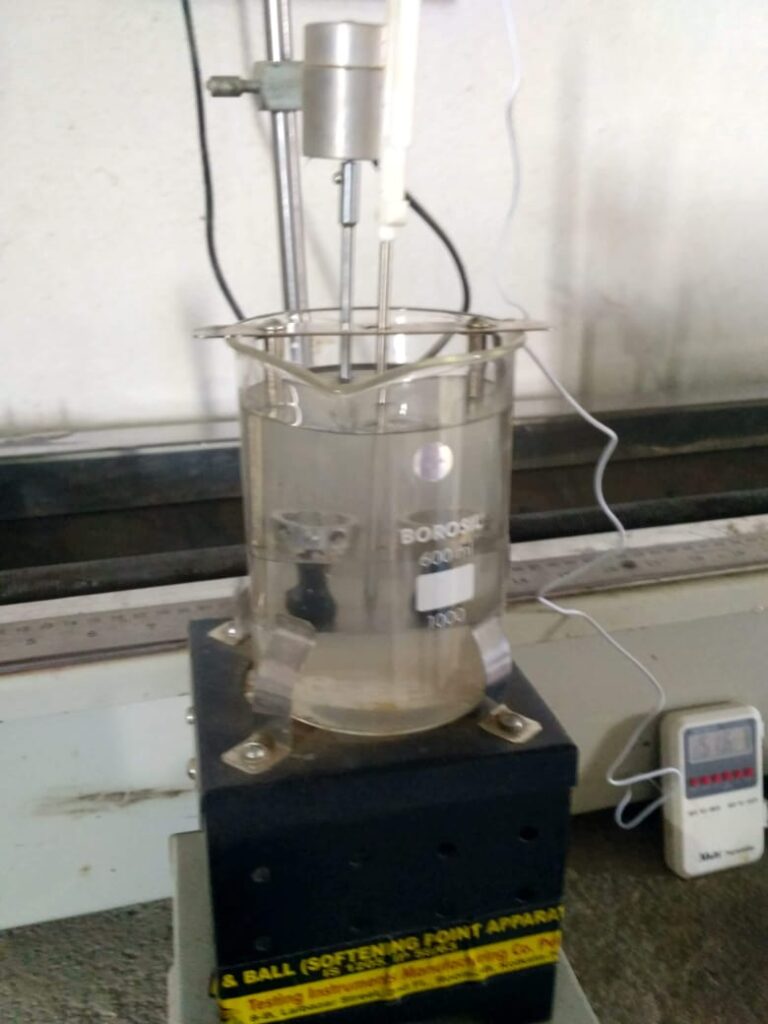
Bitumen Penetration Test – Procedure, Apparatus, Calculation & IS 1203 Limits 1. Introduction The Bitumen Penetration Test determines the hardness or softness of bitumen by measuring the depth a standard needle penetrates into the sample under specified load, time, and temperature conditions. This penetration test of bitumen is widely used in highway laboratories to determine bitumen consistency and pavement performance. 2. Definition and Standard Reference As per IS:1203 (1978) and ASTM D5, the Penetration Test determines the depth (in tenths of a millimetre) that a standard needle penetrates vertically into a bitumen sample under specific conditions of load, time, and temperature. The value obtained is known as the penetration value of the bitumen. 3. Importance of Bitumen Penetration Grade The penetration grade indicates the hardness or softness of bitumen. A higher penetration value means softer bitumen suitable for cold climates, while lower values indicate harder bitumen ideal for hot regions. Common penetration grades used in India are 30/40, 60/70, and 80/100. 4. Climate-Based Selection of Bitumen Grade Selection of bitumen grade should match the climatic conditions and traffic load. Hard grades such as VG-40 are recommended for high-temperature zones and heavy traffic, while softer grades like VG-10 are preferred in colder regions. 5. Penetration Test Apparatus for Bitumen Penetrometer with standard needle Water bath maintained at 25°C ± 0.1°C Sample container (metal cup) Thermometer (accurate to 0.1°C) Stopwatch 6. Sample Preparation Procedure Heat the bitumen sample to a pouring consistency (not exceeding 90°C). Pour the sample into a metal cup to a depth of about 35 mm and allow it to cool for 1 to 1.5 hours at room temperature. Place the sample in a water bath maintained at 25°C for at least 1 hour before testing. 7. Bitumen Penetration Test Procedure (IS 1203) Place the sample under the penetrometer needle. Ensure the needle just touches the surface of the bitumen. Apply a load of 100 g for 5 seconds. Note the penetration value in tenths of a millimetre (dmm). Repeat the test at three different points not less than 10 mm apart. Calculate the average value as the final result. 8. Calculation of Penetration Value Penetration Value (dmm) = Average of three readings Example: (67 + 68 + 69) / 3 = 68 dmm 9. Importance of the Heating Process Heating bitumen must be carefully controlled to prevent oxidation and hardening. Excessive heating alters bitumen’s chemical properties, reducing penetration value and flexibility. Purpose of Heating To bring the bitumen to a fluid state for easy pouring and uniform temperature distribution without causing aging or volatility loss. The 90°C Rule – Preventing Age Hardening Bitumen should never be heated beyond 90°C during sample preparation. Higher temperatures accelerate oxidation and make the bitumen brittle, leading to premature pavement cracking. Pro Tips Always stir the sample gently while heating. Use a controlled water bath for uniform test temperature. Record temperature before and after the test to ensure consistency. Penetration Grades of Bitumen Bitumen Grade Penetration Range (dmm) Typical Use 30/40 30–40 Heavy traffic roads 60/70 60–70 Highway construction 80/100 80–100 Cold climate regions 10. Importance of Bitumen Hardness Test in Road Construction This test ensures that the bitumen used in road construction meets design requirements for flexibility, binding strength, and temperature susceptibility. a. Quality Control Helps verify that the bitumen supplied on site matches the approved specification before mixing. b. Performance Prediction Indicates how bitumen will behave under traffic and climatic stress conditions. c. Consistency Indicator Shows the relative hardness or softness of bitumen, which influences pavement flexibility. d. Prevents Premature Failures Using bitumen of correct penetration value minimizes cracking, rutting, and bleeding in pavements. 11. Final Thoughts The Bitumen Penetration Test is an essential quality control measure that defines the usability and performance of paving bitumen. Engineers use this penetration test of bitumen to select the correct grade for durable and flexible road pavements. By maintaining the correct penetration value, highway engineers can ensure durable and flexible pavements suited to Indian climatic conditions. ✅ Expert Tip Always cross-check penetration test results with the Softening Point Test of Bitumen (IS 1205) to understand bitumen behaviour under temperature variations. Frequently Asked Questions What is IS 1203 penetration test? The IS 1203 penetration test is a laboratory method used to determine the hardness or softness of bitumen by measuring the depth a standard needle penetrates under a load of 100 g for 5 seconds at 25°C. The penetration value indicates the hardness or softness of bitumen measured as the depth a standard needle penetrates under specified conditions. What is the standard load used in penetration test? The standard load used in the penetration test is 100 grams applied for 5 seconds. What is IS 1203 penetration test? The penetration test of bitumen is conducted as per IS 1203. Related Bitumen and Pavement Tests In highway quality control laboratories, the penetration test is usually conducted along with other important bitumen and pavement tests to evaluate the overall performance of road materials. Related Bitumen & Pavement Tests Softening Point Test of Bitumen (IS 1205) Marshall Stability & Flow Test – Procedure & MoRTH Limits Ductility Test of Bitumen Bitumen Viscosity Test (IS 1206) California Bearing Ratio (CBR) Test Flakiness Index Test of Aggregates Modified Proctor Compaction Test Consistency of Cement Test

Penetration Test Read More »

Bitumen

© 2026 HIGHWAY QUALITY TEST. All rights reserved.

WhatsAppNeed Help?
Scroll to Top