Table of Contents
ToggleThis methodology covers the construction of the Wet Mix Macadam (WMM) layer over an approved Granular Sub-Base (GSB) in accordance with MoRTH Specifications Clause 406 (5th Revision). The work includes production, transportation, laying, moisture conditioning, compaction, quality control testing, inspection, and approval of the WMM layer.
The WMM shall consist of clean, hard, durable, crushed and graded aggregates, uniformly mixed with water in an approved Wet Mix Plant and laid over the prepared GSB using a sensor paver or approved mechanical equipment. The completed layer shall conform to the specified line, level, longitudinal profile, cross fall, thickness, width, density, and surface regularity as shown in the approved drawings and contract specifications.
The objective is to construct a dense, stable, well-drained pavement layer capable of providing a strong foundation for the subsequent bituminous pavement while ensuring compliance with all quality, safety, and environmental requirements.
The construction of the Wet Mix Macadam (WMM) layer shall comply with the latest editions of the following standards, specifications, and approved project documents:
Wet Mix Macadam (WMM) is a mechanically produced, well-graded granular base course consisting of crushed aggregates and water mixed in a Wet Mix Plant (WMP) and laid over an approved Granular Sub-Base (GSB). The WMM layer forms a strong, stable, and well-drained foundation for the bituminous pavement. Proper control of aggregate gradation, moisture content, layer thickness, compaction, and quality testing is essential to achieve the specified pavement performance and durability.
This methodology describes the systematic procedure for construction of the WMM layer, including pre-construction activities, material approval, plant production, transportation, laying, compaction, quality control, inspection, and final acceptance in accordance with MoRTH Specifications Clause 406.
Prior to commencement of Wet Mix Macadam (WMM) works, all engineering approvals, construction resources, plant and machinery, survey arrangements, and quality control procedures shall be verified to ensure safe, efficient, and uninterrupted execution of the work. No WMM activity shall commence until all prerequisite activities have been completed and approved by the Engineer.
The Project Manager, Construction Team, QA/QC Engineer, Survey Team, and Plant In-charge shall jointly review all relevant project documents to ensure that the construction methodology complies with the contract requirements.
The following documents shall be available, reviewed, and approved before commencement of WMM construction:
Before laying the WMM layer, the underlying GSB shall be inspected and approved to ensure that it satisfies all specified requirements.
The following shall be verified:
All construction equipment, laboratory instruments, manpower, and safety arrangements shall be mobilized before commencement of WMM works to ensure continuous production and laying operations.
The following equipment shall be available in good working condition:
Adequate trained personnel shall be deployed for execution and quality control of WMM works.
A joint inspection shall be conducted by the Contractor, Consultant, and Engineer before commencement of WMM laying. Construction shall begin only after obtaining the necessary inspection clearance and approval.
Adequate qualified and experienced manpower shall be deployed throughout the construction of the Wet Mix Macadam (WMM) layer to ensure compliance with project specifications, quality standards, safety requirements, and construction schedules. Each member of the project team shall perform the responsibilities assigned to them for effective execution, inspection, testing, and quality assurance.
| Personnel | Key Responsibilities |
|---|---|
| Project / Construction Manager | Overall planning, scheduling, resource allocation, coordination with the Client, Consultant and subcontractors, monitoring construction progress, ensuring compliance with contract specifications, quality, safety, and timely completion of WMM works. |
| Site Engineer | Supervise daily WMM construction activities, verify setting out, monitor laying and compaction operations, ensure compliance with approved drawings and Method Statement, maintain site records, and coordinate inspections. |
| Material Engineer / QA-QC Engineer | Approve construction materials, monitor WMM plant production, verify aggregate gradation and moisture content, witness laboratory and field tests, review test results, maintain QA/QC documentation, and ensure compliance with MoRTH specifications and approved JMF. |
| Survey Engineer | Carry out setting out, establish centre line, reference pegs, levels, offsets, cross fall, finished surface levels, and verify layer thickness and alignment before and after construction. |
| Laboratory Technician | Perform laboratory and field quality control tests including gradation analysis, moisture content, Field Density Test (FDT), calibration checks, sample collection, and preparation of test reports. |
| Plant In-charge / WMM Plant Operator | Operate and monitor the Wet Mix Macadam Plant, maintain correct aggregate proportioning, water dosage, production rate, equipment calibration, and ensure continuous supply of homogeneous WMM mix. |
| Paver / Motor Grader Operator | Spread the WMM mix uniformly to the specified width, line, level, cross fall, and loose thickness without segregation or surface irregularities. |
| Roller Operator | Carry out compaction using the approved rolling pattern, achieve the specified density, monitor rolling sequence, and prevent displacement or segregation of the WMM layer. |
| Safety Officer / Safety Supervisor | Ensure implementation of the approved HSE Plan, conduct toolbox talks, monitor safe working practices, inspect equipment, enforce PPE compliance, traffic management, and emergency preparedness. |
| Skilled & Unskilled Workers | Assist in material handling, site preparation, cleaning, edge dressing, traffic control, equipment support, housekeeping, and other construction activities under the supervision of the Site Engineer. |
Construction of the Wet Mix Macadam (WMM) layer shall commence only after the underlying Granular Sub-Base (GSB) layer has been inspected, tested, and approved by the Engineer. The GSB layer shall comply with the specified requirements for alignment, levels, width, cross fall, thickness, density, and surface finish as per MoRTH Clause 401.
Before commencement of WMM laying, the following shall be verified:
A joint inspection shall be carried out by the Contractor, Consultant and Engineer before commencement of WMM works. Construction shall start only after obtaining approval of the prepared GSB surface.
Survey setting out shall be carried out using a Total Station or other approved surveying equipment to establish the required alignment, pavement width, levels, cross fall and layer thickness in accordance with the approved drawings.
The following parameters shall be checked before laying:
Wet Mix Macadam shall be produced in an approved Wet Mix Plant by proportioning and mixing graded aggregates with water in accordance with the approved Job Mix Formula (JMF). The plant shall produce a uniform, homogeneous mix having moisture content close to the Optimum Moisture Content (OMC).
Only approved materials conforming to MoRTH Clause 406 and the approved JMF shall be used for production.
During production, the following parameters shall be continuously monitored:
The Wet Mix Plant shall be calibrated before commencement of production and thereafter at regular intervals or whenever there is any change in material source, aggregate gradation, or plant components. Calibration records shall be maintained and approved by the Engineer.
The WMM mix shall be transported from the Wet Mix Plant to the laying location using clean tipper trucks. Transportation shall be planned to ensure continuous paving operations without interruption and to minimise moisture loss before compaction.
Before laying WMM, the approved GSB surface shall be cleaned and inspected. Remove all loose material, dust, debris, and organic matter. Light water sprinkling may be carried out, if required, to maintain proper surface moisture.
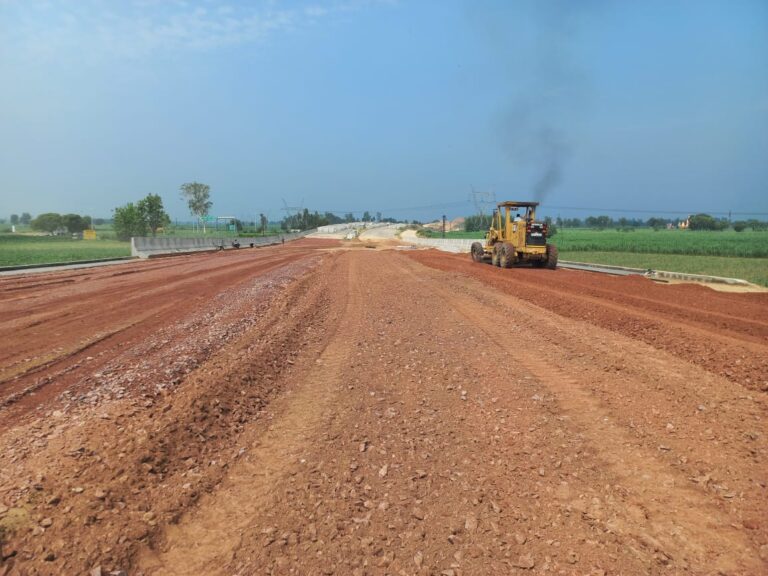
The WMM mix shall be transported from the plant and spread uniformly using a Sensor Paver or Motor Grader to the required width, thickness, line, level, and cross fall.
Before compaction, verify line, level, width, thickness, and cross fall using approved survey instruments. Any deviations shall be corrected before rolling.
Maintain the moisture content of the WMM mix at OMC ±1% throughout laying and compaction.
Compaction shall start immediately after spreading and moisture adjustment using a vibratory roller to achieve the specified density.
Compaction shall commence immediately after spreading and moisture adjustment to achieve the specified density before any significant moisture loss occurs.
| Stage | Equipment | Purpose |
|---|---|---|
| Initial Rolling | Static Roller | Seat and stabilize the layer |
| Intermediate Rolling | Vibratory Roller (80–100 kN) | Achieve required density |
| Final Rolling | Static Roller / PTR | Provide smooth surface finish |
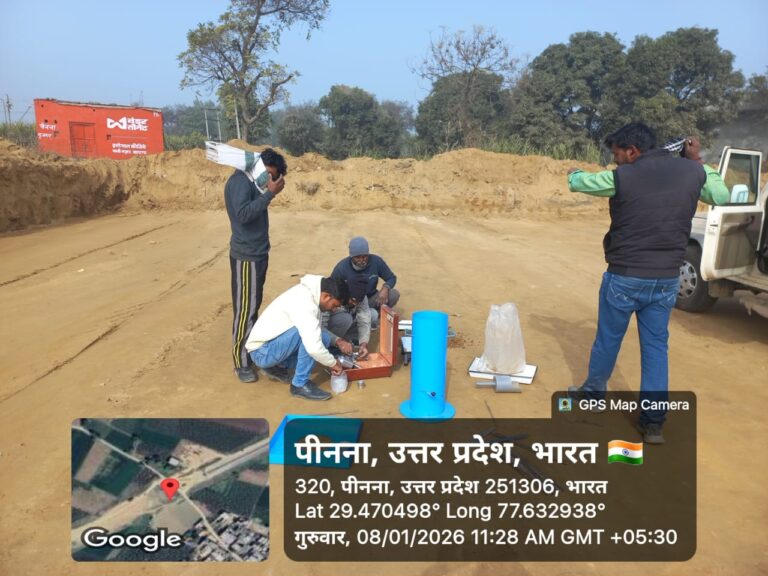
Field density testing shall be carried out after compaction to verify that the WMM layer complies with the specified density requirements.
Continuous quality control inspections and testing shall be carried out throughout the construction process to ensure compliance with MoRTH specifications and approved project requirements.
| Parameter | Purpose |
|---|---|
| Gradation Test | Verification of approved Job Mix Formula |
| Moisture Content | Verification of OMC compliance |
| Field Density Test | Verification of compaction requirements |
| Thickness Check | Verification of layer thickness |
| Surface Regularity | Verification using 3 m straight edge |
| Level Survey | Verification of levels and cross fall |
Testing frequency shall be as specified in MoRTH specifications, Quality Assurance Plan (QAP), and project requirements.
| Layer | Inspection Stage | Test / Parameter | Standard | Frequency | Acceptance Criteria | ||||||||||||||||
|---|---|---|---|---|---|---|---|---|---|---|---|---|---|---|---|---|---|---|---|---|---|
| Wet Mix Macadam (WMM) / Cement Treated Base (CTB) | Inspection at Source | Aggregate Impact Value | IS: 2386 (Part 4) | 1 Test / 1000 m³ | 30% (Max) | ||||||||||||||||
| Combined Flakiness & Elongation Index | IS: 2386 (Part 1) | 1 Test / 500 m³ | 35% (Max) | ||||||||||||||||||
| Water Absorption Value | IS: 2386 (Part 3) | As & when Required | 2% (Max) | ||||||||||||||||||
| Soundness Test (If water absorption value more than 2%) | IS: 2386 (Part 5) | As & when Required |
12% max with Sodium Sulphate 18% max with Magnesium Sulphate | ||||||||||||||||||
| Gradation | IS: 2386 (Part 1) | 1 Test / 200 m³ |
| ||||||||||||||||||
| Plasticity Index | IS: 2720 (Part 5) | 1 Test / 200 m³ | 6% (Max) | ||||||||||||||||||
| Abrasion Value | IS: 2386 (Part 4) | As & when Required | 40% (Max) | ||||||||||||||||||
| % Age of Fractured Face | IS: 2386 (Part 1) | As & when Required | 90% material retained on 4.75 mm sieve shall have at least 2 fractured faces | ||||||||||||||||||
| Modified Proctor | IS: 2720 (Part 8) | Every Month | As per MoRTH Specification | ||||||||||||||||||
| In-process Inspection | Control of Compaction (Field Density) – Sand Replacement Method | IS: 2720 (Part 28) |
0 – 1000 m² = 1 Set 1 Set = 3 Tests | 98% (Min.) | |||||||||||||||||
| Control of Compaction (Field Density) – Nuclear Density Gauge Method | AASHTO T310 |
1 – 1000 m² = 2 Sets 1 Set = 3 Tests | 98% (Min.) | ||||||||||||||||||
| Control of Compaction (Field Density) | IS: 2720 (Part 28) | Each & every layer | As per MoRTH 5th Rev. Clause 903.2.2 | ||||||||||||||||||
| Acceptance Criteria | Tolerance in Surface Level | Standard Survey Practice | As per MoRTH Specification | Machine Laid ±10 mm | |||||||||||||||||
| Surface Regularity | IRC: SP:16 | As & when Required | 8 mm | ||||||||||||||||||
| Strength of Concrete | IRC: 37-2012 | Minimum 3 Samples for Each Day Work | 4.5 – 7.0 MPa at 7 Days |
| S.No | Activity | Inspection | Testing | Remarks |
|---|---|---|---|---|
| 1 | GSB Top Approval | Yes | Yes | Joint level & density check |
| 2 | Spreading | Yes | - | Method control |
| 3 | Final Layer | Yes | Yes | Joint survey record |
| 4 | Density Check | Yes | Yes | After compaction |
| Defect | Rectification |
|---|---|
| Segregation | Remove affected material, replace with approved WMM mix, recompact and retest. |
| Low Density | Scarify the area, adjust moisture to OMC, recompact and conduct FDT. |
| Surface Undulations | Regrade, compact and verify surface regularity. |
| Thickness Deficiency | Add approved WMM material, regrade, compact and recheck thickness. |
After completion of compaction, the WMM layer shall be inspected to verify compliance with approved drawings and specifications.
The completed WMM layer shall be submitted for approval along with the following records:
Approval from the Engineer/Consultant shall be obtained before application of the Prime Coat.
GSB Approval → Setting Out → Plant Calibration → WMM Production → Transportation → Spreading → Level Check → Moisture Control → Compaction → Field Density Test → Final Survey → Layer Approval → Prime Coat
Standard construction methodologies for highway works as per MoRTH 5th Revision and IRC Specifications.
Engineering Precision. Digital Quality. Highway Excellence.
© 2026 HIGHWAY QUALITY TEST. All rights reserved.