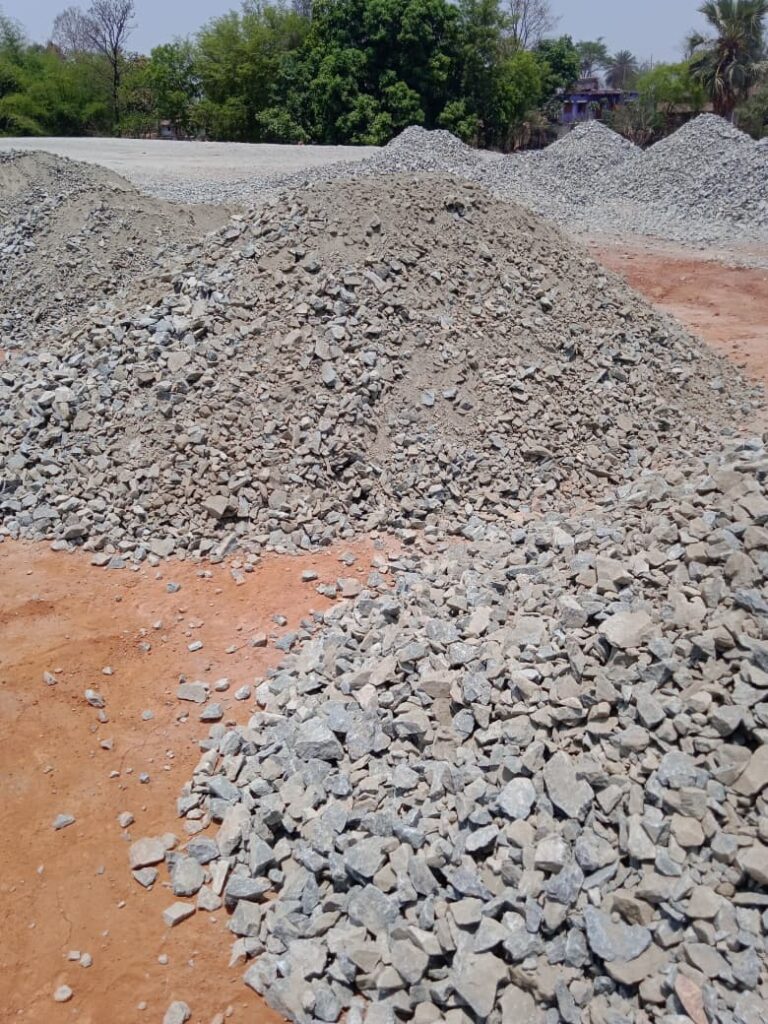
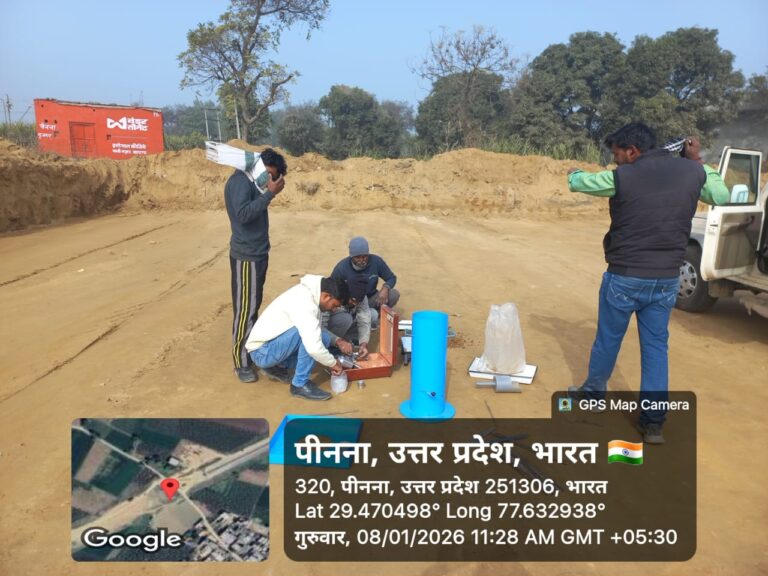
Granular Sub-Base (GSB) is a critical pavement layer constructed above the prepared subgrade to provide structural support, facilitate drainage, and distribute traffic loads to the underlying layers. The construction of GSB shall be carried out in accordance with MoRTH Clause 401, approved drawings, specifications, and project quality requirements.
Prior to commencement of GSB works, all technical approvals, resources, equipment, and quality control arrangements shall be verified to ensure smooth execution of the activity.
The following documents shall be reviewed and approved before starting construction:
Adequate manpower, equipment, materials, and testing resources shall be arranged before commencement of work.
The following equipment and testing instruments shall be available for construction and quality control activities:
Adequate manpower shall be deployed to ensure the successful execution, quality control, and safety of GSB construction activities. The key personnel and their responsibilities are summarized below.
| Personnel | Responsibilities |
|---|---|
| Construction Manager | Overall planning, execution, coordination, resource management, quality compliance, and liaison with the Client and Consultant. |
| Engineer / Supervisor | Day-to-day supervision of construction activities, deployment of resources, quality monitoring, and coordination of inspections. |
| Land Surveyor | Establishment of centerline, reference points, level controls, measurement records, and verification of alignment and levels. |
| Material Engineer | Implementation of QA/QC procedures, material approvals, laboratory and field testing, and maintenance of quality records. |
| Safety Supervisor | Monitoring compliance with HSE requirements, conducting safety inspections, hazard identification, and enforcement of PPE usage. |
| Skilled & Unskilled Helpers | Assistance in material handling, site housekeeping, equipment support, and general construction activities. |
Construction of the Granular Sub-Base (GSB) layer shall commence only after the prepared subgrade has been inspected, tested, and formally approved by the Engineer. The subgrade shall conform to the requirements of the approved drawings, technical specifications, and relevant provisions of the MoRTH Specifications.
Before permitting the placement of GSB material, the following quality control checks shall be carried out to ensure that the subgrade is suitable for supporting the overlying pavement layers.
A joint inspection of the completed subgrade shall be carried out by the Contractor, Independent Engineer/Consultant, and Client. GSB laying shall commence only after obtaining formal approval through the Inspection Request (IR) and ensuring that all quality records, field test reports, and survey checks are satisfactory.
After obtaining approval of the prepared subgrade, setting out shall be carried out to establish the exact alignment, width, levels, and cross fall of the Granular Sub-Base (GSB) layer. Survey work shall be performed using a Total Station, Auto Level, or other approved surveying instruments by qualified survey personnel.
Accurate setting out is essential to ensure that the GSB layer is constructed in accordance with the approved drawings and specified geometric tolerances.
All survey records, setting-out calculations, and level sheets shall be verified by the Survey Engineer and approved by the Engineer before commencement of GSB spreading. Any discrepancies in alignment or levels shall be corrected prior to material placement.
The Granular Sub-Base (GSB) material shall be produced from an approved quarry or crushing plant using naturally occurring gravel, crushed stone, crushed gravel, sand, or a combination of approved granular materials conforming to MoRTH Specifications (Section 400).
Production shall be carried out under controlled conditions to ensure that the material consistently satisfies the specified grading, strength, durability, and cleanliness requirements before dispatch to the construction site.
Routine laboratory and field quality control tests, including grading, Atterberg Limits (where applicable), Aggregate Impact Value, Los Angeles Abrasion Value, Water Absorption, Soaked 10% Fines Value, and other specified tests, shall be carried out in accordance with the approved Quality Assurance Plan (QAP). Details of the testing frequency are provided in Section 9 – Quality Control Tests.
Before spreading and compaction, the moisture content of the GSB material shall be adjusted to achieve the Optimum Moisture Content (OMC) determined from the laboratory compaction test. Proper moisture conditioning is essential for achieving the specified field density and ensuring uniform compaction.
The target moisture content during field compaction shall generally be maintained within OMC ± 2%, unless otherwise specified in the Contract or approved by the Engineer.
Compaction shall commence only after confirming that the field moisture content is within the specified range. Excessively dry or wet material may result in inadequate density, loss of stability, and premature pavement distress.
After obtaining laboratory approval, the Granular Sub-Base (GSB) material shall be transported from the approved quarry or crushing plant to the construction site using clean and suitable tipper trucks. Transportation shall be carried out in a manner that preserves the grading, moisture content, and overall quality of the material until it reaches the laying location.
The Contractor shall ensure that transportation operations are properly planned to maintain a continuous supply of material and avoid delays during spreading and compaction.
The Site Engineer shall verify that each load of GSB material originates from the approved source, is free from contamination and segregation, and possesses adequate moisture for placement. Any material found to be contaminated, segregated, or outside the specified moisture range shall be rejected or reconditioned before use.
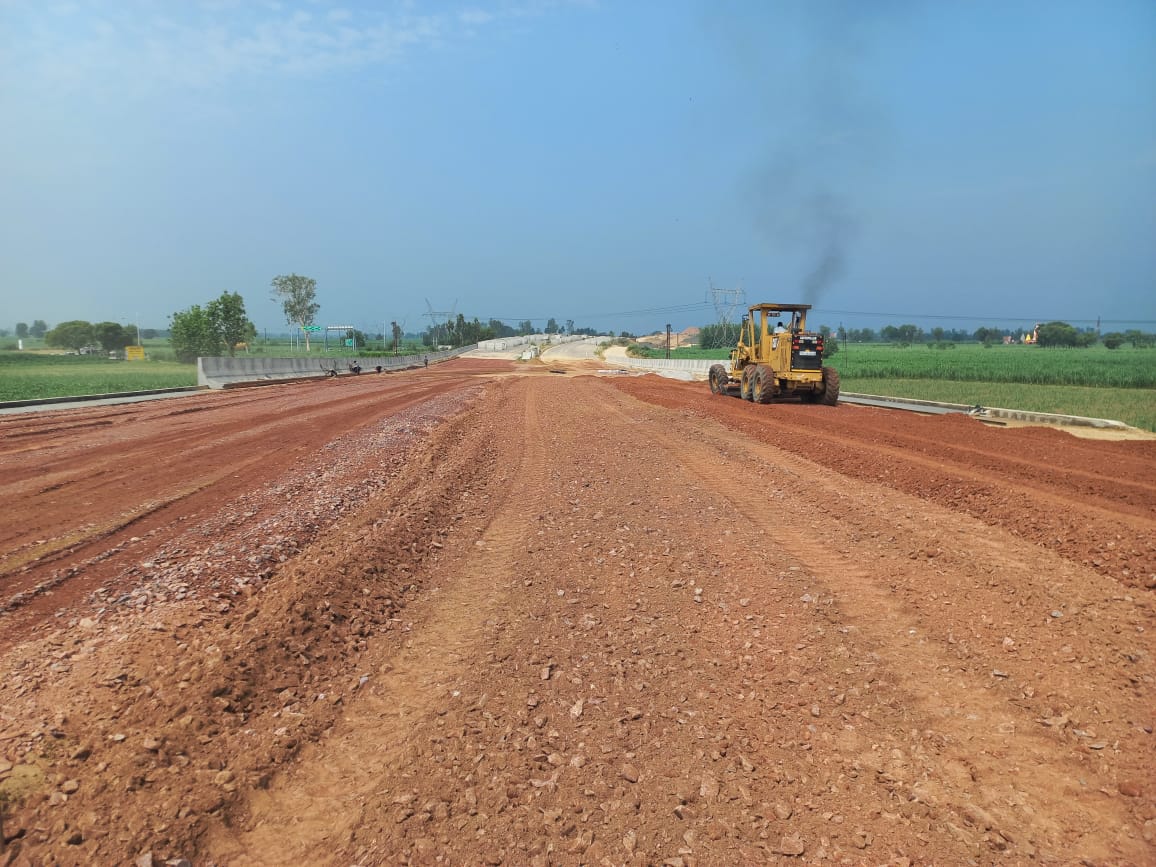
After transportation to the work site, the approved Granular Sub-Base (GSB) material shall be deposited in a controlled manner and spread uniformly over the prepared subgrade using a Motor Grader or other approved spreading equipment. The spreading operation shall ensure that the material is evenly distributed over the entire width of the carriageway without causing segregation of coarse and fine particles.
The thickness of the loose layer shall be carefully controlled by considering the anticipated compaction factor, so that the specified compacted thickness is achieved after rolling. Depending on the project specifications and compaction characteristics of the material, the GSB may be constructed in one or more layers.
During spreading, continuous checks shall be carried out to ensure compliance with the approved drawings, line, level, and cross fall.
The Site Engineer shall verify the loose layer thickness, carriageway width, line, level, and cross fall at regular intervals before rolling commences. Any deficiencies in thickness, segregation, or surface profile shall be corrected immediately. Compaction shall not begin until the spread layer has been inspected and approved by the Engineer.
Avoid dumping large heaps of GSB material directly onto the prepared subgrade. Material should be discharged in a controlled manner and spread progressively using the motor grader. This practice minimizes segregation, ensures a uniform layer thickness, and improves the quality of the finished GSB layer.
Immediately after spreading and final level correction, the Granular Sub-Base (GSB) layer shall be compacted using approved compaction equipment to achieve the specified density, strength, and stability. Compaction shall commence only after confirming that the moisture content of the material is within the specified range and that the spread layer has been inspected and approved by the Engineer.
Rolling shall be carried out using a suitable vibratory roller in accordance with the approved rolling pattern. The objective is to obtain a dense, uniform, and stable layer without causing segregation, displacement, rutting, or crushing of aggregate particles.
Unless otherwise specified in the Contract, the compacted GSB layer shall achieve a minimum 98% of the Maximum Dry Density (MDD) determined in accordance with IS:2720 (Part 8) or other approved laboratory compaction method.
A systematic rolling pattern shall be followed to achieve uniform compaction over the entire pavement width while maintaining the required line, level, and cross fall. The rolling sequence may be finalized after establishing a trial stretch and approval by the Engineer.
| Equipment | Purpose |
|---|---|
| Vibratory Roller (80–100 kN or approved) | Main compaction of GSB layer |
| Static Roller (where required) | Initial seating and finishing passes |
| Plate Compactor / Walk-behind Roller | Compaction near edges, structures, and inaccessible areas |
The approved rolling pattern shall be maintained throughout construction. The number of roller passes established during the approved trial stretch shall be adopted unless revised with the Engineer's approval.
Maintaining the correct moisture content during compaction is essential for achieving the specified field density and ensuring long-term pavement performance. Both insufficient and excessive moisture adversely affect the compaction characteristics of GSB material.
The field moisture content shall generally be maintained within Optimum Moisture Content (OMC) ± 2%, as determined from the laboratory compaction test.
Proper moisture control significantly reduces the number of roller passes required to achieve the specified density, improves layer stability, minimizes aggregate crushing, and enhances the overall quality and durability of the pavement foundation.
Quality Control (QC) activities shall be carried out throughout the construction of the Granular Sub-Base (GSB) layer to ensure compliance with the approved drawings, MoRTH Specifications, Quality Assurance Plan (QAP), and Inspection & Test Plan (ITP). All laboratory and field tests shall be performed using calibrated equipment by qualified personnel, and the results shall be documented for approval by the Engineer.
The following field and laboratory tests shall be carried out during GSB construction to verify material quality and compaction.
| Test | Purpose |
|---|---|
| Field Density Test (Sand Replacement / Nuclear Density Gauge) | To verify achievement of specified field density. |
| Moisture Content Test | To ensure compaction is carried out within OMC ± 2%. |
| Gradation Analysis | To confirm compliance with MoRTH grading requirements. |
| Thickness Measurement | To verify compliance with the specified compacted layer thickness. |
| Line, Level & Cross Fall | To verify conformity with approved drawings. |
All test reports shall be reviewed by the QA/QC Engineer before offering the completed GSB layer for inspection. Any non-conforming results shall be rectified and retested prior to proceeding with the next pavement layer.
After completion of compaction, the finished GSB layer shall be inspected to ensure compliance with the approved drawings, project specifications, and MoRTH requirements before commencement of the subsequent pavement layer.
Any defective portion shall be scarified to the required depth, replaced or corrected using approved GSB material, regraded, moisture-conditioned, and recompacted until all specification requirements are satisfied.
The completed GSB layer shall be offered for joint inspection by the Contractor, Consultant, and Engineer. Construction of the subsequent pavement layer shall commence only after obtaining written approval through the Inspection Request (IR).
Any deficiencies observed during inspection, quality control testing, or construction shall be rectified immediately before proceeding with subsequent pavement layers.
| Defect | Corrective Action |
|---|---|
| Low Density | Scarify, adjust moisture to OMC, and recompact until the specified density is achieved. |
| Segregation | Remove segregated material, replace with approved GSB material, regrade, and recompact. |
| Insufficient Thickness | Add approved material, regrade, and compact to the specified thickness. |
| Excess Thickness | Trim excess material, restore line and cross fall, and recompact. |
| Improper Cross Fall | Scarify the affected area, regrade to the correct profile, and recompact. |
Upon completion of the GSB layer, a final survey shall be conducted to verify compliance with the approved drawings and specified construction tolerances.
| Inspection Item | Acceptance Requirement |
|---|---|
| Finished Level | Within contract tolerance (typically ±20 mm or as specified). |
| Layer Thickness | Within specified tolerance. |
| Carriageway Width | As per approved drawings. |
| Cross Fall/Camber | Within specified tolerance. |
| Surface Regularity | Smooth, stable, and free from depressions or undulations. |
Before commencing the next pavement layer, the following quality records shall be submitted to the Engineer for review and approval.
The following sequence is typically adopted during construction of the Granular Sub-Base (GSB) layer on highway projects.
The quality and performance of the Granular Sub-Base (GSB) layer largely depend upon the engineering properties of the aggregates used. Therefore, all materials proposed for use in the works shall be sampled, tested, and approved before transportation to the construction site.
The material shall satisfy the minimum physical and engineering property requirements specified below:
| Property | Specified Requirement |
|---|---|
| California Bearing Ratio (CBR), Soaked | ≥ 30% |
| Aggregate Impact Value (AIV) | ≤ 40% |
| Liquid Limit (LL) | ≤ 25% |
| Plasticity Index (PI) | ≤ 6% |
| 10% Fines Value (Soaked) | ≥ 50 kN |
Materials failing to meet the above requirements shall be rejected and removed from the works.
The aggregate grading shall conform to the requirements of MoRTH Table 400-1. The selected grading shall be based on the approved mix design and project requirements. Proper gradation is essential to achieve adequate compaction, stability, load distribution, and drainage characteristics within the GSB layer.
| Sieve Size | Gr-I | Gr-II | Gr-III | Gr-IV | Gr-V | Gr-VI |
|---|---|---|---|---|---|---|
| 75 mm | 100 | - | 100 | - | 100 | - |
| 53 mm | 80–100 | 100 | - | 100 | 80–100 | 100 |
| 26.5 mm | 55–90 | 70–100 | 55–75 | 50–80 | 55–90 | 75–100 |
| 4.75 mm | 25–55 | 40–65 | 10–30 | 15–35 | 25–50 | 30–55 |
| 0.075 mm | <5 | <5 | <5 | <5 | - | 0–3 |
During production, regular sieve analysis shall be carried out to ensure that the material remains within the approved grading envelope. Any deviation from the approved gradation shall be corrected before dispatching the material to the site.
Acceptance of the GSB layer shall be based on compliance with specified requirements for material quality, gradation, moisture content, density, thickness, levels, width, and cross fall. The compacted layer shall achieve not less than 98% MDD unless otherwise specified in the Contract.
Following successful inspection and approval by the Engineer/Consultant, permission shall be granted to proceed with the construction of the overlying pavement layer.
| Test / Parameter | Standard | Frequency | Acceptance Criteria |
|---|---|---|---|
| Gradation | IS: 2720 (Part 4) | 1 Test / 400 m³ | As per MoRTH Table 400-1 (5th Revision) |
| Atterberg Limits | IS: 2720 (Part 5) | 1 Test / 400 m³ | Max 25% |
| CBR (4 days soaked) | IS: 2720 (Part 16) | As & when required | Min 30% at 98% of MDD |
| Modified Proctor | IS: 2720 (Part 8) | Every Month | Used for MDD & OMC determination |
| Water Absorption | IS: 2386 (Part 3) | As & when required | If >2%, conduct further durability checks |
| Soundness Test | IS: 2386 (Part 5) | As & when required | Max 12% (Na₂SO₄), Max 18% (MgSO₄) |
| Aggregate Impact Value | IS: 2386 (Part 4) / IS: 5640 | As & when required | Max 40% |
| Deleterious Content | IS: 2720 (Part 27) | As & when required | Sodium sulphate ≤ 0.5%, Organic matter ≤ 1.0% |
| Test / Parameter | Standard | Frequency | Acceptance Criteria |
|---|---|---|---|
| Moisture Content | IS: 2720 (Part 2) | Each & every pit | -2% to +1% of OMC |
| Field Density (Sand Replacement) | IS: 2720 (Part 28) | 0–1000 m² = 1 test (03 pits) | As per specification |
| Field Density (Nuclear Method) | AASHTO T 310 | 0–1000 m² = 2 tests | As per specification |
| Parameter | Requirement |
|---|---|
| Compaction Control | Each & every layer |
| Relative Density | As per MoRTH Specification Clause 903.3.1 |
| Finished Level Tolerance | As per project specification |
The following critical control points shall be strictly monitored during the construction of the Granular Sub-Base (GSB) layer to ensure compliance with quality requirements and prevent construction defects.
Granular Sub-Base (GSB) acts as an intermediate layer between the subgrade and the pavement layers. It distributes wheel loads, improves drainage, minimizes deformation, and provides a stable platform for subsequent construction activities.
MoRTH Section 401 specifies six grading categories (Gr-I to Gr-VI) with sieve-wise percentage passing limits. The selected grading depends on project requirements and approved mix design.
GSB is generally required to achieve a minimum field density of 98% of Maximum Dry Density (MDD) determined by the applicable laboratory compaction test, unless otherwise specified in the contract documents.
The soaked California Bearing Ratio (CBR) value for GSB material is generally required to be 30% or greater, subject to project specifications.
Maintaining moisture content near the Optimum Moisture Content (OMC) helps achieve maximum compaction and ensures the required density and structural performance of the GSB layer.
Common tests include sieve analysis, moisture content determination, field density testing, Atterberg limits, Aggregate Impact Value (AIV), Water Absorption, and California Bearing Ratio (CBR) testing.
Yes. This methodology provides practical guidance for site engineers, highway engineers, consultants, and QA/QC personnel involved in inspection, testing, and acceptance of GSB works.