What is Bitumen? — Grades, Types & Properties
Bitumen is a viscous, black, sticky hydrocarbon binder refined from crude oil (or naturally occurring). It is widely used as the binder in asphalt mixes, waterproofing, and roofing. This article explains grading systems, common types, and key laboratory properties used in QA/QC of roads.
Definition — What is Bitumen?
Bitumen, also known as asphalt cement in some regions, is a highly viscous, black or dark brown hydrocarbon product obtained from petroleum refining (residuum) or natural sources. It acts as a binder in asphalt concrete and provides waterproofing and adhesive properties.
🚧 Paving Bitumen VG Grades (IS 73:2013)
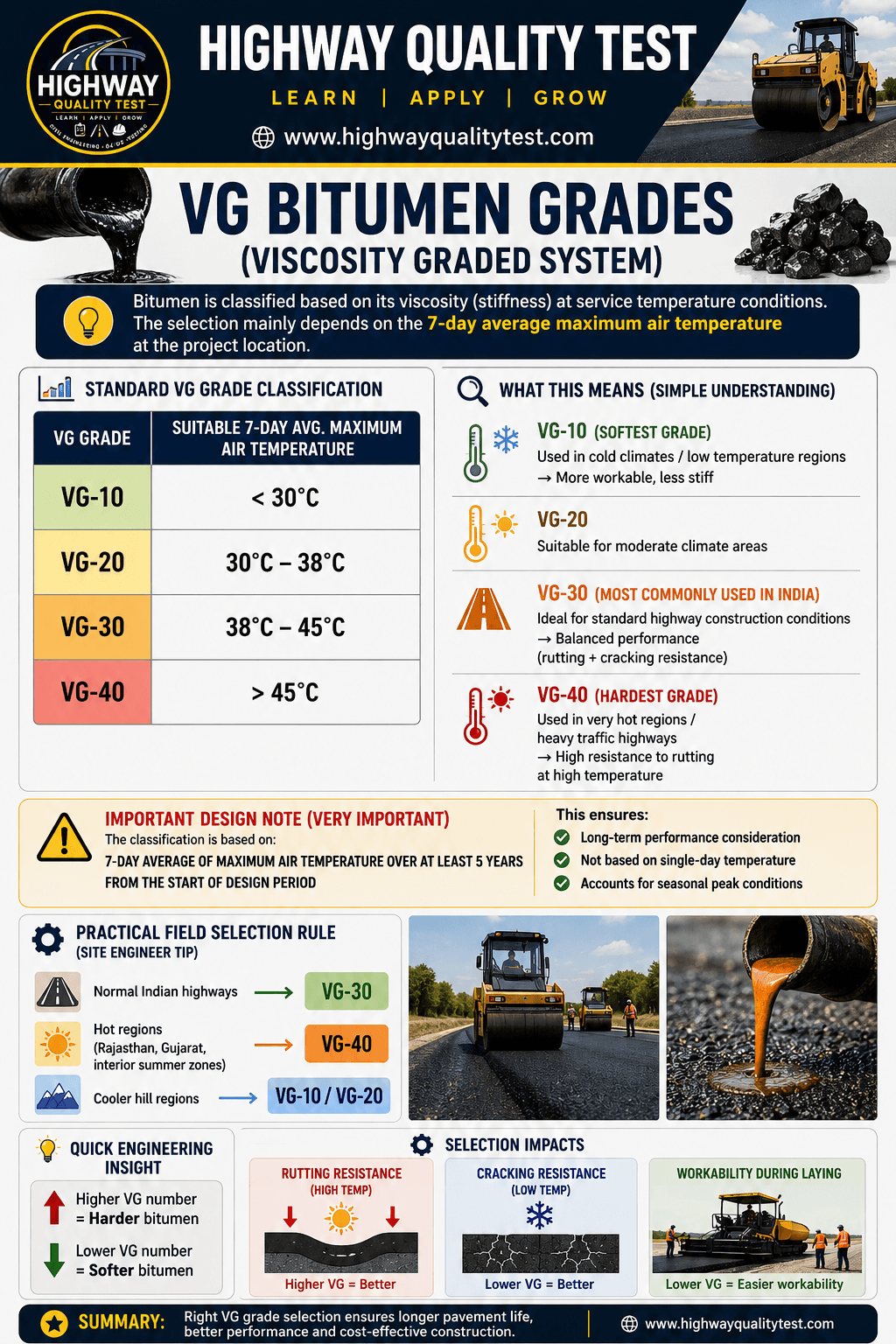
VG (Viscosity Graded) Bitumen is classified into VG10, VG20, VG30 and VG40 based on viscosity characteristics and climatic suitability. The chart below provides a quick comparison of all VG grades.
Key Points
- VG10 – Cold climate regions
- VG20 – Moderate climate regions
- VG30 – Most commonly used highway grade
- VG40 – Heavy traffic and hot climate regions
Major Types of Bitumen
- Paving Grade Bitumen: Standard refined binder for hot mix asphalt.
- Cutback Bitumen: Bitumen mixed with volatile solvent for low-temp application (RC, MC, SC).
- Bitumen Emulsion: Bitumen dispersed in water for ambient temperature application.
- Polymer-Modified Bitumen (PMB): Blended with polymers for improved elasticity, rutting & fatigue resistance.
- Oxidized / Blown Bitumen: Air-blown for higher softening point; used in roofing and damp-proof membranes.
Essential Properties and Tests
How to Select the Right Grade
- Match binder grade to climate (softer for cold, stiffer for hot/heavy traffic).
- Consider PMB or PG grades for heavy traffic or extreme temperatures.
- Ensure compatibility with plant/mixing temperatures.
- Follow MoRTH/IRC/project specifications.
VG BITUMEN GRADES – MCQs FOR EXAMS & INTERVIEWS
(Based on IS 73:2013 Specifications)
❓ Q1. Which VG grade has the highest penetration value?
🔘 A) VG10
🔘 B) VG20
🔘 C) VG30
🔘 D) VG40
✅ Answer: A) VG10
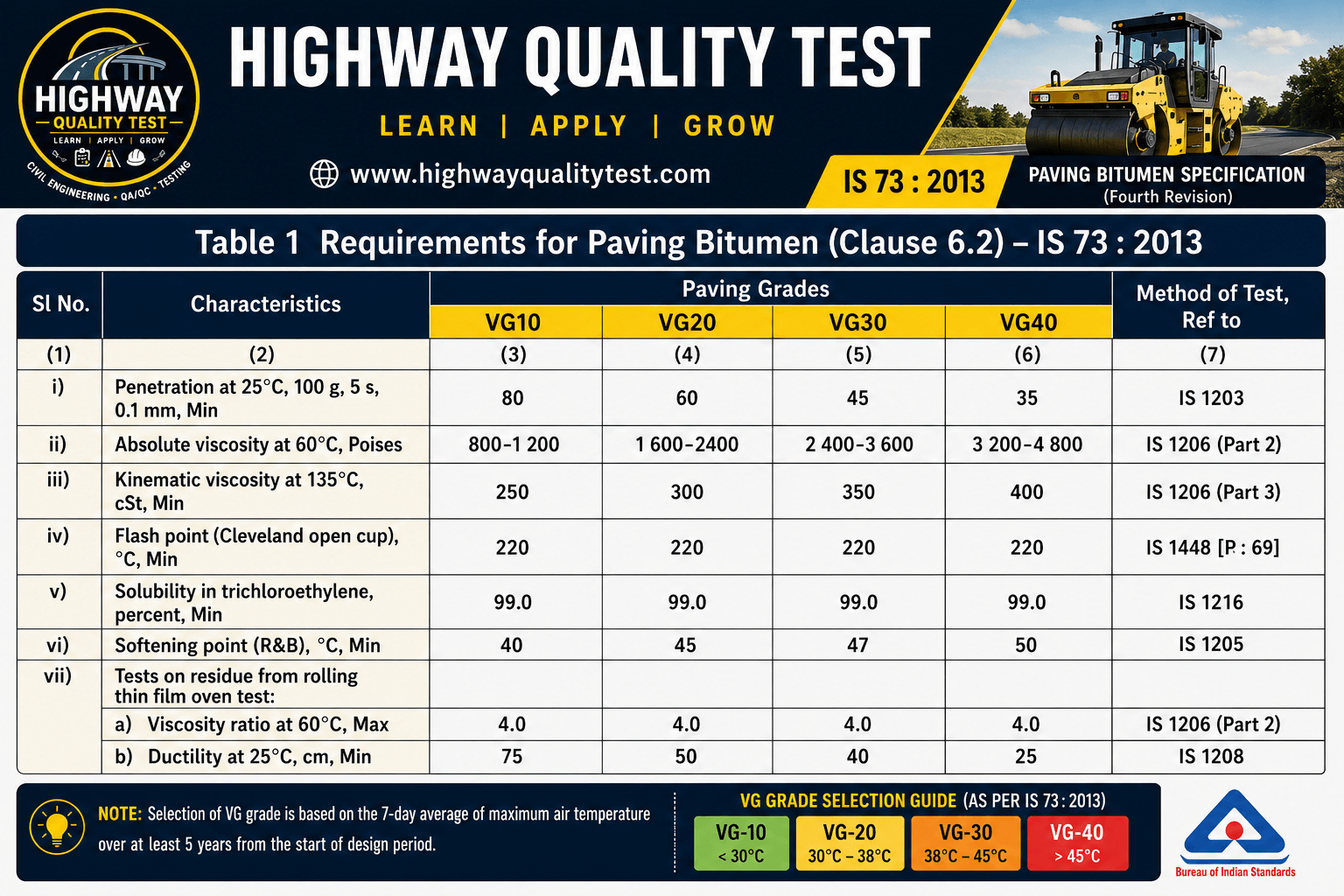
📌 Explanation: VG10 is the softest grade and therefore has the highest minimum penetration value (80).
❓ Q2. What is the minimum flash point requirement for all VG grades?
🔘 A) 200°C
🔘 B) 210°C
🔘 C) 220°C
🔘 D) 230°C
✅ Answer: C) 220°C
📌 Explanation: IS 73 specifies a minimum flash point of 220°C for VG10, VG20, VG30, and VG40.
❓ Q3. Which VG grade has the highest viscosity range?
🔘 A) VG10
🔘 B) VG20
🔘 C) VG30
🔘 D) VG40
✅ Answer: D) VG40
📌 Explanation: VG40 has the highest viscosity range (3200–4800 Poises) and is the hardest grade.
❓ Q4. What is the minimum kinematic viscosity at 135°C for VG30?
🔘 A) 250 cSt
🔘 B) 300 cSt
🔘 C) 350 cSt
🔘 D) 400 cSt
✅ Answer: C) 350 cSt
📌 Explanation: The minimum kinematic viscosity requirement for VG30 is 350 cSt.
❓ Q5. Softening point generally increases with:
🔘 A) Decrease in grade number
🔘 B) Increase in grade number
🔘 C) No relation
🔘 D) Random variation
✅ Answer: B) Increase in grade number
📌 Explanation: Higher VG grades are harder and therefore have higher softening points.
❓ Q6. Which VG grade has the lowest ductility requirement?
🔘 A) VG10
🔘 B) VG20
🔘 C) VG30
🔘 D) VG40
✅ Answer: D) VG40
📌 Explanation:
- VG10 = 75 cm
- VG20 = 50 cm
- VG30 = 40 cm
- VG40 = 25 cm
❓ Q7. Which IS code is used for the Penetration Test of bitumen?
🔘 A) IS 1203
🔘 B) IS 1205
🔘 C) IS 1448 (P:69)
🔘 D) IS 1216
✅ Answer: A) IS 1203
📌 Explanation: Penetration value is determined as per IS 1203.
❓ Q8. What is the minimum solubility requirement of VG bitumen in trichloroethylene?
🔘 A) 95%
🔘 B) 97%
🔘 C) 98%
🔘 D) 99%
✅ Answer: D) 99%
📌 Explanation: All VG grades must have a minimum solubility of 99.0%.
🎯 Rapid Fire Interview Questions
Q9. Which VG grade is most commonly used in highway construction?
✅ Answer: VG30
Q10. Which VG grade is recommended for very hot climates and heavy traffic?
✅ Answer: VG40
Q11. Which VG grade has the highest softening point?
✅ Answer: VG40 (50°C Minimum)
Q12. Which VG grade has the lowest penetration value?
✅ Answer: VG40 (35 Minimum)
Q13. What is the maximum viscosity ratio after RTFOT for all VG grades?
✅ Answer: 4.0
Q14. Which test is used to determine softening point?
✅ Answer: IS 1205 (Ring & Ball Method)
Q15. Which test is used to determine ductility?
✅ Answer: IS 1208
🧠 Memory Trick
🟡 VG20 → Medium Soft
🟠 VG30 → Standard Highway Grade
🔴 VG40 → Hardest → Highest Viscosity & Softening Point
"Higher VG Grade = Higher Viscosity = Harder Bitumen = Better Resistance to Rutting and Deformation."
Frequently Asked Questions (FAQs) – VG Bitumen Grades
What does VG stand for in bitumen?
VG stands for Viscosity Grade. Bitumen is classified based on its viscosity characteristics at specified temperatures. Common VG grades used in India are VG10, VG20, VG30, and VG40 as per IS 73:2013.
Which VG grade is most commonly used in highway construction?
VG30 is the most commonly used grade for National Highways, State Highways, and major road projects because it provides a good balance of workability and performance.
Which VG grade is suitable for hot climatic conditions?
VG40 is recommended for regions experiencing very high temperatures and heavy traffic loads due to its higher viscosity and rutting resistance.
Which VG grade has the highest penetration value?
VG10 has the highest penetration value (minimum 80), making it the softest grade among VG bitumen grades.
What is the minimum flash point requirement for VG bitumen?
The minimum flash point requirement for all VG grades (VG10, VG20, VG30, and VG40) is 220°C as specified in IS 73:2013.
How does viscosity change with VG grade?
Viscosity increases as the VG grade increases. VG10 has the lowest viscosity, while VG40 has the highest viscosity and offers better resistance to deformation.
What is the difference between Penetration Grade and Viscosity Grade bitumen?
Penetration Grade bitumen is classified based on penetration value measured at 25°C, whereas Viscosity Grade bitumen is classified based on viscosity measured at 60°C and 135°C, providing a more reliable indication of field performance.
Which test is used to determine the penetration value of bitumen?
The penetration test is conducted as per IS 1203.
Which test is used to determine the softening point of bitumen?
The softening point is determined using the Ring and Ball method as per IS 1205.
What is the minimum solubility requirement of VG bitumen?
All VG grades must have a minimum solubility of 99.0% in trichloroethylene as per IS 73:2013.
What is the memory trick for VG grades?
VG10 → Softest → Highest Penetration
VG20 → Medium Soft
VG30 → Standard Highway Grade
VG40 → Hardest → Highest Viscosity & Softening Point
