HIGHWAY QUALITY TEST
Precision Testing. Proven Quality. Safer Infrastructure.
Precision Testing. Proven Quality. Safer Infrastructure.
Table of Contents
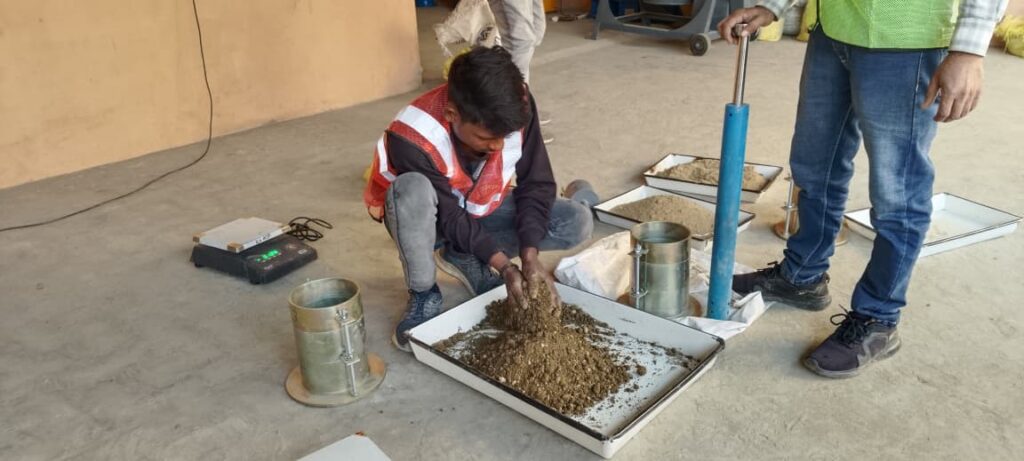
ToggleThe Plastic Limit of Soil (PL) is defined as the moisture content at which a fine‑grained soil begins to exhibit plastic behavior — it can be deformed without cracking or crumbling. Determining the PL is a key part of soil classification and geotechnical evaluation for engineering works. The outcome of the PL Test is used to compute important indices like Plasticity Index (PI), Liquidity Index (LI), and Consistency Index (CI), which help engineers predict settlement potential, shrink-swell behavior, and workability during construction.
This test is part of a suite of soil evaluations. For example, the Liquid Limit of Soil test complements the PL Test by identifying when soil transforms to a liquid state. The Modified Proctor Compaction Test determines optimum moisture content and maximum dry density, and the CBR Test evaluates soil bearing capacity for pavement design.
Fine-grained soils such as silts and clays change behavior depending on water content. These behaviors are categorized under Atterberg limits:
The Plastic Limit is considered the lower bound of the plastic state. Soils with higher PL tend to be more cohesive and resist deformation. Accurate PL determination is essential for earthwork design, foundation engineering, and soil suitability assessment in pavement and structural applications.
PI = Liquid Limit (LL) – Plastic Limit (PL)
PI = WL – WP
LI = (W – WP) / PI
Where W = natural moisture content
CI = (WP – W) / PI
TI = PI / IF
Where IF = Flow index from Liquid Limit Test
| Soil Type | Plastic Limit (PL %) | Plasticity Index (PI) | Suitability |
|---|---|---|---|
| Granular Subgrade | > 15 | < 10 | Suitable |
| Clayey Subgrade | 15–25 | 10–30 | Conditional |
| Highly Plastic Clay | > 25 | > 30 | Unsuitable |
The Plastic Limit of Soil is an essential measure of plastic behavior in fine-grained soils. Combined with Liquid Limit, Modified Proctor Compaction, and CBR Test, engineers can fully evaluate soil performance for highways, foundations, and earthworks. Accurate PL determination ensures better design, compaction control, and soil suitability assessment. ([highwayqualitytest.com](https://highwayqualitytest.com/modified-proctor-test/?utm_source=chatgpt.com))
Prepare professional Atterberg Limits Test reports in minutes using our ready-to-use Excel format with automatic calculations. Determine the Liquid Limit (LL), Plastic Limit (PL), and Plasticity Index (PI) accurately while eliminating manual calculation errors.
✔ Secure Payment | ✔ Instant Download | ✔ Editable Excel
Engineering Precision. Digital Quality. Highway Excellence.
© 2026 HIGHWAY QUALITY TEST. All rights reserved.