CBR Test of Soil – Procedure, Calculation, Formula & Result Interpretation as per IS 2720 (Part 16)
HIGHWAY QUALITY TEST | Author: Kishor Kumar | Updated: June 2026 | Read Time: 10–12 Minutes
👁️ Preview of Practical QA/QC Resources
Click any image to view full-size
1. Introduction
The California Bearing Ratio (CBR) Test is one of the most important laboratory and field tests used in highway engineering to evaluate the load-bearing capacity of subgrade soil, selected fill, granular sub-base (GSB), and pavement foundation materials. The test determines the resistance of soil against penetration under controlled conditions and is widely used for pavement thickness design.
The CBR value is expressed as a percentage and represents the ratio of the measured penetration resistance of a soil sample to that of a standard crushed stone material. Higher CBR values indicate stronger soil with better load-carrying capacity, while lower values indicate weaker subgrade requiring thicker pavement layers.
This article explains the complete CBR Test Procedure as per IS 2720 (Part 16), including sample preparation, soaking requirements, surcharge application, penetration testing, calculations, result interpretation, and practical applications in highway construction projects.
Why is the CBR Test Important?
The CBR value is one of the primary parameters used for pavement design as per IRC guidelines and MoRTH specifications. It helps engineers determine the required pavement thickness and assess the suitability of soil for embankment, subgrade, and pavement foundation layers.
- Pavement layer thickness design: Optimize base and sub-base layer thickness based on CBR values.
- Subgrade improvement decisions: Identify whether soil stabilization or improvement is needed.
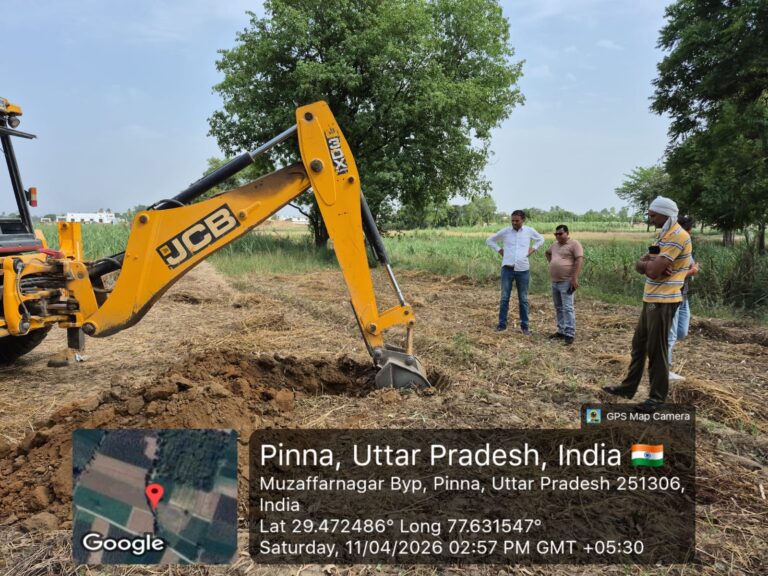
- Selection of suitable borrow soil: Choose the right soil type for highway subgrade and embankment construction.
2. Engineering Significance
The California Bearing Ratio (CBR) Test is one of the most widely used methods for evaluating the load-bearing capacity of subgrade soils and pavement foundation materials. The test provides an indication of the resistance of soil to penetration under standardized loading conditions and serves as a key input parameter for flexible pavement design.
The CBR value is extensively used in the design of highways, rural roads, airfields, and other pavement structures. In accordance with IRC guidelines and MoRTH specifications, the soaked CBR value of the subgrade is commonly adopted for determining the required pavement thickness.
A higher CBR value indicates stronger soil with greater load-carrying capacity, allowing thinner pavement layers. Conversely, a lower CBR value indicates weaker soil that may require thicker pavement sections, ground improvement measures, or soil stabilization to achieve the desired performance.
Practical Importance:
CBR values are used for the design of subgrade, selected fill, embankment materials, granular layers, and pavement rehabilitation projects. The test helps engineers assess soil suitability and optimize pavement thickness for safe and economical construction.
3. Why is the CBR Test Required?
The California Bearing Ratio (CBR) Test is conducted to evaluate the strength and load-bearing capacity of subgrade soils and pavement foundation materials. The test provides a quantitative measure of soil resistance to penetration and serves as a critical parameter in pavement design and construction quality control.
- To determine the strength of subgrade soil for pavement design.
- To establish design CBR values in accordance with IRC pavement design guidelines.
- To assess the suitability of borrow area soils, selected fill, and embankment materials.
- To verify compliance with project specifications and MoRTH requirements.
- To identify weak soils requiring stabilization, improvement, or replacement.
- To optimize pavement thickness and improve long-term pavement performance.
Engineering Insight:
A lower CBR value indicates weaker soil with lower load-carrying capacity and generally requires thicker pavement layers. Higher CBR values indicate stronger subgrade conditions and allow more economical pavement designs.
4. Applications in Highway Construction
CBR testing is extensively used during planning, design, construction, and quality control stages of highway projects. The test plays a vital role in determining pavement requirements and evaluating the performance of foundation soils.
- Design of flexible pavements as per IRC:37 guidelines.
- Approval of subgrade before placement of GSB, WMM, DLC, and pavement layers.
- Assessment and approval of borrow area materials.
- Evaluation of selected fill and embankment materials.
- Investigation and treatment planning for weak or problematic soils.
- Pavement rehabilitation and strengthening projects.
- Quality control and quality assurance during highway construction.
Field Application:
CBR testing is routinely performed on National Highways (NH), State Highways (SH), Expressways, PMGSY roads, EPC projects, HAM projects, and other pavement construction works throughout India.
5. References & Applicable Standards
-
IS 2720 (Part 16): 1987 – Methods of Test for Soils: Laboratory Determination of California Bearing Ratio (CBR), Bureau of Indian Standards (BIS).
-
IRC:37-2018 – Guidelines for the Design of Flexible Pavements, Indian Roads Congress (IRC).
-
MoRTH Specifications for Road and Bridge Works (Latest Revision) – Relevant provisions governing subgrade, embankment, and pavement construction.
-
ASTM D1883 – Standard Test Method for California Bearing Ratio (CBR) of Laboratory-Compacted Soils.
-
IRC:SP:72 – Guidelines for the Design of Flexible Pavements for Low Volume Rural Roads.
-
Project Specifications, Quality Assurance Plan (QAP), and Contract Documents applicable to the project.
These standards provide guidance on laboratory testing procedures, pavement design criteria, material acceptance requirements, and construction quality control practices used in highway engineering projects.
6. Apparatus and Equipment Required for CBR Test
The California Bearing Ratio (CBR) Test shall be conducted using calibrated equipment conforming to the requirements of IS 2720 (Part 16). All apparatus shall be maintained in good working condition and verified prior to testing to ensure reliable and reproducible results.
(A) CBR Mould Assembly
- CBR mould of approximately 2250 cm³ capacity with detachable base plate and extension collar.
- Internal Diameter: 150 mm.
- Internal Height: 175 mm.
- Extension Collar Height: 50 mm.
- Minimum Wall Thickness: 5 mm.
- Spacer disc for specimen preparation.
- Filter papers and perforated base plate.
Material Engineer's Check:
Before use, ensure that the mould is clean, free from deformation, and internally smooth. Any damaged mould shall be removed from service.
(B) Compaction Equipment
- Standard Proctor Rammer: 2.6 kg weight with 310 mm free fall.
- Modified Proctor Rammer: 4.89 kg weight with 450 mm free fall.
- Compaction shall be carried out in accordance with the selected laboratory compaction method specified in the project requirements.
(C) Loading Machine
- CBR loading machine capable of applying load at a constant penetration rate of 1.25 ± 0.05 mm per minute.
- Machine shall be capable of developing the required penetration load without vibration or shock.
- Load measurement shall be through a calibrated proving ring or load cell.
(D) Penetration Assembly
- Hardened steel penetration piston.
- Diameter: 50 mm ± 0.25 mm.
- Cross-Sectional Area: 19.35 cm².
- Surface shall be smooth, clean, and free from wear.
(E) Measuring Devices
- Calibrated proving ring or load cell of suitable capacity.
- Dial gauge for penetration measurement with least count of 0.01 mm.
- Weighing balance with suitable capacity and accuracy.
- Dial gauge arrangement for swell measurement during soaking.
(F) Soaking and Surcharge Arrangement
- Water tank of adequate size for complete immersion of test specimens.
- Perforated swell plate and surcharge weights.
- Surcharge weights shall simulate the pavement layers expected above the subgrade.
- For soaked CBR determination, specimens shall normally be submerged for 96 hours (4 days) unless otherwise specified.
QA/QC Requirement:
During soaking, the specimen shall remain completely submerged and swell readings shall be recorded as per the approved laboratory procedure.
(G) Miscellaneous Equipment
- Mixing trays and hand mixing tools.
- Straight edge for trimming the specimen surface.
- Spatula and palette knife.
- Moisture content containers.
- Drying oven maintained at 105°C–110°C.
- IS sieves for sample preparation.
- Sample extruder, where required.
QA/QC Head's Recommendation:
All proving rings, load cells, dial gauges, balances, ovens, and loading machines shall possess valid calibration certificates traceable to approved standards. Calibration status shall be verified before commencement of testing and records shall be maintained for audit and quality assurance purposes.
7. CBR Test Procedure (As per IS 2720 Part 16:1987)
CBR Test Procedure (Laboratory – Soaked Condition)
-
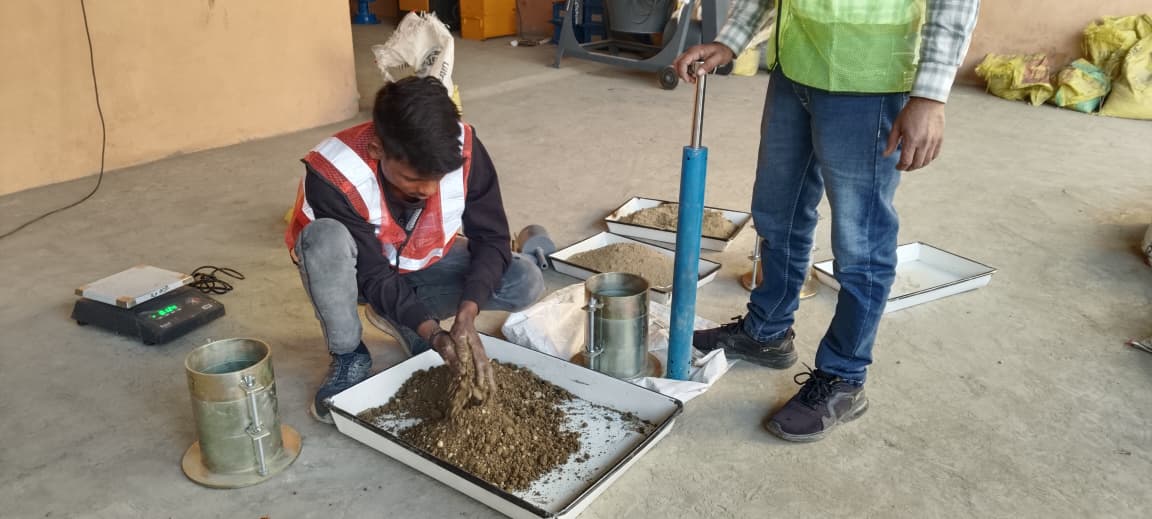
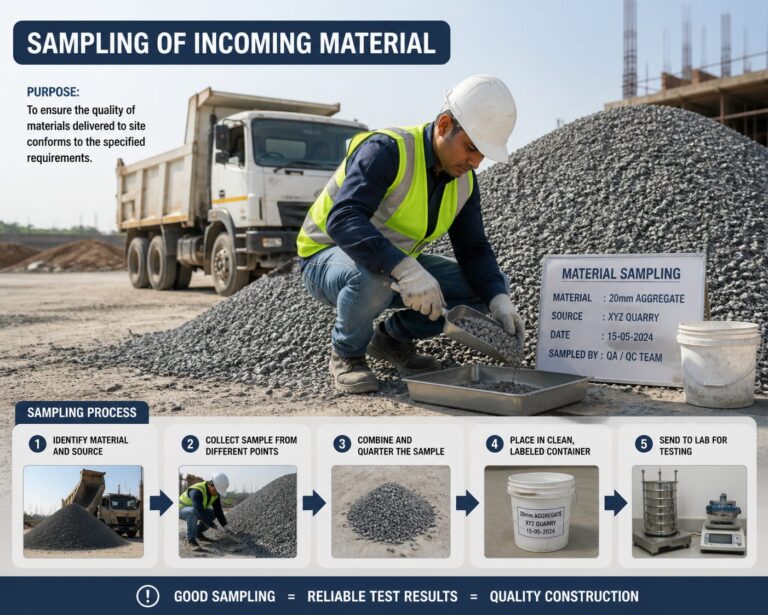
About 45 kg of material is dried and sieved through 19mm sieve. If there is not worthy proportion of materials retained on 19mm sieve, allowance for larger size materials is made by replacing it by an equal weight of material passing 19mm sieve and retained on 4.75mm sieve.
-
Determine the Optimum Moisture Content (OMC) and Maximum Dry Density (MDD) of the soil by conducting compaction test using either light compaction or heavy compaction (Modified Proctor), as per project requirements and relevant IS specifications.
-
Each batch of soil (of at least 5.5 kg weight for granular soil and 4.5 to 5.0 kg weight for fine grained soils) is mixed with water up to the optimum moisture content or the field moisture content if specified so.
-
The spacer disc (approx. 47.7 mm height) is placed at the bottom of the mould over the base plate, and a coarse filter paper (matching mould diameter ~150 mm) is placed over the spacer disc.
-
For IS heavy compaction or the modified Proctor compaction, the soil is divided into five equal parts; the soil is compacted in five equal layers, each of compacted thickness about 26.5mm by applying 56 evenly distributed blows of the 4.89 kg rammer.
The rammer shall be allowed to fall freely from a height of 450 mm, and blows shall be applied uniformly over the entire surface to ensure uniform compaction energy throughout each layer.
-
After compacting the last layer, the collar is removed and the excess soil above the top of the mould is evenly trimmed off by means of the straight edge.
Care shall be taken to ensure that the top surface is level, smooth, and flush with the top of the mould without disturbing the compacted soil.
-
Repeat the same procedure to prepare another two moulds and collect about 100g of soil sample from each mould for moisture content determination.
Care shall be taken to collect the sample immediately after compaction from different locations within the mould to ensure uniform and representative moisture content, and the determination shall be carried out as per relevant IS standards.
-
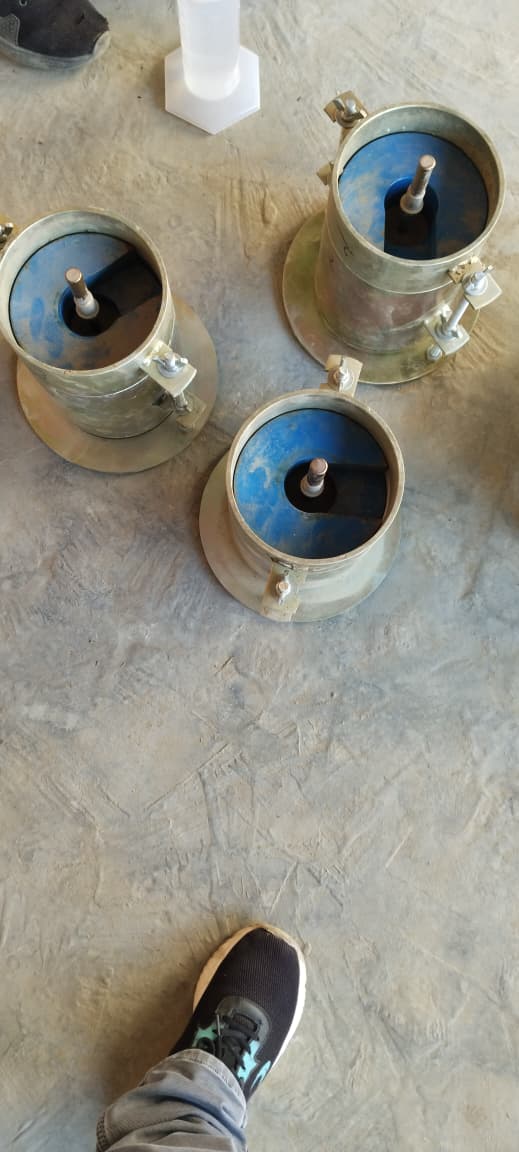
The clamps are removed and the mould with the compacted soil is lifted leaving below the perforated base plate and the spacer disc, which is removed. The mould with the compacted soil is weighed. A filter paper is placed on the perforated base plate, the mould with compacted soil is inverted and placed in position over the base plate and the clamps of the base plate are tightened. Another filter paper is placed on the top surface of the sample and the perforated plate with adjustable stem is placed over it. Surcharge weights of 2.5 or 5.0 kg weight are placed over the perforated plate and the whole mould with the weights is placed in a water tank for soaking such that water can enter the specimen both from the top and bottom.
-
The swell measuring device consisting of the tripod and the dial gauge are placed on the top edge of the mould and the spindle of the dial gauge is placed touching the top of the adjustable stem of the perforated plate. The initial dial gauge reading is recorded and the test set up is kept undisturbed in the water tank to allow soaking of the soil specimen for four full days or 96 hours. The final dial gauge reading is noted to measure the expansion or swelling of the soil specimen due to soaking.
-
The swell measuring assembly is removed, the mould is taken out of the water tank and the sample is allowed to drain in a vertical position for 15 minutes. The surcharge weights, the perforated plate with stem and the filter paper are removed. The mould with the soil sample is removed from the base plate and is weighed again to determine the weight of water absorption.
-
The mould with the specimen is clamped over the base plate and the same surcharge weights are placed on the specimen centrally such that the penetration test could be conducted. The mould with base plate is placed under the penetration plunger of the loading machine. The penetration plunger is seated at the center of the specimen and is brought in contact with the top surface of the soil sample by applying a seating load of 4.0 kg. The dial gauge for measuring the penetration values of the plunger is fitted in position. The dial gauge of the proving ring (for load readings) and the penetration dial gauge are set to zero. The load is applied through the penetration plunger at a uniform rate of 1.25 mm/min. The load readings are recorded at penetration readings of 0.0, 0.5, 1.0, 1.5, 2.0, 2.5, 3.0, 4.0, 5.0, 7.5, 10.0 and 12.5 mm. In case the load readings start decreasing before 12.5mm penetration, the maximum load value and the corresponding penetration value are recorded. After the final reading, the load is released and the mould is removed from the loading machine. The proving ring calibration factor is noted so that the load dial values can be converted into load in kg. About 50g of soil is collected from the top three cm depth of the soil sample for the determination of moisture content.
8 Sample Calculation
| Penetration (mm) | Test Load (kg) | Standard Load (kg) | CBR (%) |
|---|
| 2.5 | 480 | 1370 | 35.0 |
| 5.0 | 600 | 2055 | 29.2 |
Calculation at 2.5 mm:
CBR = (480 / 1370) × 100 = 35.0%
Calculation at 5.0 mm:
CBR = (600 / 2055) × 100 = 29.2%
Calculations – Swell Ratio & CBR
The swelling or expansion ratio is calculated from the observations during the swelling test using the formula:
Expansion ratio or swelling = 100 (df − di) / h
- df = final dial gauge reading after soaking, mm
- di = initial dial gauge reading before soaking, mm
- h = initial height of the specimen (127.3 mm), mm
The load values noted for each penetration level are divided by the area of the loading plunger (19.635 cm2) to obtain the pressure or unit load values on the loading plunger.
The load-penetration curve is then plotted in natural scale for each specimen. If the curve is uniformly convex upwards, no correction is needed. In case there is a reverse curve or the initial portion of the curve is concave upwards, necessity of a correction is indicated. A tangent is drawn from the steepest point on the curve to intersect the base at a point, which is the corrected origin corresponding to zero penetration.
The unit load values corresponding to 2.5 mm and 5.0 mm penetration values are found from the graph.
CBR Calculation
The CBR value is calculated from the formula:
CBR (%) = (Unit load carried by soil sample at defined penetration level / Unit load carried by standard crushed stones) × 100
Results and Determination of CBR Value
The California Bearing Ratio (CBR) values at 2.5 mm and 5.0 mm penetration are determined from the respective load–penetration curves for each specimen. These values are then expressed as a percentage of the standard load at the corresponding penetration.
In general practice, the CBR value at 2.5 mm penetration is higher than that at 5.0 mm penetration, and therefore this value is normally adopted for design purposes. However, if the CBR value at 5.0 mm penetration is higher, the test shall be repeated for confirmation.
If the higher value at 5.0 mm penetration is consistently obtained upon repeat testing, the same shall be adopted as the representative CBR value of the soil.
For reporting purposes, the final CBR value shall be taken as the average of three test specimens and shall be reported to the nearest one decimal place unless otherwise specified in the project requirements.
Design Recommendation:
For pavement design in accordance with IRC:37-2018 and MoRTH Specifications, the soaked CBR value corresponding to 2.5 mm penetration is generally adopted unless project-specific conditions dictate otherwise.
10. Interpretation of CBR Results
Subgrade Classification Based on CBR Value
| CBR Value (%) | Subgrade Quality | Engineering Implication |
|---|
| < 3 | Very Poor | Unsuitable without stabilization or replacement |
| 3 – 5 | Poor | Requires improvement / thicker pavement layers |
| 5 – 10 | Fair | Acceptable for low to medium traffic roads |
| 10 – 20 | Good | Suitable for standard pavement design |
| > 20 | Very Good | High bearing capacity, economical pavement thickness |
The California Bearing Ratio (CBR) represents the load-bearing capacity of subgrade soil under specified penetration conditions. A higher CBR value indicates better shear strength and reduced pavement thickness requirements.
11. Engineering Interpretation and Design Significance
The laboratory CBR value, determined under soaked conditions, is used as a critical input parameter in pavement design as per IRC:37-2018 and MoRTH Specifications. It directly governs the thickness of sub-base, base, and bituminous layers in flexible pavement design.
- CBR < 5% – Weak subgrade; requires stabilization (lime/cement) or replacement with suitable material.
- CBR 5–10% – Moderately strong soil; suitable for low to medium traffic highways with adequate granular cushion.
- CBR > 10% – Good quality subgrade; allows optimized and economical pavement design.
Laboratory vs Field Performance
- Soaked laboratory CBR represents worst-case moisture condition for design safety.
- Field CBR may vary depending on compaction control, drainage, and seasonal moisture variation.
- For all highway pavement design purposes, soaked laboratory CBR shall be adopted unless otherwise specified.
Note: In case of expansive soils (e.g., black cotton soil), if CBR is less than 5%, stabilization using lime, cement, or suitable admixtures is recommended before pavement construction.
12. Application of CBR in Pavement Design (IRC 37-2018)
- The design CBR value is used to determine total pavement thickness (bituminous + granular layers) from IRC 37 design charts.
- Lower CBR → Higher pavement thickness.
Example:
- CBR = 8%, Traffic = 20 msa → Pavement thickness ≈ 580 mm
- CBR = 5%, Same traffic → Pavement thickness ≈ 700 mm
Conclusion: Accurate CBR determination directly impacts safety, durability, and economy of pavement design.
13. Precautions for Reliable CBR Results
- Ensure uniform compaction at correct Optimum Moisture Content (OMC).
- Avoid air voids during specimen preparation.
- Maintain consistent 72–96 hours soaking for soaked CBR.
- Calibrate proving ring and dial gauges before testing.
- Conduct minimum three specimens and adopt average value.
- For expansive or silty soils, test both soaked and unsoaked conditions to assess seasonal variation.
14. Field Engineer Notes
- Always conduct soaked CBR for design and approval
- Ensure surcharge weights are placed before soaking
- Record swelling percentage during soaking period
- Check loading frame calibration before testing
- Reject results if penetration curve is abnormal
15. Common Mistakes
- Incorrect compaction energy
- Improper moisture content
- Missing surcharge weights
- Using unsoaked CBR for design
Always perform soaked CBR for MoRTH and IRC pavement design.
16. Reasons for Low CBR Values
- High plasticity clay content
- Excessive moisture in subgrade
- Poor compaction control
- Organic or unsuitable soil
- Improper drainage conditions
Soil stabilization or replacement is recommended for low CBR soils.
17. Conclusion
The California Bearing Ratio (CBR) Test provides a reliable and standardized measure of subgrade and granular layer strength essential for flexible pavement design under Indian conditions.
Strict adherence to IS 2720 (Part 16):1987 for laboratory testing and IRC 37-2018 for pavement design ensures that highway structures are safe, durable, and economically optimized.
In professional practice, the 96-hour soaked CBR value, determined using the standard 150 mm mould and tested at a penetration rate of 1.25 mm/min, represents the most dependable indicator of worst-case field subgrade performance. This value forms the basis of pavement thickness design for NHAI and MoRTH projects across India.
Accurate specimen preparation, proper soaking, calibrated loading equipment, and correct interpretation of results are critical to obtaining dependable CBR values. Since pavement thickness is directly influenced by CBR, even minor testing inaccuracies may lead to unsafe or overdesigned structures.
Therefore, CBR testing remains one of the most important quality control and design verification tools in highway engineering practice.
Frequently Asked Questions
What is the minimum CBR value required for subgrade in highway projects?
Minimum CBR values depend on MoRTH & IRC:37; typically 8–10% for subgrade, but check project specs.
Why is soaked CBR preferred over unsoaked CBR?
Soaked CBR simulates worst-case moisture and is generally required for pavement design acceptance.
At what penetrations is CBR measured?
CBR is measured at 2.5 mm and 5.0 mm penetration; the higher value is reported.
How often should CBR testing be done in the field?
Frequency depends on quality assurance plan and project requirements.
Does oversize material affect CBR test results?
Yes — oversize particles must be handled correctly to avoid incorrect CBR values.
Why do CBR results sometimes vary?
Variations arise from inconsistent moisture, compaction effort, particle gradation, or sample prep issues.