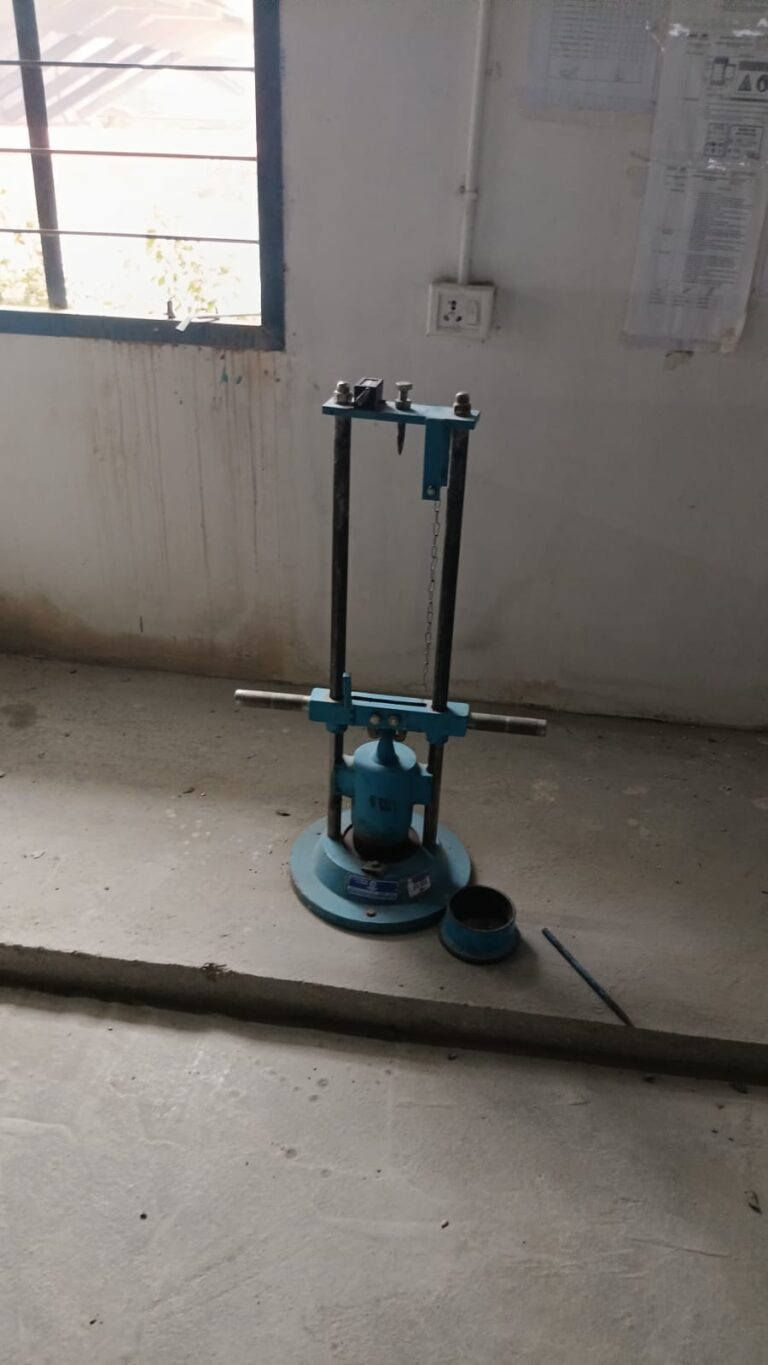
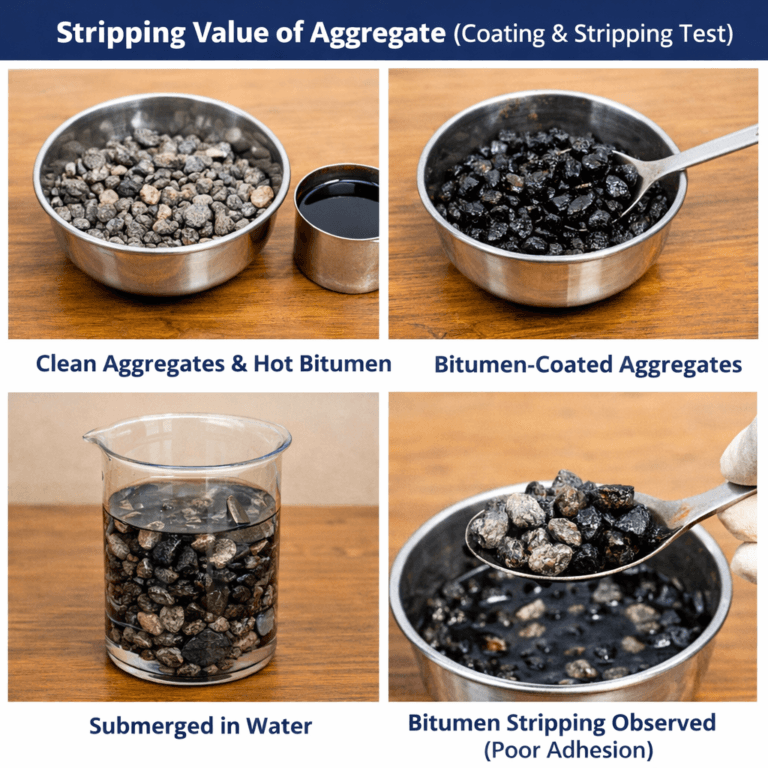
Table of Contents
ToggleIS Code: IS 2386 (Part IV) | Last Updated: 11 Dec 2025 | Author: Kishor Kumar
The Aggregate Impact Value (AIV) Test evaluates toughness and durability of aggregates. This guide per IS 2386 provides procedure, apparatus, calculation, and permissible limits, making it site-ready for engineers and QA/QC teams ensuring strong and long-lasting pavement layers.
| Trial | W1 (g) | W2 (g) | AIV (%) |
|---|---|---|---|
| 1 | 500 | 75 | 15.0 |
| 2 | 500 | 77 | 15.4 |
| 3 | 500 | 76 | 15.2 |
Average AIV = 15.2% (Suitable for wearing surfaces)
Aggregate Impact Value (AIV):
AIV (%) = (W2 / W1) × 100
| Sl. No. | Pavement Layer | Maximum LAA Value |
|---|---|---|
| 1 | Granular Sub-Base (GSB) | 40% |
| 2 | Cement Treated Granular Sub-Base (CTGSB) | 30% |
| 3 | Cement Treated Base (CTB) | 30% |
| 4 | Wet Mix Macadam (WMM) | 35% |
| 5 | Dense Bituminous Macadam (DBM) | 27% |
| 6 | Bituminous Concrete (BC) | 24% |
| 7 | Concrete (PQC/DLC Aggregates) | 30% |
Note: The Aggregate Impact Value (AIV) Test determines the toughness of coarse aggregates by measuring their resistance to sudden impact or shock. A lower AIV indicates tougher and more impact-resistant aggregates, making them suitable for high-traffic roads, pavements, and concrete works. The permissible AIV limits shall conform to the applicable MoRTH specifications for the intended pavement layer. Lower AIV values indicate stronger and tougher aggregates. High AIV values indicate weak aggregates unsuitable for heavy traffic pavements.
Aggregate Impact Value (AIV) is the percentage of fines produced when a standard aggregate sample is subjected to sudden impact loading under specified laboratory conditions. It measures the toughness of aggregates and their ability to resist impact loads from moving traffic.
The AIV test evaluates whether aggregates are sufficiently tough for use in road pavements and concrete works. It helps engineers select durable aggregates that can withstand repeated traffic impact without excessive crushing or disintegration.
The test is conducted in accordance with IS 2386 (Part IV): Methods of Test for Aggregates for Concrete – Mechanical Properties. Highway projects may also refer to the latest MoRTH Specifications for acceptance limits.
A standard aggregate sample passing the 12.5 mm sieve and retained on the 10 mm sieve is placed in a cylindrical mould. The sample is compacted and subjected to 15 standard hammer blows. The material passing the 2.36 mm sieve after testing is weighed, and the Aggregate Impact Value is calculated as a percentage.
A lower AIV indicates higher aggregate toughness and better resistance to impact loading. Such aggregates are more suitable for heavily trafficked roads, expressways, airport pavements, and wearing courses.
Generally, the Aggregate Impact Value should be:
A high AIV indicates weak aggregates that are more susceptible to crushing under traffic loads. Using such aggregates may result in ravelling, surface deterioration, potholes, and reduced pavement life.
The test is generally performed on aggregates passing the 12.5 mm IS sieve and retained on the 10 mm IS sieve, as specified in IS 2386 (Part IV).
The Aggregate Impact Value measures the resistance of aggregates to sudden impact loading, whereas the Aggregate Crushing Value measures resistance to gradual compressive loading. Both tests evaluate different mechanical properties of aggregates and are commonly performed together during material approval.
The test helps contractors and quality engineers verify that aggregates used in Dense Bituminous Macadam (DBM), Bituminous Concrete (BC), Wet Mix Macadam (WMM), and concrete pavements possess adequate toughness to withstand traffic loading throughout the design life of the pavement.
Yes. Flaky and elongated particles may fracture more easily during impact testing, resulting in a higher Aggregate Impact Value. Therefore, aggregate shape should also be checked before approving the material.
The standard procedure requires 15 blows from a specified hammer falling from a standard height to ensure consistent and repeatable test results.
The test should be performed by trained laboratory technicians or QA/QC engineers in a calibrated material testing laboratory following the procedure specified in IS 2386 (Part IV).
For EPC, BOT, HAM, and National Highway projects, the AIV test is a mandatory quality control test during material approval. It ensures only tough and durable aggregates are used, reducing the risk of premature pavement failures and improving long-term pavement performance.
Prepare professional Aggregate Impact Value (AIV) test reports in minutes using our ready-to-use Excel format with automatic calculations. Eliminate manual errors and save valuable testing time.
✔ Secure Payment | ✔ Instant Download | ✔ Lifetime Access
Need more than one Excel format? Save money with our Complete Aggregate Testing Excel Toolkit containing 19 professional Excel formats with automatic calculations, laboratory-ready observation sheets and printable reports.
✔ 19 Excel Formats | ✔ Automatic Calculations | ✔ Laboratory Ready Reports | ✔ Instant Download | ✔ Lifetime Access
Explore detailed test procedures, calculations and acceptance criteria as per IS, MoRTH & IRC specifications:
Engineering Precision. Digital Quality. Highway Excellence.
© 2026 HIGHWAY QUALITY TEST. All rights reserved.