Modified Proctor Test – OMC and MDD of Soil (IS 2720 Part 8)

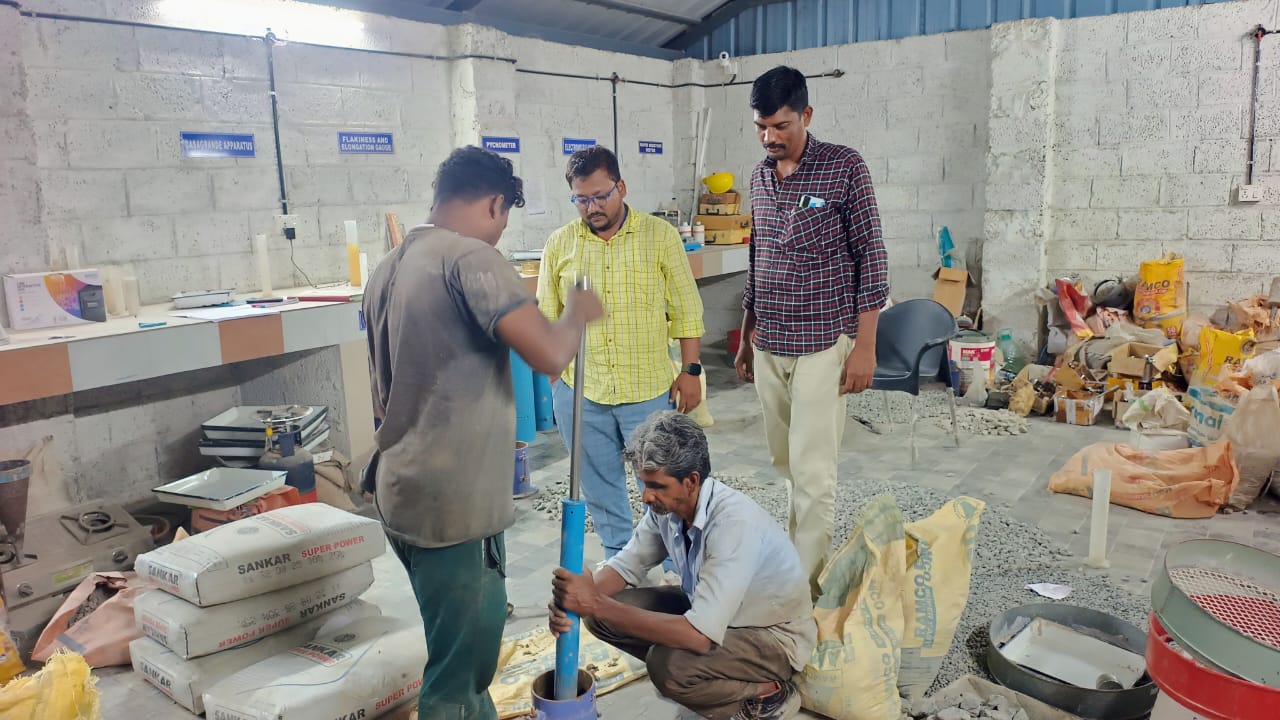
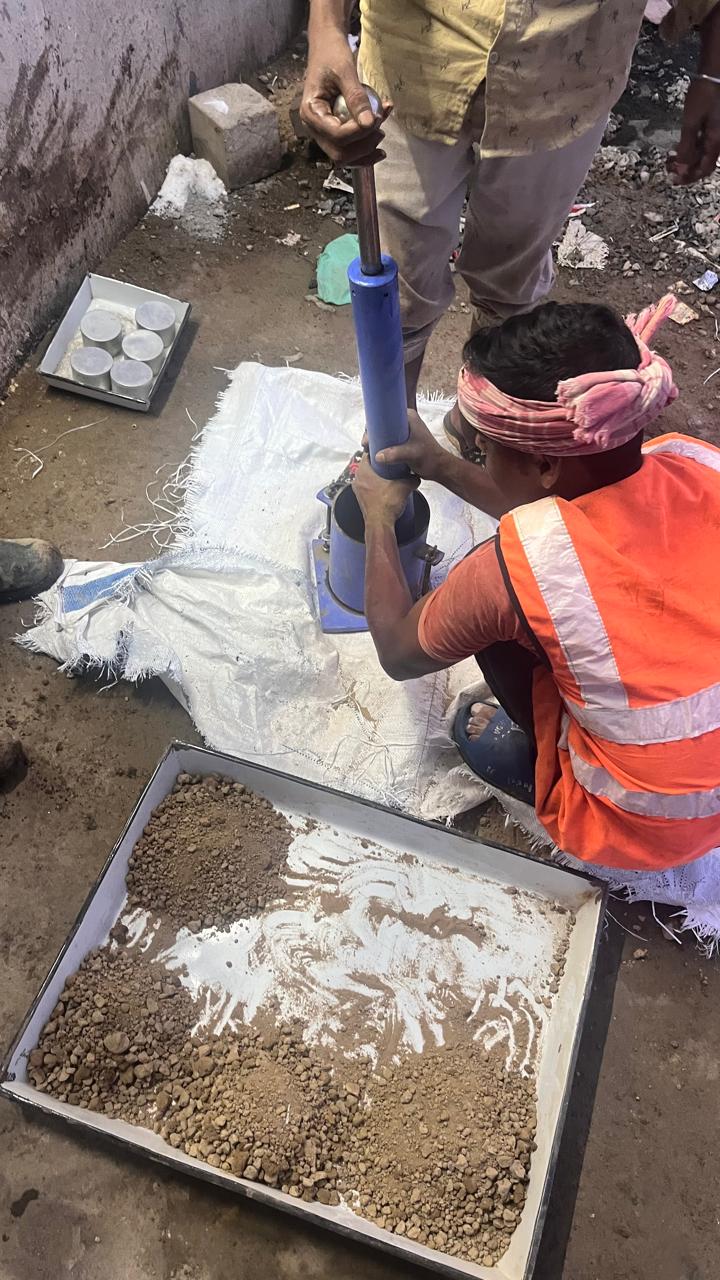
Figure: Modified Proctor Test (Heavy Compaction Test) Apparatus Setup
Modified Proctor Test – Determination of Optimum Moisture Content (OMC) and Maximum Dry Density (MDD) of Soil as per IS 2720 (Part 8)
The Modified Proctor Test is a laboratory compaction test conducted to establish the moisture-density relationship of soil under heavy compaction energy. The test is used to determine the Optimum Moisture Content (OMC) and Maximum Dry Density (MDD), which serve as reference values for field compaction control during construction of highway embankments, subgrades, shoulders, earthworks, and other geotechnical structures.
The test is performed in accordance with IS 2720 (Part 8) and is widely adopted in highway projects executed under MoRTH Specifications. The laboratory values obtained from this test form the basis for evaluating field compaction achieved through rollers and other compaction equipment during construction.
Objective
- To determine the relationship between moisture content and dry density of soil under heavy compaction conditions.
- To determine the Optimum Moisture Content (OMC) at which the soil attains maximum compaction.
- To determine the Maximum Dry Density (MDD) corresponding to the Optimum Moisture Content.
- To establish laboratory compaction characteristics for embankment, subgrade, selected fill, and other earthwork materials.
- To provide reference values for quality control and acceptance of field compaction.
- To assess the suitability of soil for highway and pavement construction in accordance with project specifications.
Standard Reference
- IS 2720 (Part 8): 1983 – Determination of Water Content–Dry Density Relation Using Heavy Compaction.
- MoRTH Specifications for Road and Bridge Works (Latest Revision).
- IRC: SP:89 – Guidelines for Soil, Granular Material, Subgrade and Pavement Investigations.
- Approved Project Specifications and Quality Assurance Plan (QAP).
- Contract Conditions, Technical Specifications, and Relevant Method Statements.
Principle of Test
Compaction is the process of increasing the density of soil by reducing the volume of air voids through the application of mechanical energy. In the Modified Proctor Test, a controlled compactive effort is applied to soil specimens prepared at different moisture contents.
As water is added to the soil, the moisture acts as a lubricant between particles, facilitating particle rearrangement and resulting in an increase in dry density. With increasing moisture content, the soil reaches a condition where the maximum possible dry density is achieved for the applied compactive effort.
The moisture content corresponding to this condition is known as the Optimum Moisture Content (OMC), while the associated dry density is known as the Maximum Dry Density (MDD).
Beyond the OMC, additional water occupies the void spaces within the soil mass and cannot be effectively removed during compaction. Consequently, the dry density begins to decrease despite further increases in moisture content.
The relationship between moisture content and dry density is represented by a compaction curve, from which the OMC and MDD are determined. These values are subsequently used as reference criteria for field compaction control and acceptance of earthwork layers in highway construction.
Equipment Required
The following apparatus and equipment shall be available in the laboratory for determination of the moisture-density relationship of soil in accordance with IS 2720 (Part 8):
- Modified Proctor Mould Assembly comprising mould, detachable collar, and base plate (1000 cc or 2250 cc capacity as applicable).
- Compaction Rammer weighing 4.89 kg with a free fall of 450 mm.
- Mechanical or Manual Compaction Arrangement capable of delivering the specified compactive effort.
- Weighing Balance having an accuracy of 1 g or better.
- Drying Oven maintained at a temperature of 105°C to 110°C for moisture content determination.
- Mixing Tray for sample preparation and moisture conditioning.
- Graduated Measuring Cylinder for accurate measurement of water.
- Straight Edge / Steel Scraper for trimming excess soil flush with the mould top.
- Moisture Content Containers with lids.
- IS Sieves including 19 mm, 4.75 mm and other sieves as required for sample preparation.
- Sample Extruder for removal of compacted specimens from the mould, where available.
- Hand Tools such as trowels, spatulas, scoop, mixing spoon, and rubber mallet.
Testing Requirement:
For the 1000 cc mould, the specimen shall be compacted in 5 layers with 25 blows per layer. For the 2250 cc mould, the specimen shall be compacted in 5 layers with 55 blows per layer using the same 4.89 kg rammer falling through 450 mm.
QA/QC Note:
In certain geotechnical investigations and research applications, compaction characteristics may be evaluated at different compaction energy levels such as 10, 30, and 65 blows per layer to study the influence of compactive effort on the moisture-density relationship of soils. Such procedures are generally derived from the principles of ASTM D1557 – Standard Test Methods for Laboratory Compaction Characteristics of Soil Using Modified Effort and other specialized laboratory practices. However, for routine highway quality control and acceptance testing, the Modified Proctor Test shall be conducted strictly in accordance with IS 2720 (Part 8) or the applicable project specification.
Step 3: Sample Preparation and Oversize Material Assessment
After air-drying, the soil sample shall be pulverized carefully without breaking individual particles. The representative sample shall then be sieved to determine the suitability of the material for the Modified Proctor Test and to assess the percentage of oversize particles.
Sieving of Soil Sample
- The entire soil sample shall be passed through the 19 mm IS Sieve.
- The material retained on the 19 mm sieve shall be separated and weighed accurately.
- The material passing the 19 mm sieve shall be used for preparation of the test specimen.
- The percentage of oversize material shall be determined before proceeding with compaction testing.
Determination of Oversize Material
The percentage of material retained on the 19 mm sieve shall be calculated using the following expression:
Percentage Retained (%) = (Weight Retained on 19 mm Sieve ÷ Total Sample Weight) × 100
Material Engineer's Note:
For the 1000 cc mould, the test specimen shall normally consist of material passing the 19 mm sieve. Where the percentage of oversize material exceeds the permissible limits specified in IS 2720 (Part 8), the larger mould and applicable correction procedures shall be adopted in accordance with the standard.
Acceptance Criteria for Oversize Material
| Percentage Retained on 19 mm IS Sieve | Recommended Action |
|---|
| Less than 5% |
The retained material may be discarded, and the Modified Proctor Test shall be conducted on the material passing the 19 mm IS sieve. |
| 5% to 30% |
The test shall be conducted on the material passing the 19 mm IS sieve, and the laboratory results shall be corrected for the oversize fraction in accordance with IS 2720 (Part 8). |
| More than 30% |
The standard 1000 cc mould procedure may not provide representative compaction characteristics. Testing using a larger mould or an alternative evaluation method should be considered as per project requirements and applicable standards. |
QA/QC Note:
The percentage of oversize material should always be reported along with the test results. Where oversize correction is applied, the corrected values of Optimum Moisture Content (OMC) and Maximum Dry Density (MDD) shall be clearly identified in the laboratory test report.
Application to Highway Embankment and Subgrade Materials
For highway embankment, subgrade, selected fill, and other earthwork applications, the laboratory compaction characteristics shall be determined on representative material prepared in accordance with IS 2720 (Part 8).
- Borrow area materials are generally processed and screened to ensure compliance with project specifications before testing.
- For routine Modified Proctor Tests using the 1000 cc mould, the test specimen normally consists of material passing the 19 mm IS sieve.
- Any oversize fraction shall be assessed and reported in accordance with the applicable standard.
- Where oversize correction is required, the corrected values of Maximum Dry Density (MDD) and Optimum Moisture Content (OMC) shall be used for field compaction control.
- The laboratory test report shall clearly indicate:
- Percentage retained on the 19 mm IS sieve.
- Method of sample preparation adopted.
- Whether oversize correction has been applied.
- Final MDD and OMC values used for construction control.
🚧 Quality Control Checklist
✅ Verify that the soil sample is representative of the approved borrow area or construction source.
✅ Remove roots, vegetation, organic matter, brick fragments, and other deleterious materials before testing.
✅ Record the percentage retained on the 19 mm IS sieve in the laboratory worksheet and final test report.
✅ Confirm that moisture conditioning is uniform throughout the sample before compaction.
✅ Ensure that rammer weight, drop height, mould size, and number of blows comply with IS 2720 (Part 8).
✅ Review MDD and OMC values for consistency before issuing the final laboratory report.
✅ Where oversize material exceeds permissible limits, obtain approval from the Geotechnical Engineer or Engineer-in-Charge before proceeding with testing.
Example
Total Soil Sample = 20.0 kg
Material Retained on 19 mm Sieve = 0.8 kg
% Retained = (0.8 / 20.0) × 100 = 4%
Since the oversize material is less than 5%, the retained material may be discarded and the Modified Proctor Test can be conducted on the soil passing the 19 mm sieve.
4. For Highway Embankment and Subgrade Materials
In most highway projects:
- Borrow earth is generally processed so that the majority of the material passes the 19 mm sieve.
- Material retained on the 19 mm sieve is usually discarded before conducting the MDD/OMC test.
- The laboratory report shall clearly indicate:
- Percentage retained on the 19 mm sieve.
- Whether oversize correction has been applied.
- Final MDD and OMC values after correction.
QA/QC Engineer's Check
✅ Ensure no roots, organic matter, bricks, stones, or foreign materials are included in the test sample.
✅ Record the percentage retained on the 19 mm sieve in the test sheet.
✅ If oversize material exceeds permissible limits, immediately inform the Geotechnical Engineer before proceeding with the test.
Sample Preparation and Moisture Conditioning
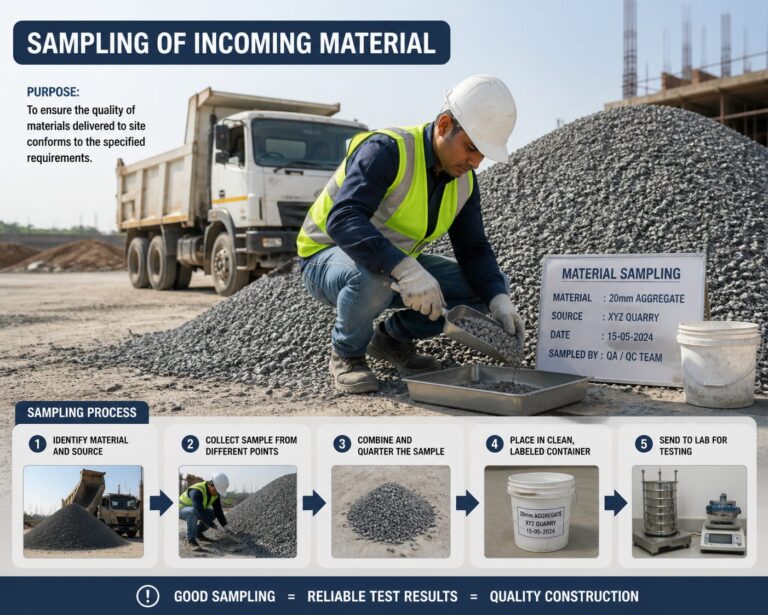
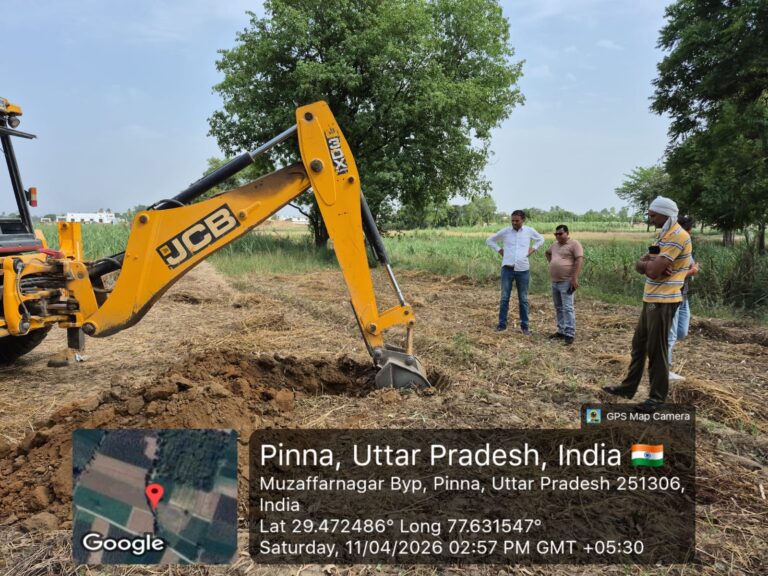
A representative soil sample shall be obtained from the approved borrow area, embankment material source, or subgrade material stockpile. The sample shall be air-dried and pulverized carefully without breaking individual soil particles.
Sieving and Oversize Material Assessment
The prepared soil shall be passed through the 19 mm IS sieve. The material retained on the sieve shall be weighed separately and its percentage determined to assess the suitability of the sample for the Modified Proctor Test.
Percentage Retained (%) = (Weight Retained on 19 mm Sieve ÷ Total Sample Weight) × 100
Example Calculation
Total Soil Sample = 20.0 kg
Material Retained on 19 mm IS Sieve = 0.8 kg
Percentage Retained = (0.8 ÷ 20.0) × 100 = 4%
Since the oversize fraction is less than 5%, the retained material may be discarded and the Modified Proctor Test may be conducted on the material passing the 19 mm IS sieve.
QA/QC Note:
Where the percentage retained on the 19 mm IS sieve exceeds the permissible limits specified in IS 2720 (Part 8), appropriate oversize correction procedures or larger mould testing shall be adopted as applicable.
Moisture Conditioning
Approximately 5 kg of representative soil passing the specified sieve shall be taken for testing. The Natural Moisture Content (NMC) shall be determined before the addition of water.
Water shall be added gradually to bring the sample to an initial moisture content approximately 3% to 4% below the anticipated Optimum Moisture Content (OMC). The soil shall be mixed thoroughly until uniform moisture distribution is achieved throughout the sample.
Subsequent specimens shall be prepared by increasing the moisture content in increments of approximately 2% until the moisture content exceeds the anticipated OMC and the complete compaction curve is established.
Illustrative Example
Weight of Soil Sample = 5.0 kg (5000 g)
Natural Moisture Content (NMC) = 3%
Target Initial Moisture Content = 4%
Additional Water Required = 1% × 5000 = 50 ml
Subsequent Moisture Contents = 6%, 8%, 10%, 12%, and 14%
Material Engineer's Note:
After moisture conditioning, the soil should be stored in a covered container for sufficient time to allow uniform distribution of moisture throughout the sample before compaction is carried out.
Compaction Procedure (Modified Proctor Test)
After completion of sample preparation and moisture conditioning, the soil specimen shall be compacted in accordance with IS 2720 (Part 8) using the specified mould and compactive effort.
-
Assemble the mould, detachable collar, and base plate securely. Record the weight of the empty mould assembly.
-
Place the prepared soil into the mould in five approximately equal layers.
-
Compact each layer uniformly using a 4.89 kg rammer falling freely through a height of 450 mm.
-
Apply the specified number of blows uniformly over the entire surface of each layer:
- 1000 cc mould: 25 blows per layer.
- 2250 cc mould: 55 blows per layer.
-
Before placing the next layer, lightly scarify the compacted surface to ensure proper bonding between successive layers.
-
After compaction of the fifth layer, remove the extension collar carefully without disturbing the compacted specimen.
-
Trim the excess soil using a straight edge so that the compacted surface is flush with the top of the mould.
-
Clean the exterior surface of the mould and determine the weight of the mould containing compacted soil.
-
Remove a representative portion of soil from the specimen and determine its moisture content in accordance with IS 2720 (Part 2).
-
Calculate the bulk density of the compacted specimen from the mould volume and compacted mass.
-
Determine the corresponding dry density for the trial moisture content.
-
Repeat the entire procedure at progressively higher moisture contents, generally in increments of approximately 2%, until the dry density values pass the peak and begin to decrease.
-
Conduct a sufficient number of trials to establish the complete moisture-density relationship of the soil.
-
Plot a graph between moisture content (%) and dry density (g/cc or kN/m³) and identify:
- Maximum Dry Density (MDD) – Peak value of dry density.
- Optimum Moisture Content (OMC) – Moisture content corresponding to MDD.
QA/QC Note:
A minimum of 5–6 moisture content trials should normally be conducted to accurately define the compaction curve. Additional trials may be required where the peak of the curve is not clearly established.
Material Engineer's Note:
The laboratory MDD and OMC obtained from this test form the basis for field density acceptance criteria during embankment, subgrade, selected fill, and pavement layer construction. All field compaction results should be compared against these reference values as specified in the project specifications and MoRTH requirements.
Quality Control Considerations
- Ensure that the soil sample is representative of the approved borrow area, subgrade, or embankment material source.
- Remove roots, vegetation, organic matter, brick fragments, and other deleterious materials before testing.
- Ensure uniform moisture distribution throughout the soil before compaction.
- Prevent moisture loss during sample preparation, conditioning, and testing.
- Verify that the mould dimensions, rammer weight, drop height, and number of blows comply with IS 2720 (Part 8).
- Record all observations accurately, including mould weight, compacted weight, moisture content, bulk density, and dry density.
- Ensure that sufficient moisture content trials are conducted to clearly define the compaction curve.
- Report any oversize correction applied during the determination of OMC and MDD.
- Use the laboratory MDD and OMC values as reference parameters for field compaction control.
- Field density acceptance shall be based on the specified percentage of laboratory MDD as required by MoRTH Specifications and project requirements.
Use of 2250 cc Mould
The 2250 cc mould is generally used when the soil contains a significant proportion of coarse particles that cannot be adequately represented in the standard 1000 cc mould. The larger mould provides a more representative assessment of the compaction characteristics of coarse-grained soils.
- Applicable for soils containing a relatively high percentage of particles retained on the 19 mm IS sieve.
- The specimen shall be compacted in five equal layers.
- Each layer shall receive 55 blows using a 4.89 kg rammer falling through a height of 450 mm.
- The remaining procedure for moisture conditioning, compaction, density determination, and plotting of the compaction curve remains the same as that adopted for the standard Modified Proctor Test.
- The selected mould size shall always comply with the requirements of IS 2720 (Part 8) and the soil gradation being tested.
Material Engineer's Note:
Selection of an appropriate mould size is critical for obtaining representative values of Maximum Dry Density (MDD) and Optimum Moisture Content (OMC). Where coarse particles constitute a significant portion of the soil, the larger mould should be used to minimize scale effects and improve the reliability of test results.
Oversize Correction (IS 2720 Part 8)
Where the soil contains a significant proportion of particles retained on the specified sieve, the compaction characteristics obtained from the material passing the sieve may not accurately represent the entire soil mass. In such cases, oversize correction may be applied in accordance with IS 2720 (Part 8).
- Determine the percentage of oversize material retained on the specified sieve.
- Conduct the Modified Proctor Test on the material passing the sieve.
- Determine the MDD and OMC of the passing fraction.
- Apply oversize correction where required by the applicable standard or project specification.
- Clearly report the percentage of oversize material and any correction applied in the laboratory report.
Technical Note:
Oversize correction is generally applicable to coarse-grained soils containing a significant proportion of particles larger than the specified sieve size. Where the oversize fraction is excessive, testing using a larger mould may provide more representative results.
Applications of Modified Proctor Test
- Determination of compaction characteristics of embankment and subgrade soils.
- Establishment of laboratory reference values for field density control.
- Quality assurance and quality control of highway earthwork construction.
- Evaluation of borrow area materials and selected fill.
- Assessment of soil suitability for pavement foundation layers.
- Verification of compaction requirements specified in MoRTH and contract documents.
- Geotechnical investigations for roads, highways, railways, airfields, and earth structures.
Summary and Precautions
- Use a representative soil sample free from roots, organic matter, and other deleterious materials.
- Ensure uniform distribution of moisture throughout the sample before compaction.
- Maintain the specified compaction energy, rammer weight, and drop height throughout the test.
- Prevent moisture loss during sample preparation and testing.
- Determine moisture content accurately using properly calibrated equipment.
- Ensure that mould dimensions and compaction procedures comply with IS 2720 (Part 8).
- Conduct sufficient moisture content trials to clearly define the compaction curve.
- Record all observations and calculations carefully.
- Maintain oven temperature between 105°C and 110°C during moisture content determination.
- Report the final Optimum Moisture Content (OMC) and Maximum Dry Density (MDD) along with any oversize correction applied.
Conclusion:
The Modified Proctor Test is one of the most important laboratory tests in highway engineering. The Optimum Moisture Content (OMC) and Maximum Dry Density (MDD) obtained from this test serve as the basis for field compaction control and acceptance of embankment, subgrade, selected fill, and other earthwork layers, ensuring the long-term performance and stability of pavement structures.
Typical Moisture Content vs Dry Density Curve
The compaction curve obtained from the Modified Proctor Test is used to determine the Optimum Moisture Content (OMC) and Maximum Dry Density (MDD) of soil. The peak point of the curve indicates the moisture content at which the soil achieves maximum compaction under the specified compactive effort.
Figure: Typical Modified Proctor Compaction Curve showing the determination of Optimum Moisture Content (OMC) and Maximum Dry Density (MDD).
🚧 Advanced Topic: Oversize Correction in Modified Proctor Test
In routine highway embankment and subgrade investigations, the Modified Proctor Test is generally conducted on material passing the 19 mm IS sieve. However, when the soil contains a significant percentage of coarse particles retained on the specified sieve, the laboratory compaction characteristics may not accurately represent the entire material.
In such cases, oversize correction may be applied in accordance with IS 2720 (Part 8) to obtain representative values of Maximum Dry Density (MDD) and Optimum Moisture Content (OMC).
When is Oversize Correction Required?
- Presence of significant coarse particles retained on the 19 mm IS sieve.
- Coarse-grained embankment materials.
- Selected fill containing gravel fractions.
- Materials where standard mould testing may not fully represent field conditions.
General Procedure
- Determine the percentage retained on the 19 mm sieve.
- Conduct the Modified Proctor Test on the passing fraction.
- Determine MDD and OMC of the tested material.
- Apply correction procedures as specified in IS 2720 (Part 8).
- Report corrected values in the laboratory test report.
Special Note:
For most highway embankment and subgrade materials approved under MoRTH specifications, the oversize fraction is generally limited and the standard Modified Proctor Test on material passing the 19 mm sieve is sufficient. Oversize correction is primarily required for coarse-grained soils and special geotechnical investigations.
📌 Engineer’s Tip:
Free Swell Index, Atterberg Limits (LL, PL & PI), Modified Proctor (OMC & MDD) and CBR Test should be evaluated together for proper assessment of subgrade performance and pavement design in accordance with IRC:37 and MoRTH Specifications.