HIGHWAY QUALITY TEST
Precision Testing. Proven Quality. Safer Infrastructure.
Precision Testing. Proven Quality. Safer Infrastructure.
Table of Contents
ToggleTest Standard: IS:2720 (Part 40) | Applicable Codes: MoRTH, IRC:75 (2015), IRC:SP:89
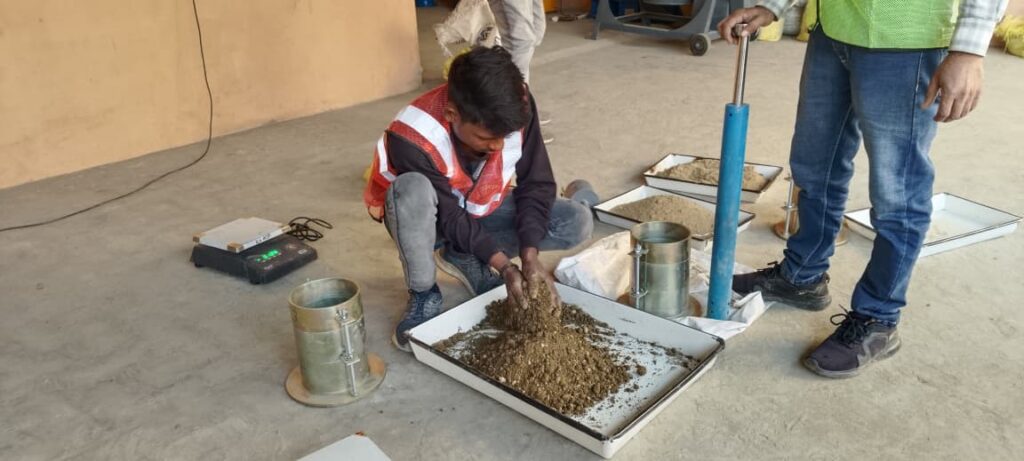
The Free Swell Index (FSI) test is a laboratory test used to determine the swelling potential of soil when immersed in water under unconstrained conditions. It helps in identifying expansive soils containing clay minerals such as montmorillonite.
FSI (%) = [(Vw - Vk) / Vk] × 100
| Free Swell Index (%) | Swelling Nature | Suitability for Subgrade |
|---|---|---|
| 0 – 20 | Low | Suitable for direct use |
| 20 – 50 | Moderate | Use with control measures |
| Above 50 | High to Very High | Stabilization or replacement required |
No. Free Swell Index measures volume increase without restraint, whereas swell pressure measures pressure developed under confinement.
No. It is only an indicator test and must be supported by other geotechnical tests.
Common methods include lime stabilization, cement stabilization, blending with non-expansive soil, or soil replacement.
Prepare professional Free Swell Index Test reports in minutes using our ready-to-use Excel format with automatic calculations. Accurately determine the Free Swell Index (FSI) of expansive soils while eliminating manual calculation errors and generating laboratory-ready reports instantly.
✔ Secure Payment | ✔ Instant Download | ✔ Editable Excel
Engineering Precision. Digital Quality. Highway Excellence.
© 2026 HIGHWAY QUALITY TEST. All rights reserved.