Top 9 Proven Steps for Bituminous Concrete (BC) Construction
Bituminous Concrete (BC) is the final wearing course of flexible pavement laid in 30–50 mm thickness over DBM or bituminous base. Construction shall strictly follow MoRTH Clause 507, including approved mix design, controlled laying temperature, proper compaction and quality control tests.
1. Scope
Methodology for laying of DBM in this project is detailed herein under. This method statement is based on parameters conforming to MoRTH, MS-2 Specifications. The construction of pavement layers on existing road involves the dismantling of existing bituminous layers, widening and strengthening of the existing road. This work covers preparation of surface, tack coat application, production of BC mix, transportation, laying, compaction, joint treatment and quality control testing in accordance with MoRTH Clause 507.
2. Reference Standards
3. Equipment Required
Materials & Job Mix Design
Test Procedure of DBM & BC Mix Design (as per MoRTH & IRC Specifications)
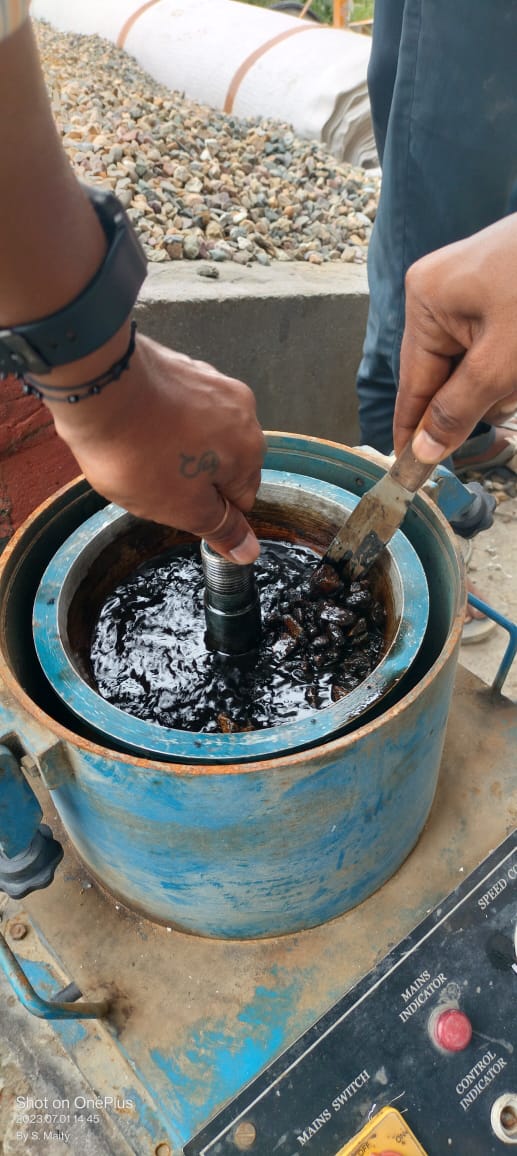
Job Mix Design for BC shall be conducted in the Field Laboratory using Marshall Method. The materials shall be collected directly from the stockyard / storage tank and shall be checked for various physical requirements.
The testing shall be carried out in the presence of the Consultant and submitted for approval.
Approval of JMF: Approval shall be based on witnessed testing by the Independent Engineer. Samples shall be tested in in-house QC lab. Any change in material source requires submission of new JMF for approval prior to execution.
Once the plant trials have been successfully completed and approved, the laying trials are executed to demonstrate that the proposed mix can be successfully laid and compacted in accordance with Clause 501. The laying trial shall be carried out on a suitable area which is not to form part of the works. The area of the laying trials shall be a minimum of 100 sq. m. of construction similar to that of the project road, and it shall be in all respects, particularly compaction, the same as the project construction, on which the bituminous material is to be laid.
Information to AE is given of the proposed method for laying and compacting the material. The density of the finished paving layer shall be determined by taking cores, no sooner than 24 hours after laying. Once the laying trials have been approved, the same plant and methodology shall be applied to the laying of the material on the project.
Tack Coat shall consist of the application of a single coat of low viscosity liquid bituminous material on the existing bituminous surface using a calibrated boom pressure sprayer, ensuring uniform and continuous coverage. The application shall be carried out at a controlled speed of approximately 45 km/hour to achieve proper bonding between existing surface and subsequent bituminous layers.
Transportation, Paving & Compaction Methodology (Enhanced)
1. Transportation of Bituminous Mix
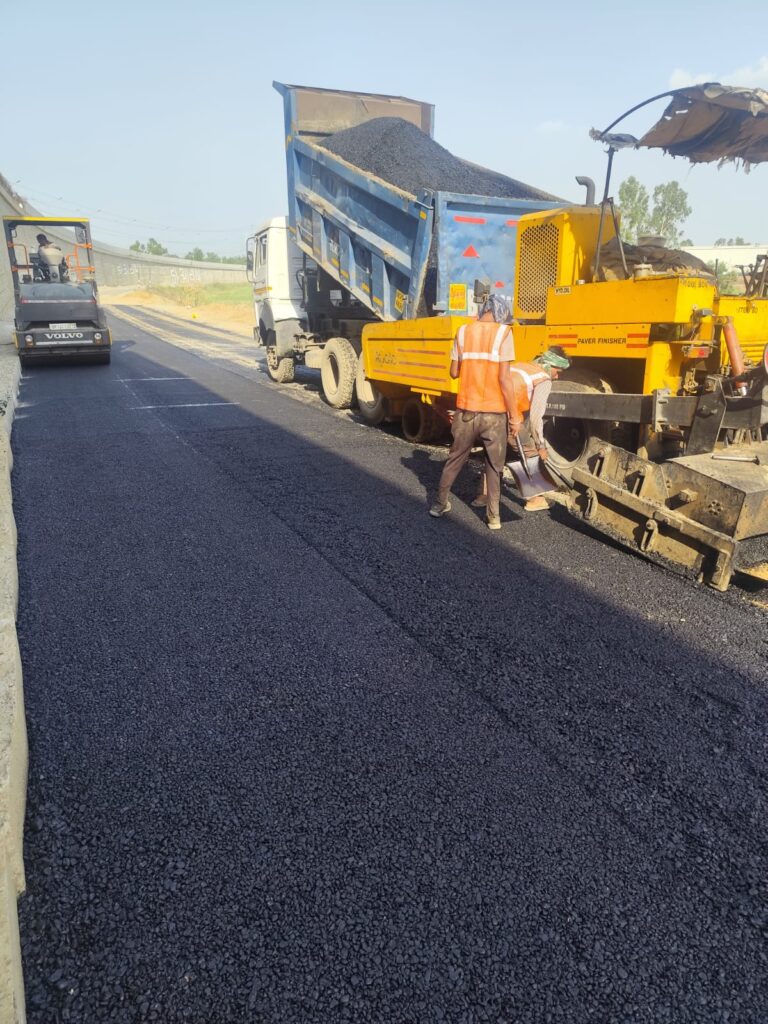
Hot Mix shall be transported in rear tipping dumpers of minimum 10T capacity or higher, ensuring uninterrupted supply to the paver. All vehicles shall be clean, leak-proof, and properly insulated where required.
To prevent heat loss, each dumper shall be fully covered with heavy-duty tarpaulin immediately after loading. The mix temperature shall be monitored at plant, dispatch, and site to ensure compliance with MoRTH specifications.
2. Paving Operations
Paving shall be carried out using a high-performance Asphalt Paver equipped with hydraulically extendable screed capable of maintaining precise longitudinal and transverse profiles, gradients, and levels.
Pavers of approved make shall be deployed, capable of paving up to 11.0 m width for full carriageway laying. For service roads and restricted areas, pavers capable of paving up to 5.5 m width shall be used.
Continuous and uniform paving shall be ensured without segregation, with automatic sensor control wherever applicable to maintain specified thickness and smooth riding quality.
3. Temperature Control
The temperature of the mix at the time of laying shall be strictly maintained as per approved Job Mix Formula (JMF). Any material outside permissible temperature limits shall be rejected at site.
Table 500-2: Mixing, Laying and Rolling Temperatures for Bituminous Mixes (°C)
| Bitumen Grade | Bitumen Temp (°C) | Aggregate Temp (°C) | Mixing Temp (°C) | Laying Temp (°C) | Rolling Temp (Start ≥ °C) |
|---|---|---|---|---|---|
| VG-40 | 160 - 170 | 160 - 175 | 160 - 170 | 150 - 165 | 150 Min |
| VG-30 | 150 - 165 | 160 - 175 | 150 - 165 | 145 - 165 | 140 Min |
| VG-20 | 145 - 165 | 150 - 165 | 145 - 165 | 140 - 160 | 135 Min |
| VG-10 | 140 - 160 | 150 - 165 | 140 - 160 | 130 - 150 | 130 Min |
Note: Rolling must be completed before the mat cools down to the specified minimum rolling temperatures to ensure proper compaction and interlocking of aggregates.
4. Rolling & Compaction Sequence
Breakdown rolling shall commence immediately behind the paver and shall start only when the mix temperature is below 120°C and stable enough to avoid displacement or cracking.
Rolling shall be completed before the mix temperature falls below 80°C to ensure optimum density and interlocking of aggregates.
Compaction shall be achieved using a combination of:
- 10T Double Drum Vibratory Roller (Primary Compaction)
- Pneumatic Tyre Roller (Secondary Compaction / Kneading Effect)
Final rolling shall ensure elimination of roller marks and achievement of uniform density across the entire surface width.
5. Quality Control & Testing
Finished surface levels shall be jointly verified with the Consultant and compared with approved design levels and tolerances.
Field density shall be checked using Sand Replacement Method or Nuclear Density Gauge at specified frequency as per QA/QC plan.
Core samples shall be extracted using a calibrated core cutting machine. All laboratory tests including thickness, density, and bitumen content shall be carried out to ensure compliance with approved specifications and JMF.
6. Opening to Traffic
The newly laid bituminous surface shall be opened to traffic only after complete cooling to ambient temperature or after a minimum curing period of 24 hours, whichever is later, and subject to approval of the Engineer.
7. Safety & Environmental Management
8. Contractor’s Technical Remarks
Additional Items
Daily Progress Reports
Composition of Bituminous Concrete (BC)
| Grading | 1 | 2 |
|---|---|---|
| Nominal Aggregate Size | 19.0 mm | 13.2 mm |
| Layer Thickness | 50 mm | 30-40 mm |
| 19.00 mm | 90-100 | 100 |
| 13.20 mm | 59-79 | 90-100 |
| 9.5 mm | 52-72 | 70-88 |
| 4.75 mm | 35-55 | 53-71 |
| 2.36 mm | 28-44 | 42-58 |
| 0.075 mm | 2-8 | 4-10 |
| Bitumen Content | Min 5.2% | Min 5.4% |
Quality Control Inspection & Frequency
Quality Control Inspection & Frequency – Bituminous Concrete (BC)
| Work | Inspection Type | Property / Test | Specification | Frequency | Requirement / Criteria | |||||||||||||||||||||||||||||||||||||||||
|---|---|---|---|---|---|---|---|---|---|---|---|---|---|---|---|---|---|---|---|---|---|---|---|---|---|---|---|---|---|---|---|---|---|---|---|---|---|---|---|---|---|---|---|---|---|---|
| Bituminous Concrete (BC) | Inspection at Source – Properties of Binder & Aggregate | Quality of Binder | IS:1201 to IS:1220 & IS:15462 | 1 Sample / Lot | Ordinary Bitumen complying with IS:73 (2013) & Modified Bitumen complying with IRC:SP:53-2010 | |||||||||||||||||||||||||||||||||||||||||
| Aggregate Impact Value | IS:2386 (Part 4) | 1 Test / 350 m³ | 24% (Max) | |||||||||||||||||||||||||||||||||||||||||||
| Los Angeles Abrasion Value | IS:2386 (Part 4) | As & When Required | 30% (Max) | |||||||||||||||||||||||||||||||||||||||||||
| Combined Flakiness & Elongation Index | IS:2386 (Part 1) | 1 Test / 350 m³ | 35% (Max) | |||||||||||||||||||||||||||||||||||||||||||
| Sand Equivalent Value | IS:2386 (Part 4) | 1 Test / Source | 50% (Min) | |||||||||||||||||||||||||||||||||||||||||||
| Stripping Value | IS:6241 | 1 Test / Source | Min Retained Coating 95% | |||||||||||||||||||||||||||||||||||||||||||
| Soundness Test | IS:2386 (Part 5) | 1 Test / Source |
12% Max with Sodium Sulphate 18% Max with Magnesium Sulphate | |||||||||||||||||||||||||||||||||||||||||||
| Water Absorption Value | IS:2386 (Part 3) | 1 Test / Source | 2% (Max) | |||||||||||||||||||||||||||||||||||||||||||
| Plasticity Index | IS:2720 (Part 5) | 1 Test / Source | 4% (Max) | |||||||||||||||||||||||||||||||||||||||||||
| Stone Polishing Value | BS:812-114 | 1 Test / Source | 55 (Min) | |||||||||||||||||||||||||||||||||||||||||||
| Inspection at Source – Properties of Mix | Aggregate Grading (Mix Aggregates) | IS:2386 (Part 1) |
1 Test / 400 MT of Mix Minimum 2 Tests / Plant / Day |
| ||||||||||||||||||||||||||||||||||||||||||
Quality Control Tests for Bituminous Mix
| Test | Standard | Frequency | Requirement |
|---|---|---|---|
| Marshall Stability | ASTM D1559 / AASHTO T245 | 3 Samples / 400 MT (Min 2 Sets/Day) | As per MoRTH |
| Marshall Flow | ASTM D1559 / AASHTO T245 | 3 Samples / 400 MT (Min 2 Sets/Day) | As per MoRTH |
| Air Voids | ASTM D2726 | 3 Samples / 400 MT (Min 2 Sets/Day) | As per MoRTH |
| Voids in Mineral Aggregate (VMA) | ASTM D2726 | 3 Samples / 400 MT (Min 2 Sets/Day) | As per MoRTH |
| Voids Filled with Bitumen (VFB) | ASTM D1559 | 3 Samples / 400 MT (Min 2 Sets/Day) | As per MoRTH |
| Binder Content | ASTM D2172 | 1 Test / 400 MT (Min 2/Day) | 5.2% (Gr-II), 5.4% (Gr-I) |
| Water Sensitivity Test | AASHTO T283 | 1 Test / Mix | Minimum 80% |
Temperature Control
| Parameter | Temperature Range |
|---|---|
| Aggregate Temperature | 150°C – 170°C |
| Binder Temperature | 150°C – 165°C |
| Discharge Temperature | 150°C – 165°C |
Aggregate Grading – Permissible Variation
| Sieve Size | Permissible Variation |
|---|---|
| 19 mm & Above | ±7% |
| 13.2 – 9.5 mm | ±6% |
| 4.75 mm | ±5% |
| 2.36 – 1.18 – 0.600 mm | ±4% |
| 0.300 – 0.150 mm | ±3% |
| 0.075 mm | ±1.5% |
Other Permissible Variations
| Parameter | Variation |
|---|---|
| Binder Content | ±0.3% |
| Mixing Temperature | ±10°C |
In-Process Inspection
| Activity | Specification | Frequency | Requirement |
|---|---|---|---|
| Check Level Control of Paver | - | At Regular Close Intervals | - |
| Temperature of Mix Before Laying & Rolling | MoRTH Specification | At Regular Close Intervals |
Laying Temperature: 140°C (Min) Rolling Temperature: 90°C (Min) Modified Binder: Laying: 130°C – 160°C Rolling: 115°C – 155°C |
Acceptance Criteria
| Test / Parameter | Standard | Frequency | Requirement |
|---|---|---|---|
| Control of Compaction (Field Density)-(Core Cutting)-NDG | ASTM D2726 | 1 Test / 700 m² | As per MORTH Clause 903.4.2 |
| Tolerance in Surface Level | Standard Survey Practice | As per Specification | Machine Laid ±6 mm |
| Surface Regularity | IRC-SP-16 | As & when required | 3 mm |
| Roughness (Longitudinal) | IRC-SP-16 | As & when required | < 2000 mm/km |
Maintaining proper temperature (160–170°C), continuous paving, and correct rolling sequence are the top 3 factors controlling BC quality on site.
Inspection Plan
| S.No | Activity | Inspection | Tests | Remarks |
|---|---|---|---|---|
| 1 | Approval of DBM Top | Yes | Yes | Density & levels jointly recorded |
| 2 | Spreading Layers | Yes | - | Method control |
| 3 | Final Layer | Yes | Yes | Joint survey |
| 4 | Density Check | Yes | Yes | After compaction |
Safety Measures
- All safety measures shall be as per approved EHS Plan.
9. Opening to Traffic
Traffic shall be permitted only after cooling of BC surface and written approval from Engineer-in-Charge.
Previous Layer → DBM Construction