Apparatus
| Item | Specification / Notes |
|---|---|
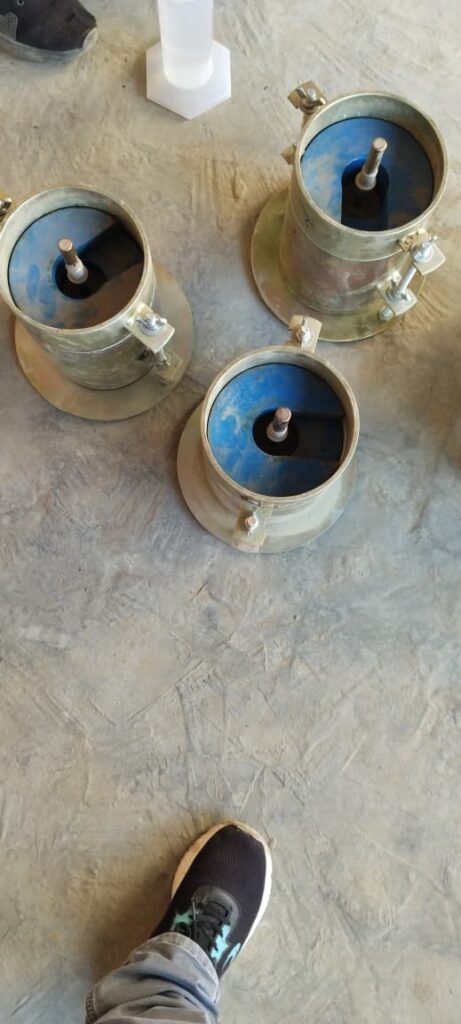
| Steel cylindrical measure | Internal diameter 115 mm, height 180 mm |
| Plunger / piston | Diameter 150 mm (for main apparatus) |
| Tamping rod | Diameter 16 mm (rounded end), length 450–600 mm |
| Balance | Capacity ≈ 3 kg with 0.01 g accuracy |
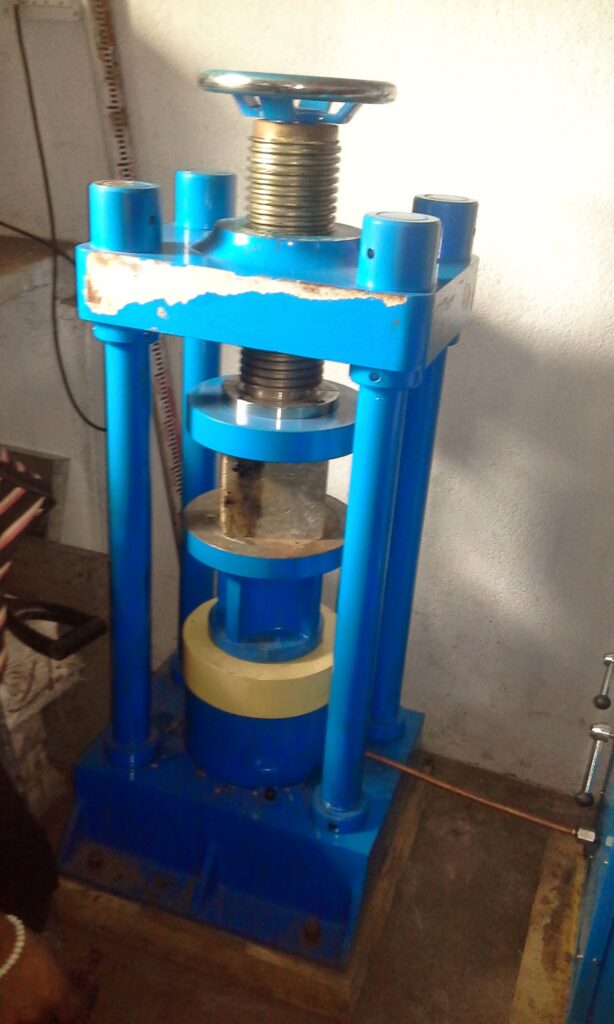
| Compressive testing machine | 40 tonnes capacity, uniform loading rate 4 tonnes/min |
| IS sieves | 12.5 mm, 10 mm, and 2.36 mm |
Sample Selection & Preparation
- Use aggregate passing 12.5 mm and retained on 10 mm IS sieve.
- Ensure the aggregates are surface-dry (no visible free moisture).
- Sample weight: as required by the cylinder capacity — record dry weight (W1).
Procedure (Step-by-step)
- The aggregate passing 12.5 mm IS sieve and retained on 10 mm IS sieve shall be selected for standard test.
- The aggregate should be in surface dry condition before testing.
- The cylindrical measure shall be filled by the test sample of aggregate in three layers of approximately equal depth, each layer being tamped 25 times by the rounded end of the tamping rod.
- After the third layer is tamped, using the tamping rod as a straight edge levels off the aggregate at the top of the cylindrical measure.
- Weigh the sample and repeat the test for another trial.
- The cylinder of the test apparatus shall be placed in position on the base plate; place one third of the test sample in this cylinder and tamp 25 times by the tamping rod.
- Similarly, the other two parts of the test specimen are added, each layer being subjected to 25 blows.
- The surface of the aggregates shall be levelled and insert the plunger so that it rests on this surface in level position.
- Keep the cylinder with the test sample and the plunger in position and place on the compression testing machine.
- Load is then applied through the plunger at a uniform rate of 4 tons per minute until the total load is 40 tonnes, and then release the total load.
- Remove the aggregates including the crushed portion from the cylinder and sieve on a 2.36 mm IS sieve. Collect the material, which passes this sieve.
- The above crushing test shall be repeated on second sample of the same weight in accordance with above test procedure. Thus two tests are made for the same specimen for taking an average value.
Calculation
Aggregate Crushing Value (ACV) is the percentage ratio of crushed fines to the total sample weight.
Aggregate Crushing Value = (W2 / W1) × 100
Where:
W1 = Total dry weight of sample
W2 = Weight of material passing 2.36 mm IS sieve
Report: Mean of two test results
Results & Reporting
Report the mean of the two test values as the final ACV for the aggregate sample. Include:
- Sample identification and date
- Apparatus used and calibration status
- W1 and W2 values for both trials and the mean ACV
- Any deviations from standard procedure
Acceptance Limits
| Application | Maximum ACV (%) |
|---|---|
| Cement concrete pavements | 30 |
| Wearing surfaces | 45 |
Frequently Asked Questions
Why do we use a 2.36 mm sieve for fines?
2.36 mm is the standard IS limit for defining crushed fines in this test — it provides a consistent basis to compare strength characteristics across aggregate sources.
What if my aggregate grading differs?
If grading is outside the specified range (12.5–10 mm) use a representative fraction or follow the standard practice for coarse/fine fractions as specified in the relevant code.
Notes & Best Practices
- Always run two trials and report the mean to reduce random error.
- Ensure the compression machine platen and the plunger are clean and parallel before applying load.
- Record ambient conditions and any visible degradation of sample during handling.