
Ductility Test of Bitumen – Complete Guide
Learn the step-by-step procedure, apparatus, sample preparation, calculation, and result interpretation for ductility testing of bitumen, as per IS 1208 standard. Explore other bitumen testing guides for complete QA/QC in highway construction.
Introduction
The Ductility Test measures the ability of bitumen to deform under tensile stress without breaking. This property is crucial for highway construction, as it indicates flexibility of bituminous pavements and resistance to cracking under traffic loads and temperature variations.
Objective
To determine the ductility of bituminous material, which measures the distance a bitumen sample can stretch before breaking.
Purpose of Ductility Test
- Assess tensile property and flexibility of bitumen.
- Ensure bitumen can withstand temperature variations without cracking.
- Determine suitability of bitumen for highway surfacing works.
Applicable Standards
IS 1208: Ductility of Bitumen – Standard Method
Apparatus Required
- Ductility testing apparatus with movable clamp and water bath.
- Test mould (100 mm × 10 mm × 3 mm).
- Hot knife, thermometer, stopwatch.
- Water bath maintained at 27 ± 0.5°C.
Sample Preparation
- Heat bitumen sample to a fluid state without overheating.
- Strain the molten bitumen through a 90-micron sieve to remove impurities.
- Pour into the standard test mould carefully to avoid air bubbles.
- Allow it to stand for 30–40 minutes, then place the mould in a water bath at 27°C for 30 minutes.
- Remove mould, level surface using a hot knife, then return to water bath for 85–95 minutes.
- Remove mould sides and attach clips to the ductility machine carefully without applying initial strain.
Visual Stepwise Guide
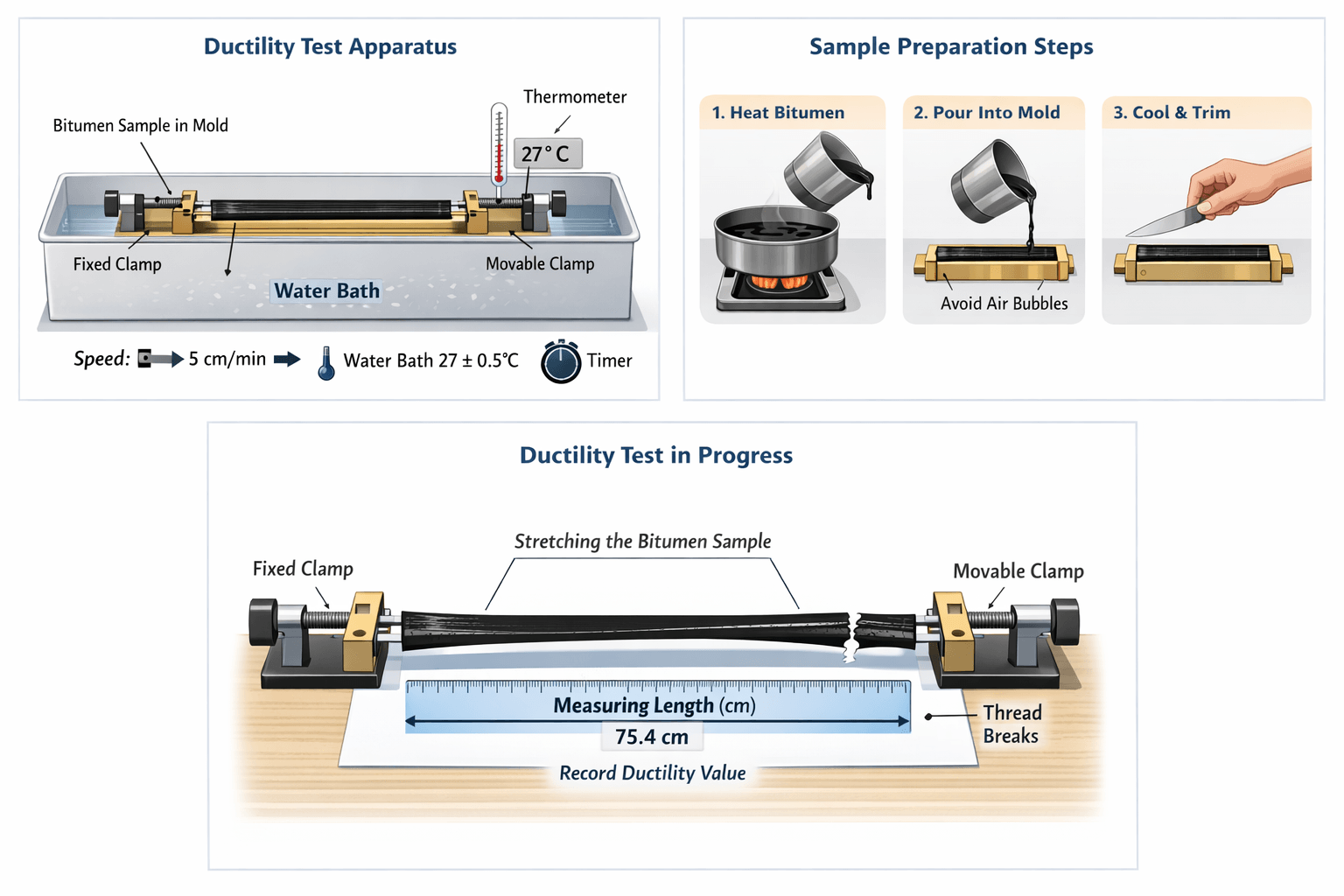
Stepwise illustration showing apparatus, sample preparation, and testing process for ductility of bitumen.
Test Procedure
- Immerse the prepared sample in the water bath maintained at 27 ± 0.5°C.
- Attach the sample ends to the movable and fixed clamps of the ductility apparatus.
- Start the apparatus and allow the movable clamp to move at a speed of 5 cm/min (50 ± 2.5 mm/min).
- Ensure the sample remains immersed in water at a depth of at least 10 mm throughout the test.
- Record the distance (cm) at which the bitumen thread breaks. This distance is the ductility value.
- Repeat the test for three specimens and calculate the average.
Observation & Calculation
The ductility of bitumen is expressed in centimeters (cm).
Formula: Ductility (cm) = Average length at which bitumen breaks
Compare the result with IS 1208 recommended minimum values for the particular bitumen grade.
Result Interpretation
- High ductility indicates good flexibility and resistance to cracking.
- Low ductility may indicate hard or aged bitumen unsuitable for flexible pavements.
- Typical values: 75–100 cm for penetration grade bitumen (VG-10, VG-20, VG-30).
Limits (IS Requirements)
- A35 & S35 Grade: Minimum ductility = 50 cm at 27°C
- Other Grades: Minimum ductility = 75 cm at 27°C
Common Mistakes
- Heating bitumen above recommended temperature (overheating reduces ductility).
- Air bubbles in sample causing early break.
- Improper water bath temperature control.
- Non-uniform sample thickness or trimming errors.
Related Bitumen Tests
Browse by Test Category
Frequently Asked Questions
Why is ductility important in bitumen?
Ductility shows how much the bitumen can stretch without breaking. Flexible bitumen reduces cracking in pavements under traffic and temperature changes. Learn about other bitumen tests here.
What is the standard temperature for the test?
The test is performed at 27 ± 0.5°C according to IS 1208.
How many specimens should be tested?
Three specimens should be tested and the average length recorded as the ductility value.