Methodology for Slab Culverts and Minor Bridges
1. Scope
The work shall consist of Reinforced Cement Concrete (RCC) works and furnishing of structures for slab culverts and minor bridges at locations shown in approved drawings or as instructed by the Engineer, in accordance with MoRTH Specifications.
2. Reference
- Contract Agreement
- IRC: SP: 84-2014
- MoRTH Specifications (5th Revision)
- Relevant Approved Drawings
3. Setting Out
After completion of site preparation, alignment of slab culverts or minor bridges shall be marked on the ground using lime and string.
Locations of wing walls, return walls, abutments, and other structural components shall be pegged accurately with reference to the approved alignment.
Temporary Bench Marks (TBM) shall be established near the structure location for construction reference. The TBM location shall be selected carefully to avoid disturbance during construction activities and shall remain intact until completion of the structure.
4. Working Drawings
Working drawings, structural drawings, and relevant details shall be submitted to the AE before commencement of work. After review and approval by the AE, setting out of the structures shall be carried out.
5. Selection of Materials
5.1 Formwork
All formwork materials shall conform to IRC:87 requirements.
- Only steel formwork shall be used.
- All bolts shall be countersunk.
- Approved internal ties and plastic spacers shall be used.
- Structural steel tubes used for staging shall have minimum wall thickness of 4 mm.
5.2 Reinforcement
Reinforcement shall consist of TMT Fe-500 grade steel bars conforming to IS:1786 and approved drawings.
- Only uncoated steel reinforcement shall be used.
- Steel shall conform to approved specifications and drawings.
5.3 Concrete & Brick
Concrete, brick, and other construction materials shall conform to Section 1000 of MoRTH Specifications.
6. Equipment & Machinery
- Batching Plant
- Transit Mixer
- Concrete Vibrator & Needles
- Wheel Loader
- Excavator
- Shuttering Materials
- Bar Bending & Cutting Machine
- Concrete Pump
- Hydraulic Crane
- Water Tanker
- Tractor Trolley
7. Method of Operation
7.1 Formwork
a. Design of Formwork
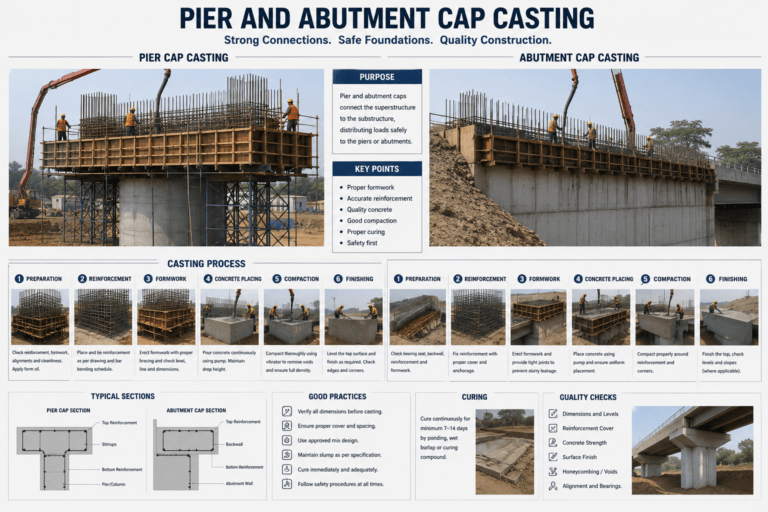
Complete design and drawings of formwork for slab superstructure shall be submitted for approval before commencement of work. Formwork design shall conform to IRC:87.
b. Workmanship
Workmanship shall comply with Clauses 1504.2, 1504.4, and 1504.10 of MoRTH Specifications.
- Formwork shall produce concrete true to shape, line, level, and dimensions.
- Steel tubes used in staging shall be free from bends and defects.
- Staging shall rest on firm foundations considering subsoil conditions.
c. Preparation of Formwork Before Concreting
- Contact surfaces shall be cleaned and dried before application of release agent.
- Approved water-based release agent shall be used.
- Release agent shall not come into contact with reinforcement or hardened concrete.
- Excess release agent shall be wiped off properly.
d. Removal of Formwork
De-shuttering and de-centering procedures shall be planned in advance and submitted to the AE for approval. Formwork shall not be removed without prior approval.
7.2 Reinforcement
a. Bending of Reinforcement
Bar Bending Schedule (BBS) shall be prepared and submitted for approval before start of work.
- BBS shall include bar mark, shape, cutting length, quantity, and weight.
- Separate schedules shall be prepared for spacers and chairs.
b. Placing of Reinforcement
-
Reinforcement shall be placed as per approved drawings and inspected by the AE before concreting.
-
Bars shall be tied securely using binding wire to avoid displacement during concreting.
-
Cover blocks shall be made from cement, sand, and aggregate of the same durability as surrounding concrete.
-
Spacer bars shall be provided at approximately 1 m intervals.
-
Minimum spacer diameter shall be 12 mm or equal to the largest main reinforcement diameter, whichever is greater.
-
Auxiliary supports such as spacers, chairs, and blocks shall be used to maintain reinforcement position.
8. Concrete
8.1 Grades of Concrete
Concrete used in structures shall be Design Mix Concrete of approved grade as specified in drawings.
8.2 Proportioning of Concrete
Concrete batching shall be carried out using computerized batching plants. Measuring equipment shall be maintained in clean and serviceable condition and calibrated periodically.
8.3 Water Cement Ratio
Water-cement ratio shall be maintained considering moisture content of aggregates and weather conditions.
8.4 Admixtures
Approved admixtures conforming to IS:6925 and IS:9103 may be used with prior approval of AE.
- Admixtures containing chlorides, sulphides, sulphates, nitrates, or harmful materials shall not be used.
- Hydrogen or nitrogen generating admixtures shall not be permitted.
8.5 Size of Coarse Aggregate
Maximum size of coarse aggregate shall conform to Table 1700-7 of MoRTH Specifications.
9. Transporting, Placing & Compaction of Concrete
Concrete shall be transported using transit mixers and placed using concrete pumps or suitable chutes.
- Pipeline routing shall have minimum bends.
- Concrete temperature during placing shall be maintained between 5°C and 40°C.
- Concrete shall be compacted within 30 minutes of discharge.
- Concrete shall be placed in horizontal layers not exceeding 300 mm compacted thickness.
- Fresh concrete shall not be placed against concrete older than 30 minutes without proper construction joints.
- Concreting shall not be carried out when ambient temperature exceeds 40°C.
10. Protection & Curing
Concrete surfaces shall be protected and cured immediately after placement.
- Surfaces shall be kept continuously wet by ponding or covering with wet hessian cloth, canvas, or sacks.
- Curing shall continue for a minimum period of 14 days.
11. Quality Control
- Inspection of Reinforcement & Cover
- Formwork Inspection
- Concrete Slump Test
- Cube Casting & Testing
- Line, Level & Alignment Checks
- Inspection of Bearings & Expansion Joints (if applicable)
12. Safety
-
All equipment and machinery shall be inspected before use.
-
Workers shall use proper PPE such as helmets, reflective jackets, gloves, and safety shoes.
-
Barricading and caution boards shall be provided around work areas.
-
Proper scaffolding and safe working platforms shall be ensured during slab construction.
-
Traffic diversion and warning signage shall be maintained throughout construction activities.