Profile Corrective Course DBM

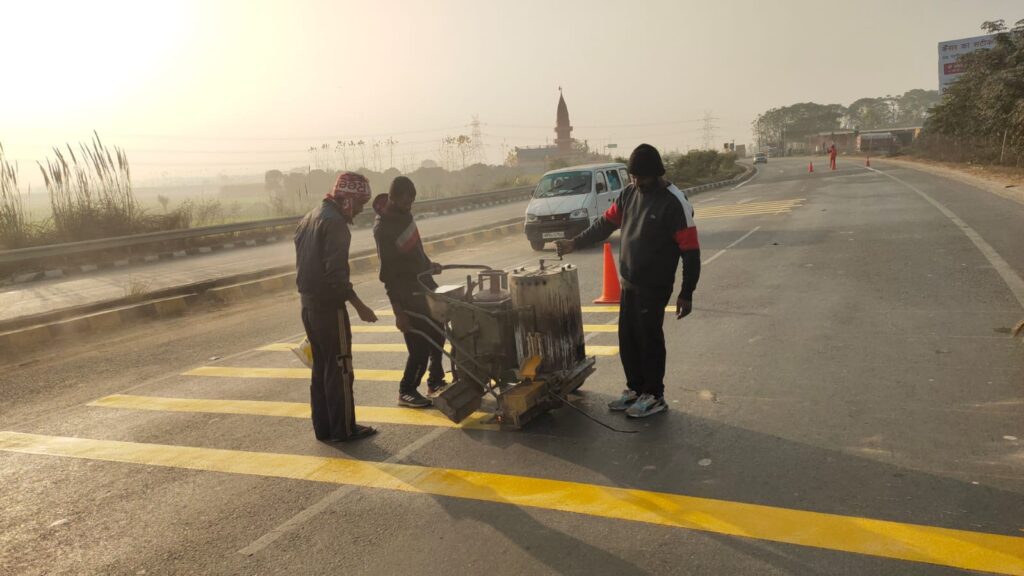
🚧 Profile Corrective Course (DBM) Construction Methodology Profile Corrective Course (DBM) Construction Methodology This work involves preparing an existing road surface (granular or bituminous) and laying a bituminous mix, typically 50 mm to 100 mm thick, to correct the pavement profile and strengthen the surface. 1.0 Scope and Preparation The Profile Corrective Course (PCC) is a layer of varying thickness designed to correct the existing pavement profile (e.g., local depressions, sags, or incorrect camber/super-elevation) before the main overlay. Existing Bituminous Surface Repair: Existing potholes and cracks must be repaired and sealed according to relevant specifications (MoRT&H Clauses 3004.2 and 3004.3). Scarifying: Where specified, the existing bituminous layer is carefully removed without disturbing the underlying layers. The exposed base is reworked, compacted, and primed (Clause 502) if needed. Tack Coat: After preparation, a Tack Coat (bituminous emulsion) is applied to the surface before laying the new DBM. Existing Granular Surface All loose materials are removed, and the surface is prepared to be firm and clean. If the PCC is bituminous, the granular surface must be primed (Clause 502) after removing loose material. The surface must be free from dust and capable of being swept by a mechanical broom. Pre-Laying Checks Before and after scarifying/preparation, the existing road top levels must be checked and recorded by the Engineer’s representative. 2.0 Resource Arrangement: Plant & Equipment Sl. No. Name of Equipment Nos. 1 Batch Type Hot Mix Plant (Capacity 200 TPH) 01 2 Sensor Paver (Automatic Screed Control) 01 3 Pneumatic Tyred Roller (PTR) 01 4 Tandem Vibratory Roller 02 5 Bitumen Sprayer (for Tack Coat) 01 6 Compressor / Hydraulic Broom 01 7 Water Tanker 01 8 Tipping Trucks As Required 3.0 Materials and Mix Production 3.1 Materials Aggregates: Coarse and fine aggregates from approved quarries. Bitumen: VG-30 or VG-40 grade from approved sources. Tack Coat: Rapid setting Bituminous Emulsion from approved sources. 3.2 Job Mix Formula (JMF) The JMF determines the precise proportions of coarse aggregates, fine aggregates, bitumen, and mineral filler/additives. It is designed in the site laboratory and must be approved by the Independent Engineer (AE/IE)/PMC. The process is the same as we do for DBM & BC mix designs. 3.3 Hot Mix Plant Operation Storage: Bitumen (VG-30/VG-40) stored in automatic temperature-controlled tanks (150°C to 165°C). Aggregates: Separate cold bins and feeders proportion the aggregates and dust into the dryer. Drying: Dryer continuously heats and dries aggregates (150°C to 170°C) minimizing fuel consumption and dust release. Mixing: Aggregates and binder combined in an inert, steam-laden atmosphere. Bitumen Temp: 150°C–165°C, Aggregate Temp: 150°C–170°C, Mixture Max Temp: 165°C. 4.0 Laying and Compaction 4.1 Transportation of Mix Mix loaded into tipping trucks (up to 20 MT). Beds sprayed with release agent. Covered with tarpaulin to maintain temperature. Temperature at loading: 155°C to 165°C. 4.2 Application of Tack Coat Applied using a mechanical sprayer. Rate: 0.25–0.30 Kg/m². Emulsion Temp: 20°C–70°C. Allow tack coat to cure before DBM layer is laid. 4.3 Spreading and Finishing Sensor wire fixed over brackets at 10m intervals. Paver guided to achieve designed finished levels. Laying temperature (Min): 125°C. Paver uses fully activated screed with tampers/vibrators. Loose thickness allowance: 25%. Manual methods for irregular areas. 4.4 Compaction Equipment: Vibratory Tandem Roller + PTR. Rolling sequence: From lower end to higher side. Passes determined on-site. Density: Rolling until specified density achieved or no further movement. Transverse joints cut full thickness; edges painted with hot bitumen/tack coat. 5.0 Quality Control and Traffic Core Cutting: After 24 hours to check density. Bitumen Testing: Softening Point, Penetration, Ductility for each consignment. Surface Finish: Must conform to Clause 902 of MoRT&H. Opening to Traffic: Minimum 24 hours after laying. Traffic diversion with cones, caution boards, flagmen. Print / Save as PDF Top FAQs – DBM Profile Corrective Course What is PCC? A layer to correct existing pavement profile before overlay. When is it required? For depressions, potholes, uneven camber or sags. Typical thickness? 50–100 mm per layer. Materials used? Aggregates, VG-30/VG-40 bitumen, mineral filler, tack coat. Surface preparation? Scarify, repair cracks/potholes, broom sweep, prime or tack coat. Compaction method? PTR + Tandem Vibratory Rollers until specified density. Joints? Full-depth transverse cut, edges coated with hot bitumen/tack coat. Traffic opening? Minimum 24 hours after laying. QC measures? Core density, bitumen tests, surface level checks. Bridge paving? Yes, temperature ≤145°C unless approved.

Water Absorption Test

Water Absorption Test of Coarse Aggregate — Objective, Procedure & Calculation Water Absorption Test of Coarse Aggregate The Water Absorption Test determines the percentage of water absorbed by coarse aggregates, providing an indication of pore structure, density, and suitability for high-quality concrete and asphalt works. 🎯 Objective To determine the Water Absorption (%) of a coarse aggregate sample using SSD and Oven-dry mass values. 🛠️ Apparatus Required Tray or suitable container Balance (Capacity ≥ 3 kg, Accuracy 0.5 g) Oven (100–110°C) Cotton cloth 🧪 Test Procedure 1. Immersion (Saturation) Take at least 2000 g (2 kg) of aggregate. Immerse in clean water for 24 hours to fill internal pores. 2. Saturated Surface Dry (SSD) Condition Remove the sample and wipe gently with a cotton cloth. Ensure no visible free water film remains on the surface. Weigh the sample → SSD Mass (A). 3. Oven Drying Place SSD sample in oven at 100–110°C for 24 hours. Cool it and weigh → Oven‑Dry Mass (B). 4. Repeat Trial Repeat the procedure on another sample and take the average. 🧮 Calculation Water Absorption (%) = (A − B) / B × 100 Where: A = SSD Mass of aggregate B = Oven‑Dry Mass of aggregate Example If: A (SSD Mass) = 2045 g B (Oven-Dry Mass) = 2000 g Water Absorption (%) = (2045 − 2000) / 2000 × 100 = 45 / 2000 × 100 = 2.25% 💡 Importance in Construction Mix Design Adjustments: Highly absorptive aggregates steal mix water → affects workability. Durability: Higher absorption = higher porosity → weaker freeze-thaw and weathering resistance. ✔️ Typical Acceptable Limits Aggregate Type Max Water Absorption (%) Coarse Aggregate (Normal concrete) ≤ 2% Fine Aggregate (Sand) ≤ 3% For high-performance or severe exposure concrete, stricter limits may apply. 📘 Background & Standard Reference The Water Absorption Test is covered under IS 2386 (Part 3) – Specific Gravity, Density, Voids, Absorption and Bulking. This test provides insight into the internal pore structure of aggregates, which directly affects concrete durability, water demand, and long‑term performance. Aggregates with excessive pores tend to absorb more water, which may lead to reduced compressive strength and increased shrinkage. By determining absorption, engineers calibrate mix water content accurately to achieve the target workability and strength parameters. ⚙️ Factors Affecting Water Absorption Aggregate Type: Crushed rock typically has lower absorption than natural aggregates. Surface Texture: Rough, angular particles may retain more surface moisture. Pore Structure: Aggregates with interconnected pores have higher absorption levels. Weathering: Older, weathered aggregates tend to be more porous. Mineral Composition: Some minerals inherently exhibit higher porosity. 🔍 Significance of SSD Condition The SSD (Saturated Surface Dry) condition is critical because it represents the state where internal pores are full of water while the exterior surface is dry. This allows mix water calculations to remain accurate. If aggregates are not brought to SSD before batching, they either absorb mix water (leading to lower workability) or contribute excess water (making the mix too wet). The SSD condition ensures correct water‑cement ratio, the single most important factor governing concrete strength. 🧱 Impact on Concrete Performance Water absorption is directly linked to aggregate quality. Aggregates with low absorption are denser and more durable, making them suitable for high‑strength and long‑life structures. On the other hand, aggregates with high absorption may lead to increased permeability, reduced freeze‑thaw resistance, and potential durability issues. Additionally, when absorption is high, the concrete mix becomes unpredictable without proper adjustments, affecting slump, cohesiveness, and compaction. ⚠️ Precautions Ensure aggregates are completely submerged during the 24‑hour soaking period. Wipe surface moisture gently—over‑drying may lead to inaccurate SSD readings. Do not exceed oven temperature beyond 110°C to avoid thermal damage. Use a calibrated balance for precise mass measurements. Allow oven‑dry samples to cool in a desiccator if available, to prevent moisture uptake from air. 📌 Notes for Field Engineers In site conditions, aggregates stored in open yards exhibit varying levels of moisture. Regular absorption testing helps determine free moisture correction during batching to maintain consistent mix quality. For automated batching plants, entering accurate absorption values ensures the batching software adjusts water content correctly. This prevents issues such as plastic shrinkage, excessive bleeding, or segregation in fresh concrete. 📘 IS Code References IS Code Description IS 2386 (Part 3) Methods of Test for Aggregates – Specific Gravity, Density, Voids & Water Absorption IS 383 Specification for Coarse and Fine Aggregates for Concrete IS 456 General concrete requirements & material quality guidance ❓ Frequently Asked Questions (FAQ) 1. What is a good water absorption value for coarse aggregates? For most concrete works, water absorption should be ≤ 2%. Lower values indicate denser and more durable aggregates. 2. Why is SSD condition important? SSD ensures that aggregate pores are filled without free surface water. This prevents errors in mix design water calculations. 3. Can high water absorption affect concrete strength? Yes. Aggregates with high absorption draw water from the concrete mix, reducing effective W/C ratio and causing poor workability and potential strength loss. 4. How often should this test be performed? Typically during material approval and periodically during construction to ensure consistent aggregate quality. 5. Do different rocks have different absorption characteristics? Yes. Dense rocks like basalt and granite have low absorption. Porous rocks like sandstone and lightweight aggregates have higher absorption.

Aggregate Crushing Value Test

Aggregate Crushing Value Test — Procedure, Calculation & Limits | QC for Pavements Aggregate Crushing Value (ACV) Test — Procedure, Calculation & Acceptance Limits Quick lab method for QC of aggregates used in concrete pavements — Field & Lab Overview The Aggregate Crushing Value (ACV) test measures the resistance of an aggregate sample to crushing under a gradually applied compressive load. The result helps determine suitability of aggregates for different pavement layers and wearing surfaces. Apparatus Item Specification / Notes Steel cylindrical measure Internal diameter 115 mm, height 180 mm Plunger / piston Diameter 150 mm (for main apparatus) Tamping rod Diameter 16 mm (rounded end), length 450–600 mm Balance Capacity ≈ 3 kg with 0.01 g accuracy Compressive testing machine 40 tonnes capacity, uniform loading rate 4 tonnes/min IS sieves 12.5 mm, 10 mm, and 2.36 mm Sample Selection & Preparation Use aggregate passing 12.5 mm and retained on 10 mm IS sieve. Ensure the aggregates are surface-dry (no visible free moisture). Sample weight: as required by the cylinder capacity — record dry weight (W1). Procedure (Step-by-step) Fill the cylindrical measure in three approximately equal layers. Tamp each layer 25 times using the rounded end of the tamping rod. After the third layer, level off the surface using the tamping rod as a straight edge. Insert the plunger carefully so it rests level on the sample surface. Place the cylinder & plunger assembly on the compression testing machine. Apply load at a uniform rate of 4 tonnes per minute until the total load reaches 40 tonnes, then release the load. Remove crushed material and sieve through a 2.36 mm IS sieve; collect fines that pass the sieve. Weigh the portion passing 2.36 mm (W2). Repeat the test on a second sample and record both W2 values. Calculation Aggregate Crushing Value (ACV) is the percentage ratio of crushed fines to the total sample weight. Aggregate Crushing Value = (W2 / W1) × 100 Where: W1 = Total dry weight of sample W2 = Weight of material passing 2.36 mm IS sieve Report: Mean of two test results Results & Reporting Report the mean of the two test values as the final ACV for the aggregate sample. Include: Sample identification and date Apparatus used and calibration status W1 and W2 values for both trials and the mean ACV Any deviations from standard procedure Acceptance Limits Application Maximum ACV (%) Cement concrete pavements 30 Wearing surfaces 45 Frequently Asked Questions Why do we use a 2.36 mm sieve for fines? 2.36 mm is the standard IS limit for defining crushed fines in this test — it provides a consistent basis to compare strength characteristics across aggregate sources. What if my aggregate grading differs? If grading is outside the specified range (12.5–10 mm) use a representative fraction or follow the standard practice for coarse/fine fractions as specified in the relevant code. Notes & Best Practices Always run two trials and report the mean to reduce random error. Ensure the compression machine platen and the plunger are clean and parallel before applying load. Record ambient conditions and any visible degradation of sample during handling. Quick Checklist Aggregate: 12.5–10 mm Tamping: 25 blows/layer Loading: 4 t/min to 40 t Sieve for fines: 2.36 mm Acceptable ACV: <=30% (concrete pavements) Useful snippets <strong>ACV = (W2 / W1) × 100</strong> Use this procedure

Plastic Limit of Soil

Plastic Limit of soil Test (PL Test) – Procedure, Calculations & Examples Plastic Limit of Soil Test (PL Test) Objective: To determine the plastic limit of Soil (PL) of soil, which is the moisture content at which soil starts to exhibit plastic behavior. Apparatus Required Evaporating dish Spatula Glass plate Moisture containers with lids Rolling rod (3 mm diameter) Sensitive balance (accuracy 0.01 g) Oven (temperature 105–110 °C) Procedure for Plastic Limit Test Take about 20 g of dry, pulverized soil passing through a 425 μm IS sieve. Mix the soil thoroughly with distilled water until it forms a plastic paste. Form a small ball of soil and roll it between fingers and glass plate to form a thread. Use just enough pressure to roll without crushing, at a speed of 80–90 strokes per minute. Continue rolling until the thread diameter is 3 mm. Observe crumbling: Diameter < 3 mm → moisture content is above PL Diameter > 3 mm → moisture content is below PL Repeat rolling and kneading until the thread crumbles at exactly 3 mm. Transfer the crumbled soil immediately to a moisture container, cover, and weigh. Dry the sample in an oven to determine dry weight and calculate moisture content. Repeat at least three times to obtain consistent PL values. Calculations Plasticity Index (PI or Ip): PI = Liquid Limit (LL) – Plastic Limit (PL) PI = WL – WP Toughness Index (TI or IT): TI = IP / IF (IF = flow index from liquid limit test) Liquidity Index (LI or IL): LI = (W – WP) / IP W = natural moisture content of soil Consistency Index (CI or IC): CI = (WP – W) / IP Notes: Maintain uniform rolling strokes for accurate results. Measure moisture content immediately after crumbling. Helps classify soil as low, medium, or high plasticity.