Final Setting Time of Cement Test – IS 4031 (Part 5)
Objective:
The final setting time of cement represents the total time elapsed from the moment water is added to cement until the paste completely loses its plasticity and develops sufficient rigidity to resist a standard penetration, as specified in IS 4031 (Part 5). This property is critical for assessing the suitability of cement in highway, pavement, and concrete construction projects. Incorrect setting times can adversely affect concrete strength, workability, pavement performance, and long-term durability. Therefore, the final setting time test is a mandatory quality control procedure in laboratory and field conditions.
1. Reference Standards
- IS 4031 (Part 5): Methods of Physical Tests for Hydraulic Cement – Determination of Setting Times
- IS 4031 (Part 4): Determination of Standard Consistency of Cement Paste
- IS 8112: Specification for 43 Grade Ordinary Portland Cement (OPC)
- IS 12269: Specification for 53 Grade Ordinary Portland Cement (OPC)
2. Apparatus Required
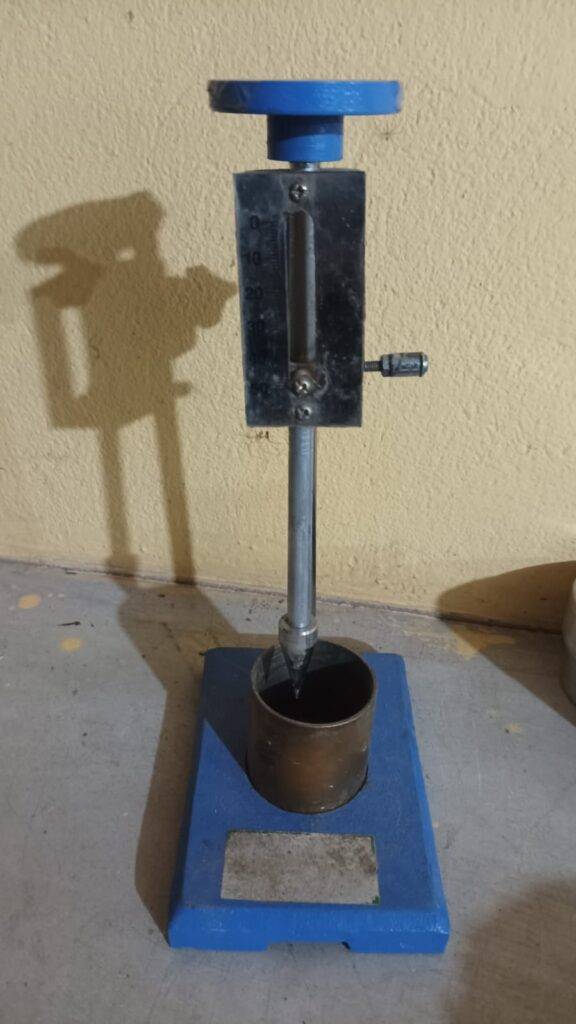
- Vicat apparatus with needle having annular attachment and a 10 mm needle for initial setting time comparison.
- Non-absorbent base plate or glass plate for placing the mould.
- Balance with an accuracy of ±0.01 g for weighing cement.
- Measuring cylinder with an accuracy of ±1 ml for water measurement.
- Mixing bowl or non-reactive container for paste preparation.
- Trowel or spatula for mixing and leveling the paste.
- Stopwatch or digital timer for precise time measurement.
- Controlled ambient conditions (temperature 27 ± 2°C and relative humidity ≥ 50%) as per IS recommendations.
Audit Tip:
Ensure the Vicat needle and annular attachment are clean, undamaged, and calibrated before testing. Calibration errors are a frequent cause of non-compliance during NHAI and third-party audits.
3. Sample Preparation
Cement Sample:
Take 300 g of cement passing completely through a 90 µm IS sieve. Sieving ensures uniform particle size and removes any lumps, which is essential for accurate determination of the final setting time as per IS 4031 (Part 5). Handle the cement carefully to avoid contamination by moisture or dust, which can significantly alter the test results.
Water Content:
Determine the water required for achieving the standard consistency (P) of the cement paste in accordance with IS 4031 (Part 4). Accurate measurement of water is critical, as any deviation can significantly affect the setting time, workability, and repeatability of test results.
Example:
If 400 g of cement is taken for the standard consistency test and the Vicat plunger penetrates the paste to the specified depth when 112 ml of water is added, then the standard consistency (P) of the cement is:
P = (112 ÷ 400) × 100 = 28%
This value (P = 28%) shall be used for calculating the water content required in subsequent tests such as initial setting time, final setting time, and soundness tests. Using incorrect water content may lead to inaccurate setting behavior and non-compliance with IS specifications.
Mixing Procedure
- Gradually add the measured water to the sieved cement to form a paste. Slow addition ensures complete wetting of cement particles and prevents dry pockets.
- Mix thoroughly for 2–3 minutes using a spatula or trowel. The paste should be smooth, uniform, and free of lumps, with no segregation of water or dry particles.
- Immediately proceed to fill the Vicat mould placed on a non-absorbent base plate. Level the surface carefully using a trowel to remove trapped air and ensure uniform contact with the needle.
- Maintain ambient conditions within recommended ranges (temperature 27 ± 2°C, relative humidity ≥ 50%) to prevent accelerated or delayed setting.
Audit Note:
Incorrect mixing techniques or improper water content can lead to premature or delayed setting. Always follow IS procedures strictly to ensure accurate and repeatable results.
4. Test Procedure – Determination of Final Setting Time
Step 1: Filling the Vicat Mould
- Place the Vicat mould on a non-absorbent, level base plate to prevent uneven penetration readings.
- Fill the mould completely with freshly mixed cement paste, ensuring there are no air bubbles or voids that could affect measurement accuracy.
- Level the top surface gently using a trowel or spatula to create a uniform paste layer and consistent thickness across the mould.
Step 2: Using the Vicat Apparatus
- Attach the needle with annular attachment to the Vicat apparatus, ensuring it is clean and calibrated.
- Start the stopwatch immediately when water is added to the cement during mixing.
- Lower the needle gently onto the cement paste at regular intervals, typically every 5–10 minutes.
- Observe the needle’s penetration and the surface impressions. Cement is considered finally set when the needle touches the surface, but the annular ring fails to make any visible indentation.
Example:
Suppose water is added to the cement at 10:00 AM. During testing:
- 10:15 AM: Needle penetrates 3 mm with a faint ring impression → cement not yet finally set.
- 10:25 AM: Needle touches the surface; the annular attachment still leaves a slight indentation → cement still not finally set.
- 10:40 AM: Needle touches the surface; annular attachment leaves no indentation → final setting time = 40 minutes.
Professional Tip:
Ensure laboratory temperature is maintained at 27 ± 2°C and relative humidity ≥ 50%. Record all observations, sample batch, operator, and timing to comply with NHAI and MoRTH audit requirements. Repeat measurements at least three times for accuracy.
Final Setting Criterion:
The cement paste is considered finally set when it has completely lost plasticity and can resist the penetration of the Vicat annular attachment. This is the basis for determining the final setting time as per IS 4031 (Part 5).
5. Recording & Calculation
Record the elapsed time from the instant water is added to the cement until the paste meets the final setting criterion.
Final Setting Time (minutes) = Time at final set – Time of water addition
It is recommended to perform the test at least three times and report the average value to account for variability and ensure accuracy.
6. Comparison: Initial vs Final Setting Time
| Parameter | Initial Setting Time | Final Setting Time |
|---|
| Vicat Needle | 10 mm needle | Needle with annular attachment |
| Indicates | Start of setting | Completion of setting |
| Standard Limit | ≥ 30 minutes | ≤ 600 minutes |
| Site Control | Placing & handling | Finishing & curing |
7. Common Site & Laboratory Mistakes (With Practical Examples)
-
Incorrect water quantity or deviation from standard consistency:
Example: Using 90 ml water instead of the calculated 84 ml (P = 28% for 300 g cement) results in delayed setting and non-repeatable test values. -
Starting the stopwatch after mould filling instead of at water addition:
Example: Starting the timer 3–4 minutes late can falsely reduce the reported final setting time, leading to incorrect compliance reporting. -
Not cleaning or calibrating the Vicat needle and annular attachment between observations:
Example: Cement paste sticking to the annular ring gives a false impression of resistance, causing premature declaration of final set. -
Testing under high temperature or low humidity:
Example: Conducting the test at 35°C or RH below 40% accelerates hydration, resulting in unrealistically short setting times. -
Using bent, worn, or damaged Vicat needles:
Example: A bent needle penetrates unevenly and may indicate setting even when the paste is still plastic. -
Delays in transferring paste into the mould:
Example: Waiting 5–7 minutes after mixing before filling the mould can cause partial setting, especially in hot weather conditions.
Quality Insight:
Failure to follow IS procedures for mixing, water content, and testing can lead to non-compliance, material rejection, or project delays. Repeated errors may result in supplier de-empanelment during audits.
8. Practical Tips for Highway and Pavement Projects (Detailed Guidance)
-
Use fresh and representative cement samples:
Always collect cement samples from freshly opened bags or silos. Sieve the sample through a 90 µm IS sieve immediately before testing to break lumps and remove agglomerated particles. Avoid samples exposed to moisture, as pre-hydrated cement can significantly alter setting times. -
Control laboratory temperature and humidity:
Maintain the laboratory temperature at 27 ± 2°C and relative humidity at not less than 50%. In hot weather or summer conditions at highway sites, conduct tests in air-conditioned labs or during early morning hours to prevent accelerated setting. -
Determine standard consistency accurately before setting tests:
Always determine the standard consistency (P) of cement as per IS 4031 (Part 4) before performing initial and final setting time tests. Even a small deviation in water content can lead to misleading results and audit non-compliance. -
Conduct both initial and final setting time tests:
Perform initial setting time to assess handling and placing time, and final setting time to understand finishing and curing readiness. Evaluating both gives a complete picture of cement behavior under site conditions. -
Follow correct time recording practices:
Start the stopwatch exactly at the moment of water addition, not during mould filling. Record each penetration attempt with time intervals (5–10 minutes) to ensure traceability and repeatability during inspections. -
Ensure equipment cleanliness and calibration:
Clean the Vicat mould, needle, and annular attachment after every observation. Periodically verify calibration of the Vicat apparatus, balance, and measuring cylinder to avoid systematic errors during repeated testing. -
Minimize delays between mixing and mould filling:
Transfer the cement paste into the Vicat mould immediately after mixing. Delays can initiate early hydration, especially in hot and windy environments common on highway projects. -
Maintain proper test documentation:
Record cement brand, grade, batch number, date of manufacture, standard consistency value, ambient conditions, and observed setting times in the laboratory register. Proper documentation is essential for NHAI, MoRTH, and third-party audits. -
Train site laboratory personnel regularly:
Ensure that laboratory technicians and engineers are trained in IS procedures and aware of common mistakes. Consistent methodology across shifts improves data reliability and avoids conflicting test results. -
Correlate laboratory results with site performance:
Compare setting time results with actual site behavior such as finishing time, formwork removal, and curing response. Abnormal trends should be investigated immediately to prevent pavement defects.
9. Conclusion
The final setting time of cement is a critical quality parameter influencing workability, finishing, formwork removal, early strength, and long-term durability of highways, pavements, and concrete structures.
Strict adherence to IS 4031 (Part 5) ensures:
- Reliable measurement: Repeatable and accurate setting times.
- Proper workability: Facilitates concrete placement and finishing.
- Strength development: Supports design strength at curing intervals.
- Durability: Prevents weak zones, shrinkage cracks, and surface defects.
Key practices for accurate results include using fresh cement, measuring standard consistency correctly, controlling temperature and humidity, maintaining calibrated equipment, following proper Vicat testing procedures, documenting all observations, and training personnel.
Following these guidelines ensures cement quality, reduces the risk of non-compliance or project delays, and contributes to safe, durable, and high-performing infrastructure.
For a complete understanding of cement behavior, the Initial Setting Time of Cement Test (IS 4031) should always be conducted before determining the final setting time.