Methodology of Wearing Coat, Approach Slab & Floor Protection
Introduction
This methodology describes the procedure for execution of wearing coat, approach slab,
floor protection works, curtain walls, and backfilling behind structures in accordance
with MoRTH Specifications and IRC guidelines.
Applicable Standards:- MoRTH Specifications Clause 2702.1 (Type-1)
- IRC: 78
- IRC: 89
- MoRTH Sections 1600 & 1700
What is Wearing Coat?
A wearing coat is the top protective layer provided over the bridge deck or concrete surface
to provide smooth riding quality, waterproofing, and protection against traffic wear and weather effects.
In bridge construction, the wearing coat is generally made of Bituminous Concrete (BC)
laid to a specified thickness as per MoRTH Specifications.
The main purpose of the wearing coat is to:
- Provide smooth and comfortable riding surface
- Protect bridge deck from water penetration
- Improve skid resistance and traffic safety
- Increase durability of bridge deck surface
- Provide proper drainage through cross slope or camber
1. Methodology of Wearing Coat
A layer of Bituminous Concrete (BC) 50 mm thick shall be laid in a single layer
as per Clause 2702.1 (Type-1) of MoRTH Specifications.
The cross slope in the deck shall be maintained as per approved drawings.
- For flat deck surfaces, camber/super-elevation shall be achieved by providing a profile making course.
- The profile making course shall be of the same material as that of the wearing coat.
- The thickness of the wearing coat at any point shall not be less than that specified in Clause 2702.1 (Type-1) of MoRTH Specifications.
- Surface preparation and cleaning shall be completed before laying BC.
- Temperature of bituminous mix and rolling pattern shall conform to approved methodology.
- Compaction shall be achieved using suitable rollers to obtain specified density and surface finish.
What is Approach Slab?
An approach slab is a reinforced cement concrete slab constructed between the roadway embankment
and bridge structure to provide smooth transition for moving vehicles.
It helps in reducing settlement differences between the bridge and the approach road.
The approach slab improves riding comfort and prevents sudden bumps at bridge entry and exit locations.
- Provides smooth transition between road and bridge
- Reduces impact load on bridge structure
- Minimizes settlement problems near abutments
- Improves safety and riding quality
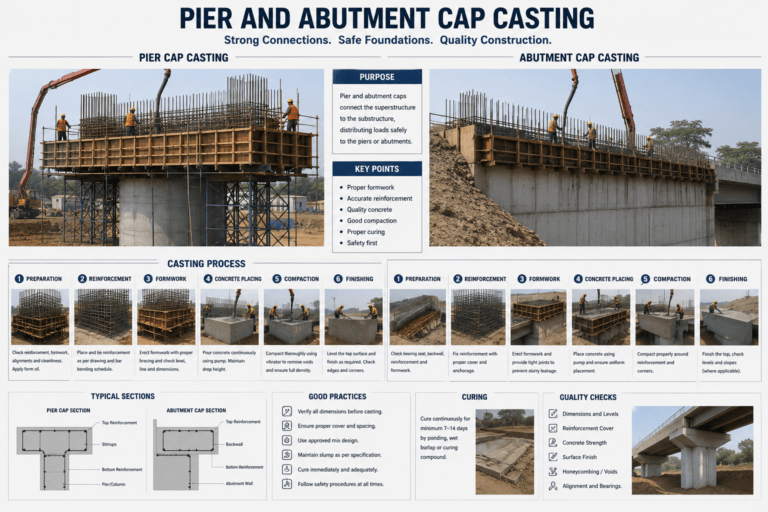
2. Methodology for Approach Slab
A reinforced cement concrete slab covering the entire width of roadway shall be provided as an approach slab.
- Minimum length of approach slab shall be 3.50 m or as per approved drawings.
- Minimum thickness of slab shall be as per approved drawings.
- The details of slab shall conform to approved drawings.
- Cement concrete and reinforcement shall conform to Sections 1600 & 1700 of MoRTH Specifications.
- The base of approach slab shall be prepared as shown in approved drawings.
- Proper alignment, level, and compaction of foundation layer shall be ensured before concreting.
- Concrete shall be properly compacted and cured as per specifications.
What is Floor Protection?
Floor protection is provided around bridge foundations, culverts, and hydraulic structures
to protect the bed surface from erosion, scouring, and water damage caused by flowing water.
It generally consists of apron, pitching, and curtain walls.
The purpose of floor protection is to:
- Prevent scouring near foundations
- Protect river bed and slopes from erosion
- Improve stability of bridge foundation
- Increase durability of hydraulic structures
3. Methodology for Floor Protection
What is Apron Protection?
Apron protection is a layer of heavy stones or concrete blocks laid on the river bed
near bridge foundations and retaining structures to prevent scouring caused by flowing water.
The apron acts as a protective blanket and helps in maintaining stability of the structure foundation.
- Prevents erosion of river bed
- Protects foundation against scouring action
- Improves structural stability during floods
- Provides additional protection to floor system
3.1 Apron
- The surface for apron laying shall be levelled and prepared for the required length and width as shown in drawings.
- The size of stones shall conform to Clause 5.3.7.2 of IRC: 89.
- The specific gravity of stones shall not be less than 2.65.
- The size of stone shall be such that the weight of any fragment shall not be less than 40 kg.
- The stones shall be hand packed within the specified limits.
- Voids between stones shall be minimized to ensure stability of apron protection.
What is Curtain Wall?
A curtain wall is a vertical wall constructed below the floor protection or apron
to prevent undermining and seepage below the structure.
It is generally constructed using PCC or RCC below upstream and downstream floor levels.
The curtain wall helps in:
- Preventing seepage below floor protection
- Reducing chances of undermining
- Improving safety of foundation system
- Providing additional scour protection
3.2 Curtain Wall
- Foundation trenches shall be excavated providing adequate working space as per approved drawings.
- The minimum depth of curtain wall below floor level on upstream side shall be 2.0 m.
- The minimum depth of curtain wall below floor level on downstream side shall be 2.5 m.
- The curtain wall shall be constructed in PCC of M15 grade.
- Concrete shall be placed in properly prepared trench and compacted adequately.
- Curing shall be carried out as per specifications.
4. Methodology for Backfilling Behind Structures
- Backfilling shall commence in conformity with Appendix VI of IRC: 78.
- Backfilling shall be carried out with approved material only after concrete has fully set.
- Backfilling shall be done carefully to avoid undue thrust on any part of the structure.
- All spaces between foundation masonry/concrete and excavation sides shall be refilled in layers up to original ground level.
- The thickness of each compacted layer shall not exceed 150 mm.
- Compaction shall be carried out using suitable equipment such as mechanical tampers, rammers, or plate vibrators after proper watering.
- Filter material shall be well packed to a thickness of 300 mm to 600 mm with smaller size towards soil and bigger size towards the structure.
- Specified density and moisture content shall be maintained during compaction.
5. Quality Control Checks
| Activity | Inspection Requirement |
|---|
| Wearing Coat | Thickness, temperature, density, cross slope |
| Approach Slab | Reinforcement, concrete grade, alignment, curing |
| Apron | Stone size, packing, surface preparation |
| Curtain Wall | Depth, dimensions, PCC grade |
| Backfilling | Layer thickness, moisture content, compaction |
6. Safety Precautions
- Workers shall use PPE such as helmets, gloves, reflective jackets, and safety shoes.
- Proper barricading and warning signs shall be provided near work areas.
- Bituminous works shall be executed carefully to avoid burns and fire hazards.
- Excavation areas shall be protected against collapse and water accumulation.
- Construction equipment shall be operated only by trained personnel.