Grain Size Analysis of Soil – Sieve Analysis Procedure, Calculation & Interpretation
1. Introduction
The Grain Size Analysis of Soil, commonly known as the Sieve Analysis, is a fundamental laboratory test used to determine the particle size distribution of soil. It plays a crucial role in highway and civil engineering projects.
Most of the methods for soil identification and classification are based on certain physical properties of the soils. The commonly used properties for the classification are the grain size distribution, liquid limit and plasticity index. These properties have also been used in empirical design methods for flexible pavements, and in deciding the suitability of sub grade soils.
Grain size analysis also known as mechanical analysis of soils is the determination of the percent of individual grain sizes present in the sample.
The mechanical Analysis consists of two parts:
- Determination of coarse material using sieves.
- Analysis of fine grained fraction by sedimentation method.
The sieve analysis is a simple test consisting of sieving a measured quantity of material through successively smaller sieves. The weight retained on each sieve is expressed as a percentage of the total sample.
The sedimentation principle has been used for finding the grain size distribution of fine soil fraction; two methods are commonly used:
- Pipette method
- Hydrometer method
The grain size distribution of soil particles of size greater than 75 micron is determined by sieving the soil on a set of sieves of decreasing sieve opening placed one below the other and separating out the different size ranges.
Two methods of sieve analysis are as follows:
- Wet sieving applicable to all soils
- Dry sieving applicable only to soils, which have negligible proportion of clay and silt
The soil received from the field is divided into two parts: one, the fraction retained on 2mm sieve and the other passing 2mm sieve. The sieve analysis also may be carried out separately for these two fractions.
The fraction retained on 2mm sieve may be subjected to dry sieving using bigger sieves and that passing 2mm sieve may be subjected to wet sieving; however if this fraction consists of single grained soil with negligible fines passing 0.075mm size, dry sieving may be carried out.
Proper soil gradation ensures good drainage, uniform compaction, and strong load-bearing capacity. Coarse-grained soils are generally suitable for sub-base layers, while fine-grained soils may require stabilization.
2. Purpose of Grain Size Analysis
- Determine particle size distribution and gradation
- Assist in soil classification (Gravel, Sand, Silt, Clay)
- Design subgrade, embankment, and pavement layers
- Assess permeability and drainage characteristics
- Guide soil stabilization decisions
3. Applicable Standards
- IS 2720 (Part 4) – Grain Size Analysis
- IS 2720 (Part 1) – Sample Preparation
- MoRTH Specifications – Subgrade, GSB & WMM
- ASTM D6913 / D422 – International standards
4. Apparatus Required
- Standard sieve set (4.75 mm to 75 μm)
- Mechanical sieve shaker
- Weighing balance (0.1 g accuracy)
- Oven (105°C to 110°C)
- Hydrometer (for fine soils)
- Brush, spatula, containers
5. Sample Preparation
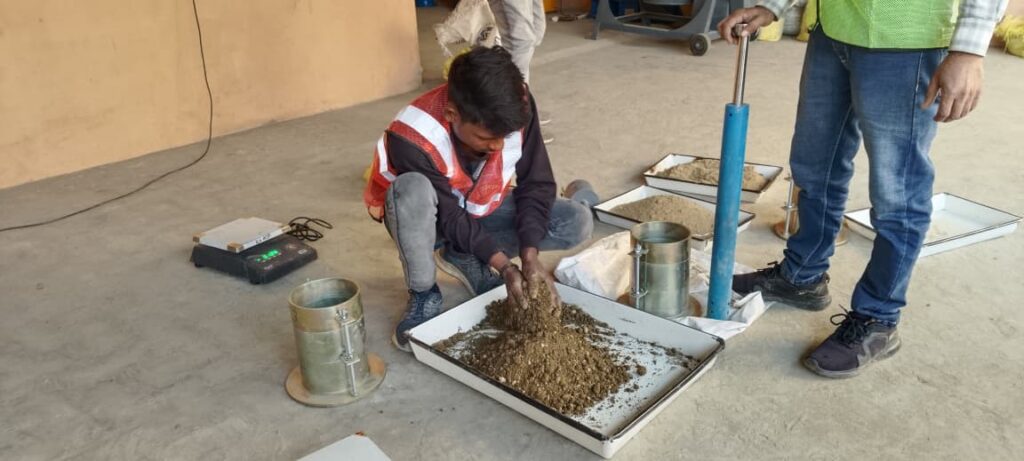
The soil sample should be oven-dried at 105°C–110°C and cleaned of organic matter. Lumps should be broken gently without crushing particles.
- Take ~500 g dry soil sample
- Ensure moisture content is minimal
- Remove oversized particles and debris
- Mix thoroughly for uniformity
6. Test Procedure – Sieve Analysis
(a) Fraction retained on 2.0mm sieve: Sufficient quantity of the dry soil retained on 2.0mm sieve is weighed out. The quantity of sample taken may be increased when the maximum size of particles is higher.
The sample is separated into various fractions by sieving through the set of sieves of sizes 100 mm, 63 mm, 20 mm, 6 mm, 4.75 mm and 2 mm IS sieves. Additional sieve sizes may also be introduced if necessary.
After initial sieving, the material retained on each sieve is collected, the lumps are broken down using mortar and rubber covered pestle and is re-sieved. Thus, the soil fraction retained on each sieve is carefully collected and weighed.
(b) For the fraction passing 2.0mm sieve and retained on 0.075mm sieve: Dry sieving may be done in the case of soils which are cohesion less, single grained and without lumps.
Rifling or quartering method takes the required quantity of soil sample, dried in oven at 1050 to 1100°C and is subjected to dry sieve analysis using a set of sieves with sieve openings 2.0 mm, 0.6 mm, 0.425 mm, 0.15 mm and 0.075 mm, pan and lid. Additional sieves may be used or any of the sieves removed, depending upon the requirement of the test. The material retained on each sieve and on the pan are separately collected and weighed.
Wet sieving may be adopted in the case of clayey or cohesive soils. Required quantity of sample taken by riffling is weighed. The sample is spread in a tray or bucket and covered with water.
In case of soils having fractions that are likely to flocculate, a dispersing agent like sodium hexametaphosphate (2.0g) or sodium hydroxide (1.0g) and sodium carbonate (1.0g) per liter of water may be added to the water.
The mix is stirred and left for soaking. The soaked soil specimen is placed over the set of sieves with the finest sieve and pan at the bottom and washed thoroughly. Washing is continued till the water passing each sieve is substantially clean.
The fraction of each sieve is emptied carefully without loss of material in separate trays, oven dried at 1050 to 1100°C and each fraction weighed separately.
CALCULATIONS:
The weight of dry soil fractions retained on each sieve is calculated as a percentage of the total dry weight of the sample taken.
RESULTS:
The results are plotted on a semi-logarithmic graph with the grain size or sieve size on the X-axis (log scale) and the percentage finer of each sieve on the Y-axis (ordinary scale).
The smooth curve joining the points thus obtained is known as the particle size distribution curve or diagram.
Uniformity coefficient of soil (Cu): Cu = D60 / D10
Coefficient of curvature (Cc): Cc = (D30)2 / (D10 × D60)
Where, D60, D30 and D10 are particle sizes corresponding to 60%, 30% and 10% finer respectively.
(c) For the fraction passing 0.075mm sieve: Two methods are in use based on sedimentation principle that the larger grains settle more rapidly than the smaller ones.
The Stoke’s law is made use of according to which the velocity of settlement of spherical particles is proportional to the square of their diameters.
Thus, if the depth and the duration of settlement are known, the velocity and hence the diameter of particles at that depth can be estimated.
The percentage of particles finer than this diameter should be found using any one of the two methods viz;
- Pipette method
- Hydrometer method
APPARATUS:
- Density hydrometer confirming to IS: 3104-1965 – (Range 0.995 – 1.030)
- Two glass measuring cylinders of 1000 ml capacity with ground glass or rubber stoppers about 7 cm diameter and 33 cm height, marked at 1000 ml volume
- Thermometer to cover the range 0 to 50°C, accurate to 0.5°C
- Water bath or constant temperature room
- Stirring apparatus
- 75 micron sieve
- Balance accurate to 0.01 g
- Stop watch
- Wash bottles containing distilled water
- Glass rod, about 15 to 20 cm long and 4 to 5 mm in diameter
- Reagents: Hydrogen peroxide, Hydrochloric acid (N solution) and Sodium hexametaphosphate
- Conical flask of 1000 ml capacity
- Funnel, filter paper, measuring cylinder (100 ml capacity) and blue litmus paper
PROCEDURE:
(A) CALIBRATION OF HYDROMETER:
Determination of volume of hydrometer bulb (Vh): Pour about 800 ml distilled water in the 1000 ml measuring cylinder and note the reading at the water level. Immerse the hydrometer in water and note the water reading. The difference between the two readings is recorded as the volume of hydrometer bulb plus the volume of that part of the stem submerged.
For practical purposes, the error due to the inclusion of this stem volume may be neglected. Alternatively, weigh the hydrometer to the nearest 0.2 g. This weight in grams is recorded as the volume of hydrometer (ml). This includes the volume of the bulb plus the volume of the stem. For practical purposes, the error due to the inclusion of the stem may be neglected.
In order to find the cross-sectional area (A) of the measuring cylinder in which the hydrometer is to be used, measure the distance (cm) between two graduations of the cylinder. The cross-section area (A) is equal to the volume included between the two graduations divided by the distance between them.
Measure the distance (h) from the neck to the bottom of the bulb and record it as the height of bulb.
With the help of an accurate scale, measure the height (H) between the neck of the hydrometer to each of the other major calibration marks (Rh).
Calculate the effective depth (He) corresponding to each of the major calibration marks (or hydrometer readings, Rh) by the following expression:
He = H + 1/2 (h − Vh/A)
Draw a calibration curve between He and Rh, which may be used for finding the effective depth (He) corresponding to hydrometer readings (Rh) obtained during the test.
Meniscus correction (Cm): Insert the hydrometer in the measuring cylinder containing about 700 ml water. Take the readings at the top and bottom of the meniscus. The difference between the two readings is taken as the meniscus correction (Cm), which is a constant for hydrometer.
During the actual sedimentation test, readings should be taken at the bottom of meniscus, but since the soil suspension is opaque, readings are taken at the top of meniscus. The meniscus correction is always positive.
(B) PRE-TREATMENT OF SOIL:
- Weigh accurately (to 0.01 g) 50 to 100 g of oven dried soil sample (Wd) passing the 0.075 mm IS sieve. If the percentage of soluble salts is more than one percent, the soil should be washed with water before further treatment, ensuring no soil particles are lost.
- Add 150 ml hydrogen peroxide to the soil sample placed in a wide mouth conical flask and stir gently using a glass rod. Cover and leave it to stand overnight.
- Next morning, gently heat the mixture in an evaporating dish, stirring periodically. Reduce the volume to about 50 ml by boiling. Additional peroxide may be required for organic soils.
- If the soil contains insoluble calcium compounds, add about 50 ml hydrochloric acid to the cooled mixture. Stir and allow to stand for one hour or more. The solution will show acid reaction to litmus.
- Filter the mixture and wash with warm water until no acid reaction is observed. Transfer the soil to an evaporating dish using distilled water and oven dry. Take the weight (Wb) and calculate loss of weight due to pre-treatment.
(C) DISPERSION OF SOIL:
- To the oven-dried soil, add 100 ml sodium hexametaphosphate solution and warm gently for 10 minutes. Transfer to mechanical mixer and stir for 15 minutes. Solution preparation: 33 g sodium hexametaphosphate + 7 g sodium carbonate per liter of water. Prepare fresh solution monthly.
- Transfer suspension to 75 micron IS sieve and wash using distilled water (~500 ml).
- Transfer filtrate to 1000 ml measuring cylinder and make volume exactly 1000 ml.
- Collect retained material on 75 micron sieve and oven dry.
- Determine the dry weight of soil retained on 75 micron sieve.
(D) SEDIMENTATION TEST WITH HYDROMETER:
- Seal the 1000 ml measuring cylinder and shake vigorously. Start stopwatch immediately after stopping.
- Insert the hydrometer gently and take readings at 0.5, 1, 2 and 4 minutes. Clean hydrometer with distilled water after each reading.
- Take further readings at 8, 15, 30 minutes, and 1, 2, 4 hours. After 4 hours, readings may be taken within 24 hours.
- Composite correction (C): Prepare a comparison cylinder with 100 ml dispersing solution diluted to 1000 ml. Insert hydrometer and take reading at top of meniscus. The negative value gives composite correction. Record at 30 min, 1 hr, 2 hr, 4 hr intervals.
- Record the temperature during first 15 minutes and after each reading.
CALCULATIONS:
The loss in weight in pre-treatment of the soil in percentage is calculated from the following expression:
P = {1 - Wb/Wd} × 100
Where, P = Loss in weight in percentage
Wd = Weight of dry soil sample taken from the soil passing 2 mm sieve
Wb = Weight of the soil after pre-treatment
The diameter of the particle in suspension at any sampling time (t) is calculated from:
D = 10-5 M (He/t)0.5
Where, M = Poise constant factor
He = Effective depth of the hydrometer
t = Elapsed time (minutes)
The percentage finer (N’) based on the weight Wd is calculated from:
N’ = (100 × G) / [Wd (G − 1)] × R
Where, N’ = Percentage finer based on dry soil weight (Wd)
Wd = Weight of dry soil sample passing 2 mm sieve
G = Specific gravity of soil passing 75 micron sieve
R = Corrected hydrometer reading
R = Rh + C
Rh = Rh’ + Cm
Where, Rh’ = Observed hydrometer reading
Rh = Hydrometer reading corrected for meniscus correction
The percentage finer (N) based on the total dry weight (W) is obtained from:
N = N’ × (W’/W)
Where, W’ = Cumulative weight passing 2 mm sieve
Explanation with Example
The table represents grain size distribution obtained from sieve analysis. The important column for calculations is % Passing.
Step 1: Given Data
| Sieve Size (mm) | % Passing |
|---|---|
| 20 | 90 |
| 10 | 70 |
| 4.75 | 40 |
| 2.36 | 24 |
| 0.425 | 10 |
| 0.075 | 0 |
Step 2: Determination of D10, D30, D60
D10 = 0.425 mm (at 10% passing)
D30 lies between 2.36 mm (24%) and 4.75 mm (40%)
D30 ≈ 3.5 mm (approx)
D60 lies between 4.75 mm (40%) and 10 mm (70%)
D60 ≈ 7 mm (approx)
Step 3: Calculations
Uniformity Coefficient (Cu):
Cu = D60 / D10 = 7 / 0.425 = 16.47
Coefficient of Curvature (Cc):
Cc = (D30²) / (D10 × D60)
= (3.5 × 3.5) / (0.425 × 7)
= 12.25 / 2.975 = 4.11
Step 4: Interpretation
Cu = 16.47 → Indicates well graded soil
Cc = 4.11 → Slightly outside ideal range (1–3)
Final Results
- D10 = 0.425 mm
- D30 ≈ 3.5 mm
- D60 ≈ 7 mm
- Cu ≈ 16.47
- Cc ≈ 4.11
8. Soil Classification
- Gravel: > 4.75 mm
- Sand: 0.075 – 4.75 mm
- Silt: 0.002 – 0.075 mm
- Clay: < 0.002 mm
9. Engineering Significance
- Well-graded soil provides better strength and compaction
- Uniform soil has higher voids and lower stability
- Critical for subgrade and embankment design
- Helps in drainage and pavement design
10. Common Mistakes
- Improper drying of soil sample
- Insufficient shaking time
- Incorrect weighing
- Ignoring fine particle analysis
11. FAQs
What is the purpose of grain size analysis?
To determine soil gradation and suitability for construction.
Which IS code is used?
IS 2720 Part 4.
Can sieve and hydrometer be used together?
Yes, for complete particle size distribution.
12. Conclusion
Grain Size Analysis is essential for highway engineering. It ensures proper soil selection, improves design accuracy, and helps achieve durable pavement structures.