

Fineness of Cement Test as per IS 4031 – Procedure, Formula & Importance
🧪 Determination of Fineness of Cement IS 4031 (Part 3) 🎯 Objective To determine the fineness of cement by dry sieving method using 90 micron IS sieve as per IS 4031 (Part 3). 🛠 Apparatus Required Standard balance with 100 g weighing capacity IS 90 micron sieve Soft sieve brush Cement sample ⚙ Test Procedure Break down any air-set lumps in the cement sample gently with fingers. Accurately weigh 100 g of cement sample. Place the sample on a standard 90 micron IS sieve. 📷 Laboratory Fineness Test of Cement using 90 Micron IS Sieve Continuously sieve the sample for 15 minutes. Collect and weigh the residue retained on the sieve after sieving. 📐 Calculation The percentage residue by weight over the total cement sample is reported as the fineness of cement. % Weight of Residue = (Weight of Sample Retained on Sieve × 100) ———————————————- Total Weight of Cement Sample 📊 Permissible Limits The percentage residue retained on 90 micron sieve should NOT exceed 10%. 💡 Importance of Test Fineness of cement directly affects the rate of hydration, heat generation, setting time, and strength development of concrete. Finer cement provides higher early strength but may increase shrinkage and heat of hydration. This test is essential for NHAI, MoRTH, bridge, highway, and structural QA/QC works. 🧪 IS 4031 • IS 516 • MoRTH • NHAI QA/QC Complete Cement Laboratory Test Series Sequential cement testing procedures performed as per Indian Standard Codes for concrete quality assurance in highway, bridge, rigid pavement, structural, and infrastructure projects. 🔬 IS 4031 (Part 1) STEP 1 Fineness of Cement Determination of cement particle fineness using 90 micron IS sieve and Blaine air permeability method. ⚙️ IS 4031 (Part 4) STEP 2 Standard Consistency Determination of optimum water percentage using Vicat apparatus. ⏱️ IS 4031 (Part 5) STEP 3 Initial Setting Time Measurement of initial hardening stage using Vicat needle penetration. 🧱 IS 4031 (Part 5) STEP 4 Final Setting Time Determines complete hardening stage of cement paste. 📏 IS 4031 (Part 3) STEP 5 Soundness Test Le Chatelier method for determining expansion characteristics of cement. 💪 IS 4031 (Part 6) STEP 6 Compressive Strength Mortar cube compressive strength evaluation at different curing ages. 📌 Quality Control Insight Cement testing must be performed in proper IS code sequence to establish accurate correlation between fineness, consistency, setting characteristics, soundness, and strength development. Sequential testing is mandatory during NHAI, MoRTH, bridge, highway, rigid pavement, and third-party QA/QC inspections.
Soundness Test of Cement – Le Chatelier Method
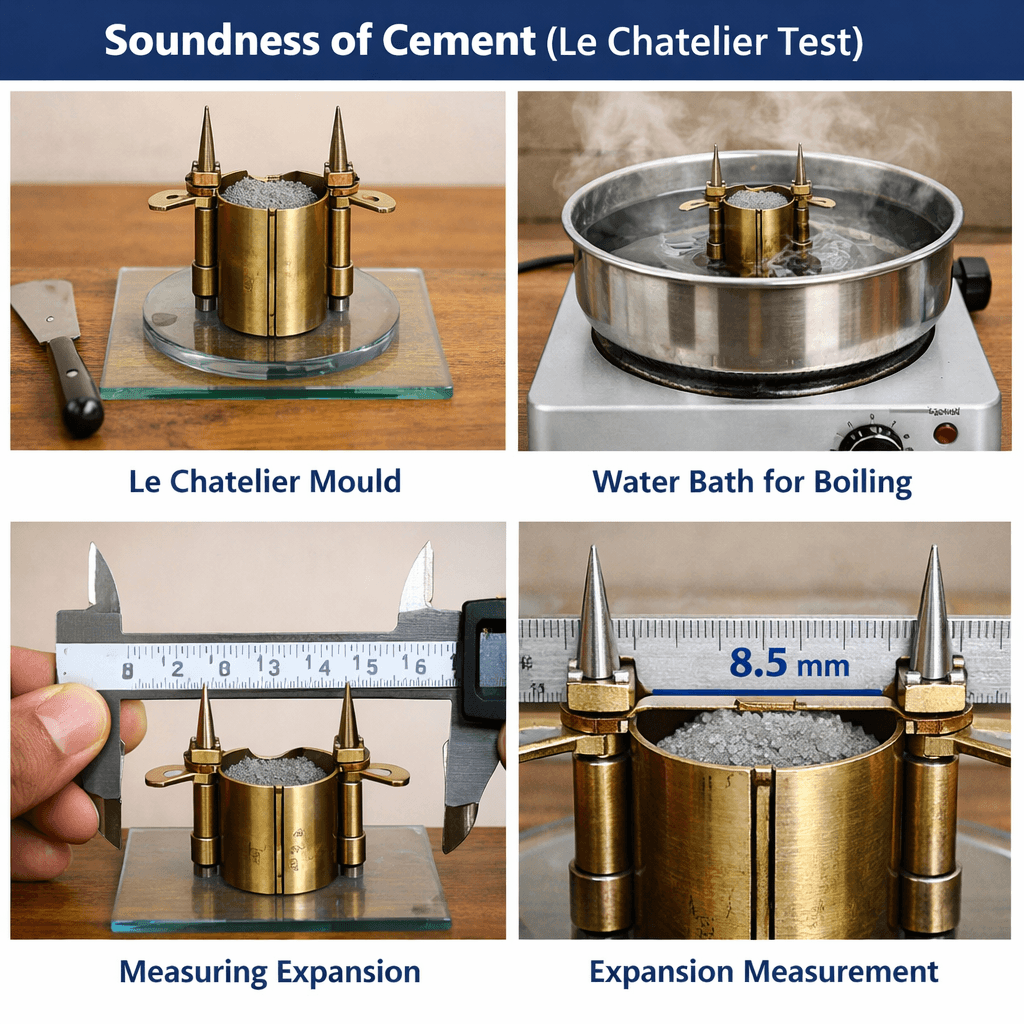
Soundness Test of Cement – Le Chatelier Method Author: Kishor Kumar · Updated: February 2026 · Read time: ~8 minutes 1. Introduction The Soundness Test of Cement ensures that cement does not undergo excessive expansion after setting, which can cause cracks in concrete and structural failure. The Le Chatelier Method specifically measures expansion due to free lime (CaO) or magnesia content. 2. Purpose Check dimensional stability of cement Detect presence of free lime (CaO) or magnesia Prevent cracking in concrete structures Ensure compliance with IS 4031 Part 3 and MoRTH specifications 3. Applicable Standards IS 4031 (Part 3) – Soundness test of cement using Le Chatelier method IS 4031 (Part 4) – Standard consistency for paste MoRTH Specifications – Cement quality control 4. Apparatus Le Chatelier Mould (split ring, inner & outer arcs) Vernier Caliper – for measuring expansion Water Bath / Beaker – 27–30°C Glass Plate / Base Plate Mortar Preparation Tools (trowel, spatula) 5. Test Sample Preparation Cement paste is prepared using standard consistency water. Example ratio: 1 part cement : 0.78 parts water (by weight). Sample Preparation Example: For 100 g of cement: Water required = 100 × 0.78 = 78 g Mix cement and water to obtain a uniform paste for filling the Le Chatelier mould. 6. Test Procedure – Le Chatelier Method Preparation of Cement Paste Determine the standard consistency of cement using IS 4031 (Part 4). Mix cement and water (~1:0.78 by weight) to obtain uniform paste. Avoid lumps to ensure accurate test results. Filling the Le Chatelier Mould Clean mould thoroughly and lightly oil to prevent sticking. Fill mould carefully, avoiding air pockets. Tap gently or use spatula to compact paste evenly. Leveling the Paste Level top of paste to match upper rim of mould. Ensure flush surface to avoid erroneous readings. Immersion in Water Bath Place mould in water bath maintained at 27–30°C for 24 hours. Keep undisturbed and maintain constant temperature. Measurement of Expansion Remove mould carefully after 24 hours. Measure distance between indicator arms using vernier caliper. Take measurements to nearest 0.5 mm for precision. Calculation of Expansion Formula: Expansion (mm) = Final distance between arms – Original distance between arms Record mean of two measurements if multiple moulds are tested for accuracy. 7. Acceptance Criteria Maximum expansion for OPC: ≤ 0.8 mm (IS 4031 Part 3) Rapid Hardening Cement: slightly lower limits 8. Engineering Significance Prevents cracks in concrete due to excessive expansion Ensures dimensional stability of cement in structural and pavement applications Critical for highway pavements, bridges, and high-rise concrete structures 9. Common Mistakes Air bubbles while filling mould Incorrect water bath temperature Improper vernier caliper measurement Using non-standard consistency paste Ensure proper handling to avoid false readings; repeat test if inconsistent. 10. Frequently Asked Questions What is the purpose of the Le Chatelier test? It checks cement expansion due to free lime or magnesia, ensuring dimensional stability. Which IS code covers the test? IS 4031 (Part 3) What is the maximum allowable expansion? ≤ 0.8 mm for Ordinary Portland Cement (OPC) How is cement paste prepared? Using standard consistency water; example ratio: 1 part cement : 0.78 parts water by weight. What happens if expansion exceeds the limit? Excessive expansion indicates free lime; cement should be rejected or used with caution in structural work. 11. Conclusion The Soundness Test of Cement – Le Chatelier Method ensures cement stability, prevents cracks, and guarantees compliance with IS 4031 and MoRTH specifications. Always perform this test for critical concrete and pavement works. Written by: Kishor Kumar · Civil / Highway Engineer – QA/QC & Site Execution · Source: HighwayQualityTest.com 🧪 Complete Cement Laboratory Test Series IS 4031 IS 516 MoRTH NHAI QA/QC These laboratory tests are conducted sequentially for complete cement and concrete quality verification in highway, bridge, structure, and rigid pavement works as per IS 4031, IS 516, MoRTH Specifications, and NHAI Quality Assurance Protocols. 🔬 Fineness of Cement IS 4031 (Part 1) Sieve analysis and Blaine air permeability method for determining cement particle fineness. ⚙️ Standard Consistency IS 4031 (Part 4) Determination of optimum water percentage using Vicat apparatus. ⏱️ Initial Setting Time IS 4031 (Part 5) Measures the beginning of cement hardening using Vicat needle penetration. 🧱 Final Setting Time IS 4031 (Part 5) Determines the complete hardening stage of cement paste. 💪 Compressive Strength IS 4031 (Part 6) Mortar cube crushing strength evaluation at different curing ages. 🏗️ Concrete Cube Test IS 516 Concrete compressive strength testing for site quality control and mix validation. 📌 Quality Control Insight These tests must be conducted in proper sequence to establish correlation between cement fineness, water demand, setting characteristics, and strength development during highway, bridge, and structural concrete works—especially under NHAI, MoRTH, and independent third-party QA/QC audits.
Compressive Strength of Cement
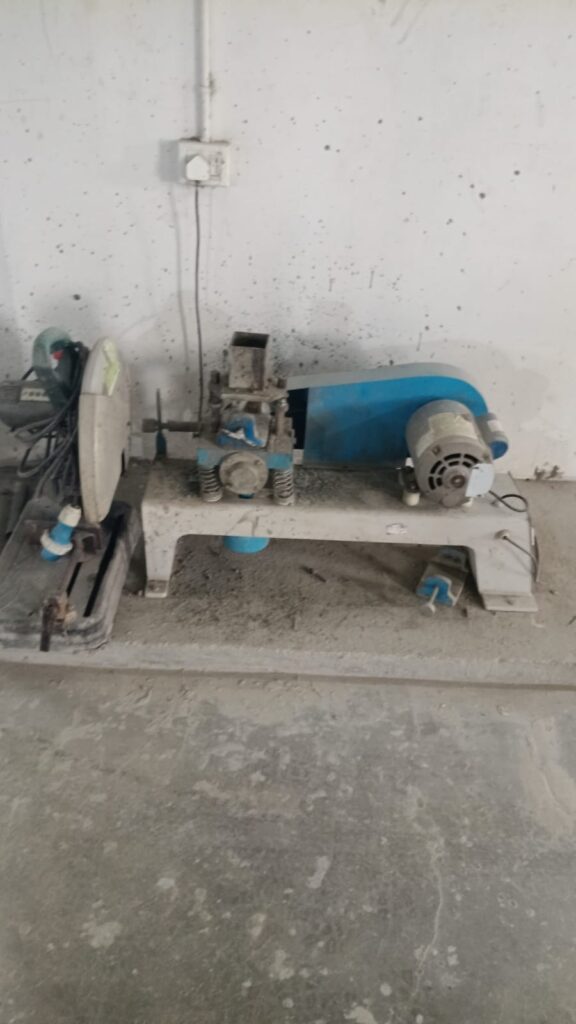
Compressive Strength Test of Cement Mortar Cubes – IS 4031 (Part 6) | Step-by-Step with Examples Compressive Strength Test of Cement Mortar Cubes (IS: 4031 – Part 6) Quick Summary: IS:4031 (Part-6) specifies the method for determination of compressive strength of cement using standard mortar cubes of size 70.6 mm. Cubes are prepared in a 1:3 cement–standard sand mix, compacted by vibration, cured for 3, 7 and 28 days, and tested at a loading rate of 35 N/mm²/min. The test ensures that cement meets the minimum strength requirements prescribed for OPC-43 and OPC-53 grades. See calculation & examples → Example: This test is used to check whether an OPC 43 or OPC 53 cement bag supplied to site meets BIS strength requirements at 3, 7 and 28 days. 1. Intoduction: To determine the compressive strength of hydraulic cement, standard cement mortar cubes (70.6 mm size) are cast and compacted using a standard vibration machine as per IS 4031 (Part 6). This Compressive Strength Test ensures cement quality by covering cube casting, curing, testing, calculation, and result interpretation, making it field-ready for engineers and QA/QC teams to ensure reliable concrete performance in highway and structural applications. 2. Apparatus Vibration machine (12,000 ± 400 vibrations/min) Cube moulds – 70.6 mm × 70.6 mm × 70.6 mm Standard sand (IS 650 : 1966) Prodding rod Non-porous mixing plate Weighing balance Cube crushing testing machine (CTM) Mould oil, petroleum jelly Potable / distilled water Example: If your CTM capacity is 2000 kN and vibration machine speed is calibrated annually, the setup satisfies IS requirements. 3. Standard Sand (IS 650) Particle Size Range Percentage 2.0 mm – 1.0 mm 33.33% 1.0 mm – 500 micron 33.33% 500 micron – 90 micron 33.33% Example: If 900 g of standard sand is tested for gradation, each fraction should weigh approximately 300 g. 4. Mix Proportion Material Quantity Cement 200 g Standard Sand 600 g Water (P/4 + 3)% P = % water required for standard consistency (IS 4031 Part 4) Example: If standard consistency P = 26% Water = (26/4 + 3)% = 9.5% Total mass = 800 g Water = 0.095 × 800 = 76 g 5. Mixing Procedure Dry mix cement + sand for 1 minute. Add calculated water. Mix for minimum 3 minutes. Reject mix if uniform colour is not achieved within 4 minutes. Example: Dry mixing from 10:00–10:01 AM Wet mixing ends at 10:04 AM → ACCEPTABLE If mixing continues beyond 10:05 AM → REJECT batch 6. Moulding of Specimens Oil mould and base plate. Fix mould firmly on vibration table. Fill mortar in layers. Prod each layer 20 times in ~8 seconds. Vibrate for 2 minutes. Finish surface using trowel. Example: 1st layer: 20 rod blows in 8 s 2nd layer: 20 rod blows in 8 s Vibration time: 2 minutes exactly 7. Curing of Specimens Keep moulds in moist room for 24 hours. Demould and immerse in water. Maintain water temperature at 27 ± 2°C. Renew water every 7 days. Example: Casting completed at 4 PM on Day-0 Demould at 4 PM on Day-1 3-day test conducted at 4 PM on Day-3 8. Testing of Specimens Test cubes on their sides. Load rate: 35 N/mm² per minute. Test minimum three cubes. Example: For cube area 50 cm² (=5000 mm²), Load rate ≈ 175 kN per minute 9. Calculation of Compressive Strength Compressive Strength = P / A Example (kg-machine): Crushing load = 7200 kg Area = 50 cm² Strength = 7200 / 50 = 144 kg/cm² Example (kN-machine): Load = 720 kN Equivalent load = 720 × 101.97 = 73418 kg Strength = 73418 / 50 = 1468 kg/cm² 10. Minimum Strength Requirements OPC 43 Grade Cement Age Strength (MPa) kg/cm² 3 Days 23 235 7 Days 33 337 28 Days 43 438 OPC 53 Grade Cement Age Strength (MPa) kg/cm² 3 Days 27 275 7 Days 37 377 28 Days 53 540 ⬇ Download Cement Mortar Cube Test – Excel Sheet Top 10 FAQs – Compressive Strength of Cement What is the compressive strength of cement? It is the maximum load per unit area that a cement mortar cube can withstand under compression. Which IS code governs the compressive strength test of cement? IS:4031 (Part-6) specifies the procedure for determination of compressive strength of cement. Why is standard sand used in cement strength testing? Standard sand (IS:650) ensures uniform grading and repeatable test results. What is the size of cement mortar cube? Standard cube size is 70.6 mm × 70.6 mm × 70.6 mm with a cross-sectional area of 50 cm². What is the mix proportion for cement mortar cubes? Cement : Standard Sand = 1 : 3 by weight. How is water quantity calculated? Water = (P/4 + 3)% of the combined weight of cement and sand, where P is the standard consistency. What are standard curing periods? Cement mortar cubes are tested at 3 days, 7 days, and 28 days. What is the required compressive strength for OPC cement? OPC-43: 23, 33, 43 MPa and OPC-53: 27, 37, 53 MPa at 3, 7, and 28 days respectively. How is compressive strength calculated? Strength (kg/cm²) = Crushing Load (kg) / Area (cm²). Can a compression testing machine display load in kN? Yes. Load in kN must be converted into kg before calculating strength. Prepared by Kishor Kumar | Source: HighwayQualityTest.com Standard Reference: IS 4031 (Part 6) – Methods of Physical Tests for Hydraulic Cement (BIS). Quick Reference: Compressive Strength of Cement (IS:4031 Part-6) Test Objective: Determine compressive strength of standard cement mortar cubes Specimen Size: 70.6 mm × 70.6 mm cube (area = 50 cm²) Mix Proportion: Cement : Standard Sand = 1 : 3 by weight Quantity per Cube Set: Cement = 200 g, Sand = 600 g Water Content: (P/4 + 3)% of combined mass of cement and sand Standard Sand: Conforming to IS:650 (100% passing 2 mm, retained on 90 micron) Compaction: Vibration for 2 minutes @ 12,000 ± 400 vibrations/min Curing Periods: 3 days,
Initial Setting Time of Cement – IS 4031 (Part 5)
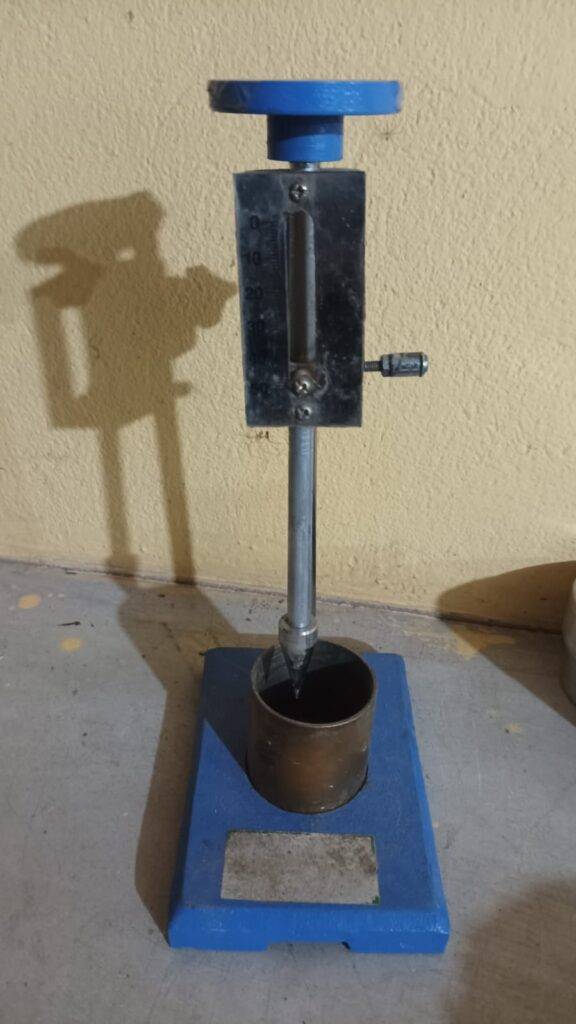
The Initial Setting Time Test measures the time when a cement paste starts losing its plasticity and begins to harden. This test ensures that cement provides adequate workable time for mixing, transporting, and placing
Consistency of Cement | Standard Consistency Test (Vicat Apparatus)
The cement consistency test is performed to determine the standard water content required to achieve a paste of normal consistency, which is crucial for ensuring optimum hydration of cement, achieving desired strength & workability in concrete and mortar.
• Preventing excess bleeding or shrinkage.