Important IS & IRC Codes for Highway Engineers
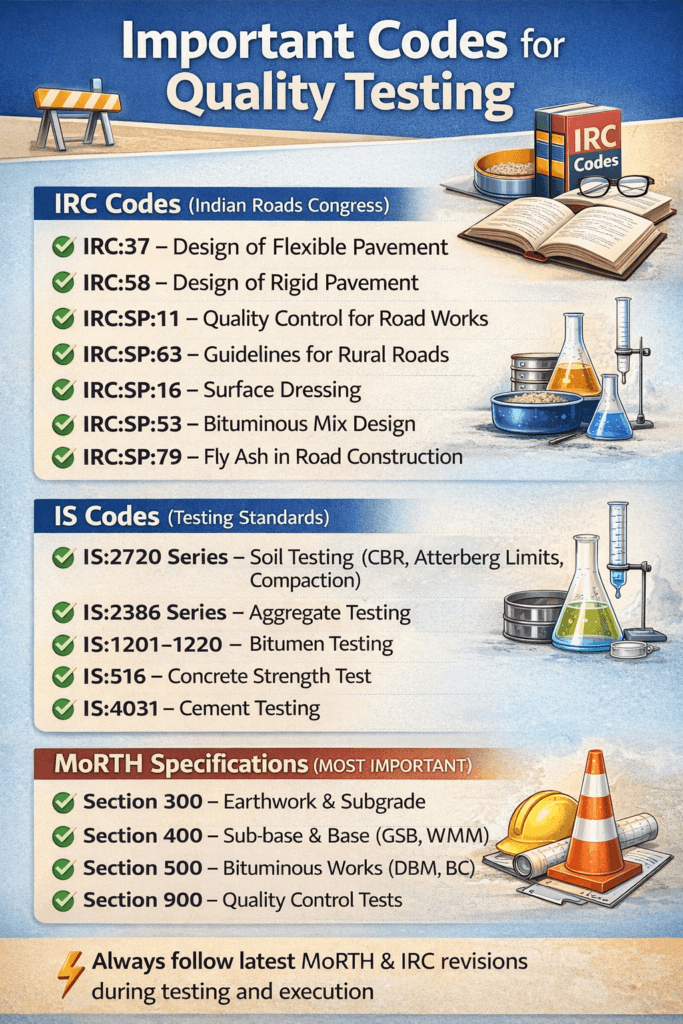
Important IS & IRC Codes for Highway, Site and QA/QC Lab Engineers ⚡ Quick Summary ✔ Know essential IS & IRC codes ✔ Understand their basic usage ✔ Improve compliance in QA/QC work ✔ Avoid specification-related errors Standards and codes play a crucial role in ensuring quality and uniformity in highway construction. Every QA/QC Engineer must have basic knowledge of IS Codes, IRC Guidelines, and MoRTH Specifications to ensure proper testing and execution. 🌍 IS 2720 – Soil Testing IS 2720 (Part 1) – Preparation of soil samples IS 2720 (Part 2) – Moisture content IS 2720 (Part 3) – Specific gravity IS 2720 (Part 4) – Grain size analysis IS 2720 (Part 5) – Liquid limit IS 2720 (Part 5) – Plastic limit IS 2720 (Part 7) – Standard Proctor Test IS 2720 (Part 8) – Modified Proctor Test IS 2720 (Part 10) – UCS Test IS 2720 (Part 16) – CBR Test IS 2720 (Part 28) – Sand Replacemet Method IS 2720 (Part 40) – Free Swell Index Test 👉 Use: Subgrade and earthwork quality control 🪨 IS 2386 – Aggregate Testing IS 2386 (Part 1) – Sampling of aggregates, Flakiness & elongation index IS 2386 (Part 2) – Deleterious materials IS 2386 (Part 3) – Specific gravity & water absorption IS 2386 (Part 4) – AIV, ACV, Crushing Value IS 2386 (Part 5) – Soundness of Aggregate 👉 Use: GSB, WMM, DBM & Concrete works 🛢️ IS 1200 Series – Bitumen Testing IS 1201 – Sampling of bitumen IS 1202 – DETERMINATION OF SPECIFIC GRAVITY IS 1203 – DETERMINATION OF PENETRATIONt IS 1205 – DETERMINATION OF SOFTENING POINTt IS 1206 (Part 2) – DETERMINATION OF VISCOSITY: PART II ABSOLUTE VISCOSITY IS 1206 (Part 3) – DETERMINATION OF VISCOSITY : PART III KINEMATIC VISCOSITY IS 1208 – DETERMINATION OF DUCTILITY IS 1209 – DETERMINATION OF FLASH POINT AND FIRE POINT IS 1211 – Water content 👉 Use: Bituminous layers (DBM, BC, SDBC) 🧱 IS 4031 – Cement Testing IS 4031 (Part 1) – Fineness IS 4031 (Part 3) – Soundness Test IS 4031 (Part 4) – Standard consistency IS 4031 (Part 5) – Setting time IS 4031 (Part 6) – Compressive Strength 👉 Use: Concrete and structural works 📘 MoRTH Specifications Defines construction standards for highways Includes materials, execution methods, tolerances 👉 Use: Overall highway construction & QA/QC 🛣️ IRC Guidelines Provides design and construction standards Includes pavement design, traffic & safety 👉 Use: Highway planning and design ⚠️ Important Note Always refer to the latest revision of codes for accurate results. Using outdated standards may lead to rejection of work. 💡 Pro Tip: Keep soft copies of IS, IRC & MoRTH for quick site reference 🔒 Want Detailed Code Explanations? Unlock full interpretations, test procedures & practical applications Unlock Pro Bundle
Top QA/QC Site Mistakes Engineers Must Avoid
Top QA/QC Site Mistakes Engineers Must Avoid ⚡ Quick Summary ✔ Identify common QA/QC mistakes ✔ Understand their impact on projects ✔ Learn how to avoid costly errors ✔ Improve overall site quality Mistakes in QA/QC can lead to serious consequences such as project delays, rework, financial loss, and even structural failure. Understanding these common errors will help you become a more efficient and reliable site engineer. ❌ Skipping Material Testing Ignoring required tests can result in using poor quality materials on site. Impact: Weak structure, early failure Solution: Always follow testing frequency as per specifications ❌ Improper Compaction Inadequate compaction reduces strength of soil and pavement layers. Impact: Settlement, cracks, pavement failure Solution: Ensure proper rolling and density checks (FDT) ❌ Using Unapproved Materials Using materials without approval or testing can compromise quality. Impact: Rejection of work, penalties Solution: Use only approved and tested materials ❌ Poor Documentation Missing or incorrect records can lead to rejection even if work is good. Impact: Audit issues, claim rejection Solution: Maintain proper and updated records ❌ Ignoring Specifications Not following MoRTH/IS codes leads to non-compliance. Impact: Work failure and re-execution Solution: Always follow approved drawings and specifications ⚠️ Key Takeaway Most site failures happen due to small mistakes repeated daily. A disciplined QA/QC system can prevent major losses. 💡 Pro Tip: Test → Record → Approve → Then Execute ⚠️ Free Download Get QA/QC Checklist to avoid common site mistakes Download Checklist 🔒 Want Complete QA/QC System? Unlock SOPs, checklists, formats & advanced tools used by professionals Upgrade to Starter Bundle @299
Site Documentation Guide for QA/QC Engineers
Site Documentation Guide for QA/QC Engineers ⚡ Quick Summary ✔ Learn essential QA/QC documents ✔ Understand their purpose ✔ Improve site record management ✔ Avoid documentation errors Site documentation is a critical part of quality control in highway projects. Proper records ensure transparency, traceability, and approval of work. Even good quality work can be rejected if documentation is incomplete or incorrect. 📅 Daily Progress Report (DPR) Details of daily work executed Manpower and machinery used Weather conditions Work progress status 👉 Purpose: Track daily site activities and progress 🧱 Cube Test Register Concrete sample details Casting date and location Test results (7 & 28 days) 👉 Purpose: Ensure concrete strength compliance 📦 Material Receipt Register Material quantity and source Approval status Test results and usage 👉 Purpose: Track all incoming materials 📨 Inspection Request (IR) Raised before inspection Submitted to consultant/client Approval required before next activity 👉 Purpose: Get official approval for work execution ⚠️ Common Documentation Mistakes ❌ Missing or incomplete records ❌ Incorrect data entry ❌ Delay in updating registers ❌ No proper approval tracking 💡 Pro Tip: Proper documentation = strong claim & audit support 🔒 Want Editable Excel Formats? Unlock professional templates, auto-calculation sheets & reporting tools Unlock Pro Bundle
Highway Construction Basics (Step-by-Step Guide)
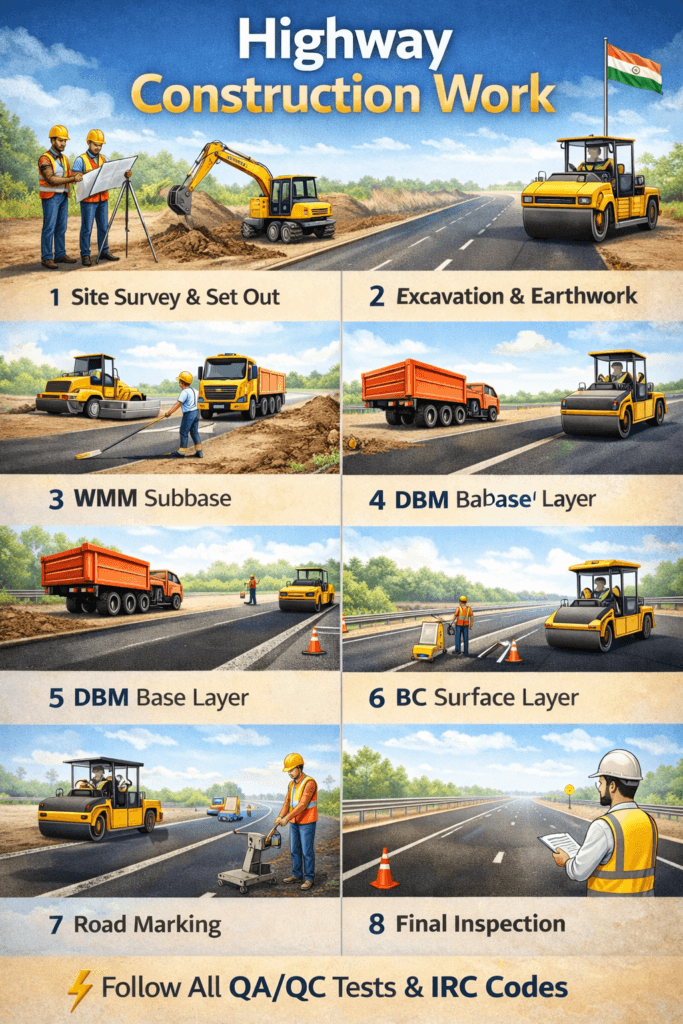
Highway Construction Basics (Step-by-Step Guide) ⚡ Quick Summary ✔ Understand full construction process ✔ Learn layer-wise execution ✔ Know key quality checks ✔ Avoid common site mistakes Highway construction is a systematic process involving multiple layers, each contributing to the strength and durability of the pavement. Proper execution and quality control at every stage are essential to achieve long-lasting performance. 🟤 Step 1: Earthwork (Subgrade Preparation) Clearing & grubbing Excavation or filling Layer-wise compaction 👉 Quality Check: Field Density Test (FDT) 🟫 Step 2: Subgrade Final leveling and dressing Moisture conditioning Compaction as per specification 👉 Key Point: Strong subgrade = strong road foundation 🪨 Step 3: Granular Sub Base (GSB) Material spreading in layers Watering and mixing Rolling and compaction 👉 Quality Check: Gradation + Density 🏗️ Step 4: Wet Mix Macadam (WMM) Mixing in plant Transport to site Laying using paver Compaction with rollers 👉 Quality Check: Thickness + Compaction 🛢️ Step 5: Bituminous Layers Prime coat application Tack coat application Asphalt laying (DBM/BC) 👉 Quality Check: Temperature + Surface finish ⚠️ Common Construction Mistakes ❌ Poor compaction of layers ❌ Incorrect layer thickness ❌ Skipping quality tests ❌ Improper material usage 💡 Pro Tip: Always follow layer sequence + testing requirements 📥 Free Download Get Construction Checklist + QA/QC Formats Download Starter Kit 🔒 Want Full Construction Methodology? Unlock detailed procedures, execution steps & advanced tools Unlock Pro Bundle
Basic Material Testing Guide for Highway Projects
Basic Material Testing Guide for Highway Projects ⚡ Quick Summary ✔ Learn essential material tests ✔ Understand testing purpose ✔ Know key parameters to check ✔ Avoid common site mistakes Material testing is one of the most critical responsibilities of a QA/QC Engineer. The quality of materials directly affects the strength, durability, and performance of a highway. This guide provides a basic overview of the most important tests used on site. 🟤 Soil Testing (Subgrade & Earthwork) Field Density Test (FDT): Ensures proper compaction Moisture Content: Helps achieve optimum density 👉 Key Point: Proper compaction = Strong foundation ⚪ Cement Testing Initial & Final Setting Time: Workability control Fineness Test: Affects strength and hydration 👉 Key Point: Poor cement quality = weak concrete ❌ ⚫ Aggregate Testing Sieve Analysis: Determines grading Impact Value: Measures strength & toughness 👉 Key Point: Proper grading = better load distribution 🛢️ Bitumen Testing Penetration Test: Measures hardness Ductility Test: Measures flexibility 👉 Key Point: Correct grade = longer pavement life ⚠️ Common Testing Mistakes ❌ Wrong sampling method ❌ Skipping test frequency ❌ Uncalibrated equipment ❌ Improper record keeping 💡 Pro Tip: Always follow standard procedures & codes 🎁 Free Download Get Material Testing Formats + Basic Calculators Download Starter Kit 🔒 Want Full Testing Procedures? Unlock step-by-step SOPs, lab methods & Excel tools Upgrade to Pro Bundle
QA/QC Starter Guides for Highway Engineers
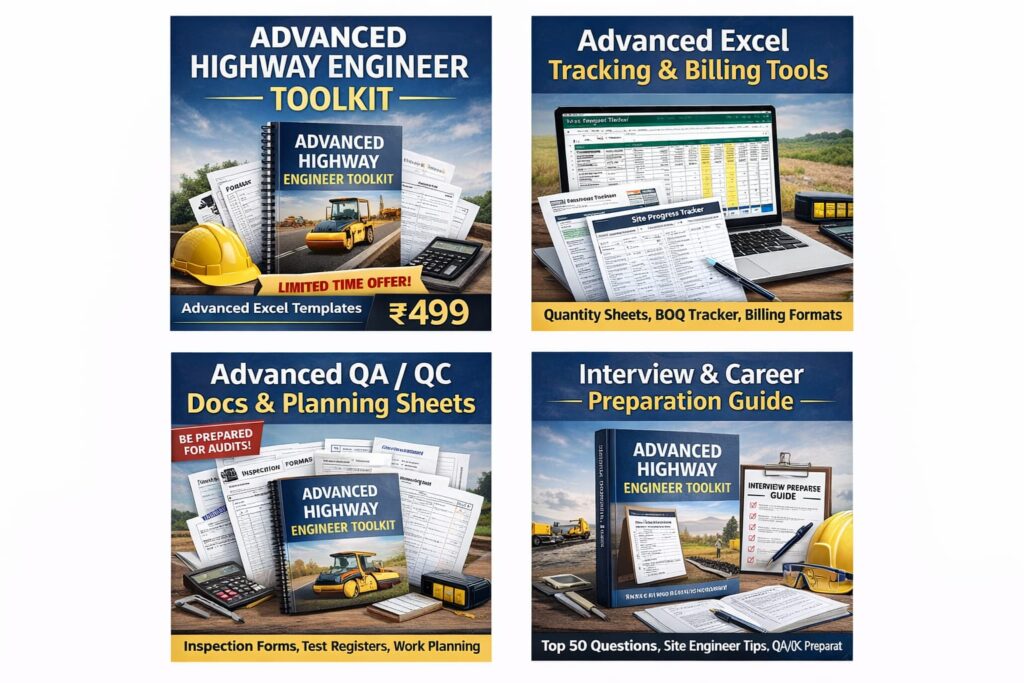
QA/QC Starter Guides for Highway Engineers 🚧 QA/QC Engineer Starter Guide for Highway Projects ⚡ Quick Summary ✔ Understand QA vs QC ✔ Know your daily site responsibilities ✔ Learn essential QA/QC workflow ✔ Avoid common beginner mistakes A QA/QC Engineer plays a critical role in ensuring that all construction activities meet required quality standards, specifications, and safety requirements. This guide will help you understand your role and daily workflow on highway projects. 🧠 What is QA/QC? Quality Assurance (QA): Planning activities to maintain quality, including method statements, material approvals, and procedures. Quality Control (QC): Execution stage involving testing, inspection, and verification of work. 👉 Simple: QA = Planning | QC = Testing + Execution 👷 Your Role on Site ✔ Conduct material testing (soil, concrete, bitumen) ✔ Perform site inspections (IR/RFI) ✔ Maintain quality documentation ✔ Coordinate with contractor & consultant 📅 Daily Work Checklist (Must Follow) 🔹 Check incoming material quality 🔹 Perform required field/lab tests 🔹 Maintain registers & reports 🔹 Raise Inspection Requests (IR) 💡 Pro Tip: Strong documentation = strong QA system 🎁 Get Free QA/QC Starter Kit Download site formats, calculators & beginner guides Download Free 🔒 Want Full Professional Tools? Get detailed SOPs, Excel formats & advanced calculators Unlock Starter Bundle
Quality Control tests & Frequency
Quality_Control_Test_Frequency